










































Adopting a Gender Lens to Improve and Sustain Polio Vaccine Uptake in Afghanistan
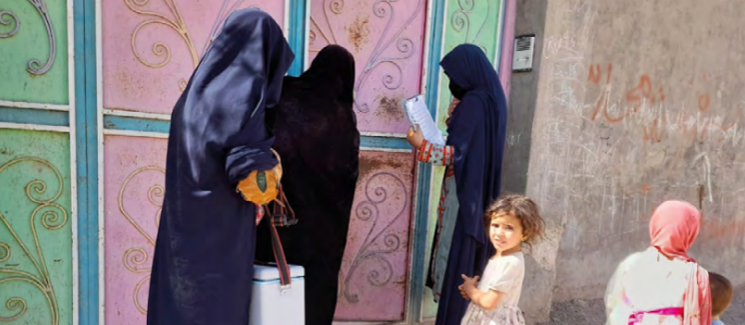
"Finally ridding the world of this virus will...take a massive effort involving all members of society..., and women play a significant role. Hence, understanding this role, and reviewing the challenges and opportunities in meeting it, are critical in achieving the eradication of polio."
The United Nations Children's Fund (UNICEF) conducted this study in 2021 to understand the role of women in Afghanistan's polio programme. The study aimed to identify gender challenges, assess internal policies and procedures around women's participation, review communication for development (C4D) and social and behaviour change (SBC) materials through a gender lens, and provide actionable advice.
As UNICEF explains, the historical context has shaped cultural norms and men and women's socially defined roles and responsibilities in Afghanistan. Social reform to raise women's status within Afghan society has met with strong resistance, particularly among rural communities and, at times, by women themselves. In addition, different religious interpretations have influenced the gender roles of rural and urban Afghan women in several ways, resulting in a considerable gender gap for various Sustainable Development Goal indicators.
The study was based on a qualitative assessment involving: literature review, in-depth interviews with UNICEF Afghanistan Country Office (ACO) staff and partners, a focus group discussion with female frontline health workers, and content analysis of UNICEF C4D campaign products and other communication and training materials in local languages. There were significant challenges in undertaking this assessment due to the changing internal situation in Afghanistan during the research period (February to December 2021).
Findings related to women's participation in the programme were assessed in line with the InterAction Gender Audit Handbook's Gender Integration Framework and theory of change. The socioecological model and human-centred design approach, with a focus on the journey to immunisation, were considered in analysing the determinants and causes of gender inequities that impact frontline health workers. This approach includes barriers and opportunities affecting the uptake of the polio vaccine.
The ACO shared five polio communication strategies for 2021: the national communication strategy and four strategies for the east, west, south, and south-east regions. The multisectoral C4D strategy (2020-2025) and the 2019-2020 digital and social media strategy were also shared. The multisectoral C4D national strategy is the only document that references gender-specific norms affecting progress of women in Afghanistan. There seems to be little guidance in this document on how to tailor communication interventions to overcome gender-related barriers to immunisation, especially when it comes to dispelling misinformation and myths. Moreover, there appears to be some disconnect between the strategies, and a lack of opportunities for the regions to share and build on effective approaches and lessons learned for gender mainstreaming through their ongoing plans.
Most participants agreed that there is political will within Global Polio Eradiation Initiative (GPEI) partners UNICEF and World Health Organization (WHO) leadership to build gender-responsive programming and increase women's participation in the programme. Women's involvement in campaigns is still well below the standard set by the UNICEF Gender Parity and Equality Policy and Gender Action Plan, which call for 50/50 gender distribution at all levels. Women in Afghanistan are not afforded independent decision-making power when pursuing job opportunities, although women with higher levels of education and economic status and those who live in urban areas were more likely to be allowed to be employed.
Challenges within the internal working environment include stereotypes concerning women's ability to work effectively in a challenging operational context. On the topic of security, interviewees also cited campaign visibility as a security risk for female frontline workers and social mobilisers. The issue of women attending meetings in the community has also been raised, as they no longer feel welcome in certain places.
Going beyond gender issues into broader SBC-related findings, all key informants agreed that there is a need to strengthen the capacity of local staff to use participatory approaches and to design culturally tailored C4D strategies, tools, and communication materials. Key informants highlighted that affected communities must be included "in decisions to ensure that the humanitarian response is relevant, timely and effective". They also pointed out that more coordinated, cross-sectoral interventions could present a strategic opportunity to integrate polio into maternal, newborn, and child health messaging, as well as other community activities. In addition, they stated that it is vital to tailor programme materials to different audiences, such as by appealing to religious norms and addressing topics such as rumours and misinformation. Social media can also play a crucial role in debunking false information.
A case study of the November 2021 campaign included in the report shares various insights, such as the following ranking by social mobilisers (both men and women) of the effectiveness of campaign modalities in overcoming gender-based barriers to vaccination:
- House-to-house, where coverage typically reaches 90-95%, and the female vaccinators can visit women in their homes and count their children, meaning that mothers do not leave the house;
- Site-to-site, especially when the site chosen is an elderly community leader's home that women can access easily; and
- Mosque-to-mosque, which is least accessible due to cultural and religious norms that restrict women from entering.
A series of recommendations for UNICEF and/or WHO are offered based on the findings, in the following categories:
- To mainstream gender in communications and community engagement - Example: Produce pre-recorded radio drama episodes/spots and discussion guides with the relevant gender content integrated for different audiences, and use them in listening and/or reconciliation circles.
- To strengthen women's participation in the polio programme - Example: Take concrete efforts to improve knowledge and skills related to gender concepts, gender mainstreaming, and the influence of gender on immunisation.
- To improve gender and security factors affecting women's participation - Example: Continue to encourage Imams who are engaged in child health and who can mobilise men during the Friday prayers and expand mobilisation to include fathers and grandfathers.
GPEI website, July 13 2022; and emails from Sahar Hegazi and Eman Eltigani to The Communication Initiative on July 14 2022 and July 28 2022, respectively. Image credit: © UNICEF
- Log in to post comments