










































Applying a Primary Health Care Approach to Closing the Human Resource for Health Gaps for Immunization
Public Health Institute, Via United States Agency for International Development's Global Health Training, Advisory and Support Contract (GHTASC) Project (Olayinka, Reed); New York University (O'Connell); Jhpiego, The Johns Hopkins University Affiliate (Morgan); Ministry of Health, Argentina (Monzon); Gavi, The Vaccine Alliance (Oshin); World Health Organization (Tampe, Cometto); Ministry of Health, Liberia (Clarke); Government of Pakistan (Kazi); independent researcher (Shearer)
"An adequately skilled, appropriately distributed, and motivated health workforce is essential to achieve immunization for all, as well as foundational to strengthening the PHC [primary health care]-oriented health system..."
The Immunization Agenda 2030 (IA2030) highlights a vision for ensuring global equity in immunisation, with no one left behind, through a strong emphasis on primary health care (PHC). Achieving IA2030 will require well-motivated human resources for health (HRH) in the right numbers, equitably distributed, and with the required competencies to deliver high-quality services, beginning with patient education. The aim of this perspective article is to highlight the growing gap between the needs and the realities related to health workforce for PHC, including immunisation, and to call for increasing the visibility of HRH within global and national immunisation agendas. It highlights key guidelines and tools to improve HRH, such as integrating immunisation and PHC and addressing gender-related issues.
In 2020, the global health workforce shortage was estimated to be 15.4 million health workers. Data cited here suggest that the shortage of health workers is not being addressed quickly nor comprehensively enough to achieve IA2030. Huge inequities exist between and within regions and countries, with high-income countries having a health worker density that is 6.5 times that of low-income countries. There is a need to learn more about what motivates health workers supporting PHC - including immunisation - and what is required to enable them to sustain and grow careers in health, ensure decent work environments, and address gender inequities that hamper advancement. The community health workforce is an important but underutilised resource in the provision of basic promotive and preventive primary care services, especially in hard-to-reach areas. CHWs in many countries are trained to mobilise families for immunisation, provide information and education, and trace defaulters.
Many health workers and CHWs are women. The article examines the gendered dimensions of the health and social care workforce. "[C]ompared to men, women's contributions to health and the health labor market remain markedly undervalued....Equity issues pertaining to decent work free from all forms of discrimination; harassment, including sexual harassment; the gender pay gap; and occupational segregation by gender and leadership are important for all member states to address the protection and retention of existing health and care workers, if the 15.4 million health worker shortfall is to be redressed in an equitable, inclusive and sustainable way....Gender equality is key to building resilient health systems, and gender transformative health and social care policies are key to achieving gender equality globally."
In the aftermath of the COVID-19 pandemic, "[t]he rebound of immunization programs is closely linked with the availability of well-performing and an adequately distributed health workforce, among other factors, such as vaccine confidence."
The article offers three case studies sharing good HRH practices across a range of countries, which immunisation and PHC policymakers could consider to improve health workforce availability, competencies, and satisfaction:
- Leveraging a trusted community workforce in Liberia
- Fostering long-term institutionalisation of team-based PHC in Brazil
- Leveraging short- and long-term recruitment strategies in Pakistan to fill HRH gaps
Next, several actions are proposed going forward. The article identifies closing the gaps in the Africa region as a top priority, as more than half of the world's HRH shortages are projected to be occurring there. Sharing the best practices on reducing the gender pay gap from countries in the Western Pacific and South East Asia regions could be helpful for cross-regional learning. Beyong a regional perspective, the IA2030 Framework for Action: Immunization for Primary Health Care discusses how to strengthen HRH as follows: advocate for policies to attract and retain a fit-for-purpose and motivated health workforce at the primary care level, especially in remote settings; integrate priority PHC topics into immunisation training and vice versa; ensure regular integrated supportive supervision visits for PHC and immunisation; optimise digital tools for learning and performance; develop standard operating procedures, training materials, and job-aids for continuous learning through hybrid and blended approaches; and deliver high-quality integrated services.
In conclusion, addressing gaps in human resources to help meet IA2030 goals "requires political and country leaders, multilateral institutions, development partners, public and private sector stakeholders, civil society, and community leaders to take concerted, proactive, inclusive and collective action to make this a reality. Low-income contexts must not be left behind. One of the biggest lessons from COVID-19 is that we must commit to solidarity and global safeguards in optimizing the health workforce around the globe to achieve health and development goals, and certainly to prevent and respond to future pandemics."
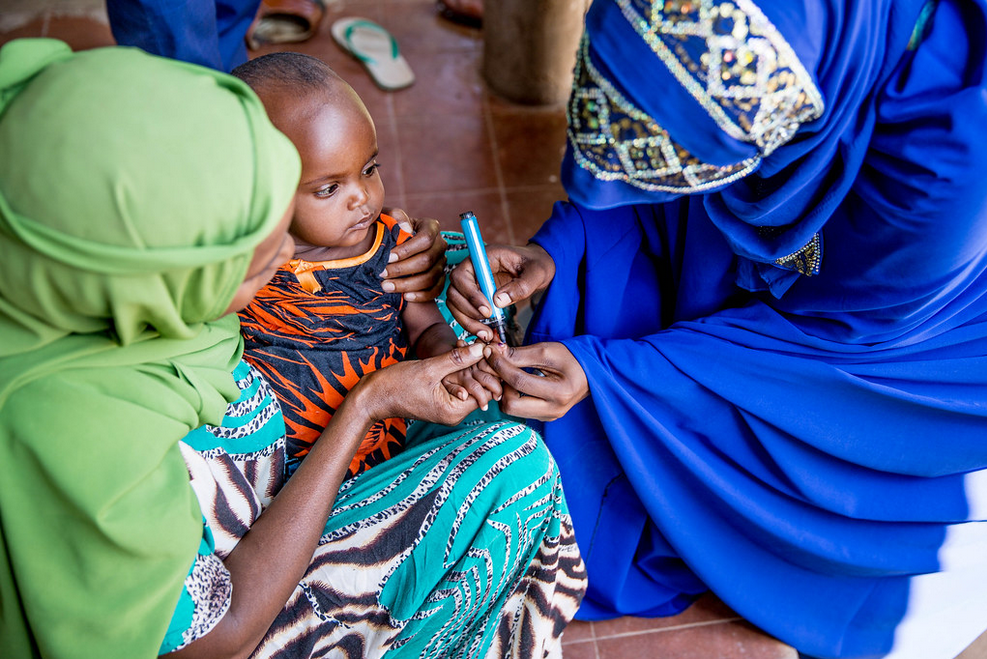
Healthcare 2024, 12, 1449. https://doi.org/10.3390/healthcare12141449. Image caption/credit: Health worker marks 11-month-old Nimo Mohamed's finger after her vaccination against polio. © UNICEF Ethiopia/2015/Meklit Merhsa via Flickr (CC BY-NC-ND 2.0)
- Log in to post comments