










































Building Evidence for Improving Vaccine Adoption and Uptake of Childhood Vaccinations in Low- and Middle-Income Countries: A Systematic Review
Shenyang Pharmaceutical University (Aslam, Yang); University of Vienna (Ali); University of Huddersfield (Babar); Tsinghua University (Yang); Fatima Jinnah Women University (Ali)
"...socio-cultural factors highlight the importance of clear and accurate information regarding the vaccine's health advantages, as well as proper sensitization and lobbying among parents and other key community stakeholders..."
Complex and interrelated variables affect vaccination uptake. In an effort to improve understanding of the supply- and demand-side constraints to immunisation in low- and middle-income countries (LMICs), this systematic review explores the system-level obstacles that hinder the effective delivery and uptake of immunisation services through the Expanded Programme on Immunization (EPI).
Two reviewers conducted a literature search using PubMed and Google Scholar along with targeted grey literature on June 2 2021, following PRISMA guidelines. Of the 689 records published between 2000 and 2020 in English, 11 articles met inclusion criteria and were included in this review. Five of the articles related to vaccination coverage, four focused on components of the routine immunisation (RI) system, one examined the implementation of new and under-utilised vaccines, and one looked at vaccine financing. The reviewers evaluated the quality of the included studies and extracted findings into tables.
The literature indicates that, globally, around 20 million children remained unvaccinated; 12.2 million (62%) of them were living in LMICs. The African continent and conflict-affected countries have a disproportionate number of zero-dose children. In addition, disruptions to normal immunisation programmes associated with the COVID-19 pandemic and response actions were prevalent in 2020, affecting almost every country.
Eight obstacles have been found that affect immunisation coverage related to both demand and supply sides: (i) greater land area; (ii) linguistic fractionalisation; (iii) gender inequality; (iv) conflict areas (urban/rural residence); (v) population displacement; (vi) security; (vii) wealth; and (viii) socioeconomic status (e.g., multidimensional poverty). Moreover, vaccination uptake is also influenced by, for example: inadequate record-keeping, concerns about bad outcomes of immunisation, shortage of a competent primary care system, complexity of immunisation schedule, vaccine charges, issues with access to healthcare facilities, carelessness of parents, lack of parental knowledge, conflicting parental interests, and requirements for many injections in a single visit.
One finding that may call for greater attention includes that higher educational attainment (as a means to minimise gender inequalities) helps mothers take an active role in the public and private spheres, allowing them to seek better healthcare (e.g., vaccine coverage) for their newborns. Immunisation services may be unavailable to people irrespective of gender who lack financial or general autonomy. Furthermore, women who are younger, less educated, or uneducated were more likely to lack practical understanding about vaccination services and were less likely to grasp vaccination cards, return dates, and the need for repeat visits. Overall, boys had greater percentages of full vaccination coverage than girls in LMICs.
Review findings suggest that context-specific strategies to reduce inequality may be required to increase vaccine uptake and acceptance in LMICs. Supplementary Immunisation Activities (SIAs), often known as mass immunisation programmes, are one strategy that has been shown to be effective in minimising inequity inside populations. Although SIAs have been shown to improve uptake, such as in the case of polio vaccination, a percentage of children may still be left out of such practices. Integrating health strategies can also aid in coverage improvement: Immunisation programme managers and field-based health workers should regularly use each and every encounter with a child to check their (and mother's) immunisation status, with adequate vaccination as required. Also, the review suggests the need for effective and accurate communication of vaccines' preventive health benefits and the appropriate build-up of awareness and advocacy between parents and key community players, with an eye toward addressing rumours and social and cultural barriers. Since a virus can cross any geographical border, there is a need for regional and global cross-border coordination.
In conclusion: "The ability of LMICs to achieve high and equal levels of coverage is necessary to obtain herd immunity. Critical socioeconomic determinants of health, such as geographic and social exclusion, gender inequality, and the unavailability of financial protection for health, must be considered in creating policies and programs to improve vaccination coverage and equity. Opportunities to strengthen immunization services and the health system should be actively pursued in order to alleviate system bottlenecks and incur advantages for other health priorities."
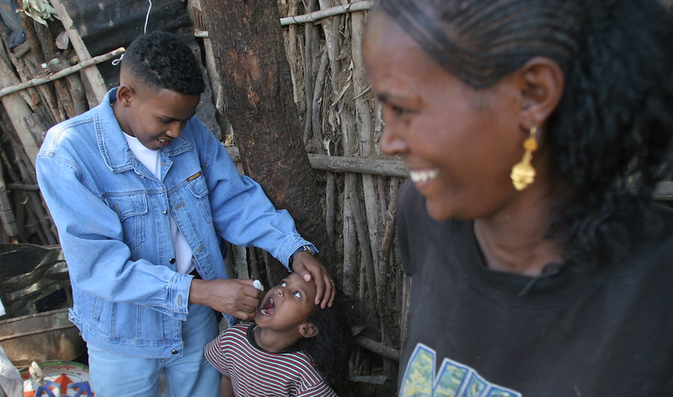
Drugs & Therapy Perspectives. 2022; 38(3): 133-45. doi: 10.1007/s40267-021-00890-7. Image credit: UNICEF Ethiopia via Flickr (CC BY-NC-ND 2.0)
- Log in to post comments