










































Capacity Development and Community Engagement to Overcome Misinformation About Vaccination
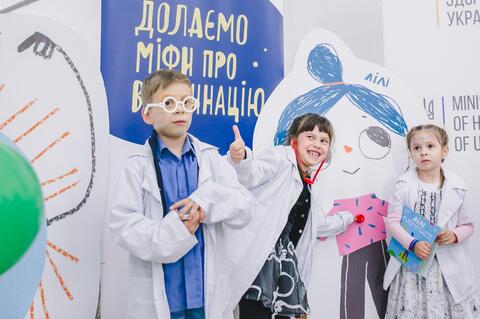
"Gaining insight into the parental demands to vaccinate and enhancing compliance for immunisation schedules can be done with the help of behavioural tools." - Anna Sukhodolska, Anastasia Nurzhynska, and Kateryna Bulavinova
Based on social data collected in 2019, the United Nations Children's Fund (UNICEF) Ukraine has developed a communication for development (C4D) response to confront low immunisation rates in the country, and the misinformation that can contribute to the problem. Applying behavioural science to create solutions, the organisation has been engaging (including on social media) with children, health professionals, fathers, and communities to increase their loyalty towards immunisation.


- Children: Edutainment interventions included online and off-line activities and products. Based on "Lili Who Made friends with Viruses, a children's book with augmented reality, a World's Largest Lesson action was developed for primary school children that engaged teachers through an online tutorial that was designed to help them integrate evidence-based information on vaccination into the school curriculum. Over 3,000 children took part in the lesson in majority regions of Ukraine in a one-month period. In addition, the book was distributed at the edutainment events across the country, where over 100,000 children took part in learning sessions on vaccination through play. Lesson plans, handouts, and recommendations for primary school teachers on how to talk with children and parents about vaccination were also created; UNICEF Ukraine partnered with an online education platform for teachers in Ukraine to disseminate the materials.

- Healthcare providers: UNICEF Ukraine proposed a 4-step approach to vaccination counselling for healthcare providers: Be prepared, listen, use appropriate messages, and plan with the patient. A guide was created to synthesise current knowledge on evidence-based vaccination practice, psychology, and behavioural sciences.

- Fathers: Survey findings showed that fathers are less informed about the danger of infectious diseases and benefits of vaccination and are not afraid of infectious diseases. Thus, UNICEF Ukraine addressed fathers with a series of creative communication products shared via digital media activation. Among them is an emotional video, shared via Twitter, with fathers telling others about their feelings about children. And in partnership with Cannes Lions Ukraine, teams of young creators developed a series of images addressing fathers, such as one drawing on a popular sport among fathers, football. This activation has reached over 1.3 caregivers, mainly fathers, and received high engagement from the audience.
Development IssuesImmunisation and Vaccines
Key PointsIn Ukraine, less than 80% children are vaccinated, with one of the lowest levels of trust in vaccination and one of the lowest vaccination rates for routine immunisation in Europe and globally during 2016-17. Following a polio outbreak in the country in 2015-16, one of the world's largest measles outbreaks began there in 2017: Over 57,000 Ukrainians became ill with measles in 3 years. Children in Ukraine are still at risk of infectious diseases, as cases of tetanus, diphtheria, and pertussis have been reported from various localities of the country.
 According to an August 2019 KAP study ("Assessment of Knowledge, Attitudes and Practices on Vaccination in Ukraine", UNICEF, InMind, N=1,277 mothers), for mothers who made the decision not to vaccinate their baby, the main concerns were: fear of reactions, distrust of vaccinations and vaccine manufacturers, and previous negative experience of vaccination.
- The age group of 25-34 is the most active.
- Top arguments against vaccination are supported primarily by the female audience, an average of 76% (from 58% to 82%). The biggest male audience (42%) was interested in a post about Bill Gates and United States (US) elites refusing to vaccinate their children.
- Fake and manipulative messages form 30-33% of the overall media landscape of a negative character. Fake media waves not only extend, but they also result in a reaction in the comments. This testifies to the "adaptability" of fakes - they get used in discussions in social networks as an argument against vaccinations.
- The Facebook community is in search of professional medical advice. Questions range from, "Where to get health certificate for school/pre-school institution?" to "Where do I find a vaccine?" to "Which drug is better?", to "Did your child experience these side effects?"
- Frequent comments about "the side effects of vaccination" and "the lack of responsibility of doctors/medical institution/state for consequences" seem to be always present in the discussions throughout the research period and do not depend on external newsbreaks.

- Positive intentions have the potential to alter behaviour without significant changes to attitudes.
- Negative audiences are resistant to attitudinal and behavioural changes.
- Loss framing and whether people consider vaccination to be safe, simple, and accessible is an effective strategy in addressing vaccine hesitancy.
- Messages from doctors around social norms positively affect mothers' vaccination behaviours.
- Messages about mandatory vaccination used by public authorities are unlikely to reduce vaccine hesitancy; parental demand for vaccination could be gained with the help of behavioural tools such as those used in the project described above.
 Sources
"Restoring trust in routine immunization: case of Ukraine" [unpublished], by Anna Sukhodolska, Anastasia Nurzhynska, and Kateryna Bulavinova - sent via Anastasia Nurzhynska to The Communication Initiative on July 27 2020; "Fighting myths and disinformation about vaccination in Ukraine", UNICEF Ukraine website, July 27 2020; and email from Anastasia Nurzhynska to The Communication Initiative on July 28 2020. Image(s) credit(s): © UNICEF Ukraine
- Log in to post comments
- Healthcare providers: UNICEF Ukraine proposed a 4-step approach to vaccination counselling for healthcare providers: Be prepared, listen, use appropriate messages, and plan with the patient. A guide was created to synthesise current knowledge on evidence-based vaccination practice, psychology, and behavioural sciences.