










































Challenge Mapping in Pakistan [Presentation from the Sharing Learning from Polio SBC Side Event at the 2022 SBCC Summit]
United Nations Children's Fund (UNICEF) Pakistan
"So along with communities, we started mapping challenges...and then we...can have some solutions for some of the important areas where we can minimize the resistance for polio vaccination."
In this presentation, delivered at the Sharing Learning from Polio SBC: Misinformation, Social Data and Conflict side event at the 2022 International SBCC Summit, Jahan Uddin describes "challenge mapping", a well-designed tool to identify the key challenges around polio vaccination in endemic zones of Pakistan. Challenge mapping involves collecting social data and qualitative information at the granular level, which helps address local issues in high-risk areas and ultimately supports efforts to minimise resistance to polio vaccination in Pakistan.
An area is considered to be high risk when oral polio vaccine (OPV) refusals are high, such as among Pashtun populations. In these areas, there are serious trust issues between the government and communities, specifically because of the war in South Waziristan and North Waziristan that began in 2004, and in other parts of the Federally Administered Tribal Area (FATA). Many Pashtun people in these areas believe that those who are coming to vaccinate their children are a threat to them because of a Western conspiracy against Muslims and, specifically, Pashtuns. These super-high-risk union councils (SHRUCs) also have severe lack of basic civic services, which further fuels their complaint that the government only cares about polio, not about other problems.
In brief, as Uddin explains, challenge mapping begins with a post-campaign review that informs the profiling of refusal children. It includes a risk analysis/vulnerability assessment (the children who have poor routine immunisation coverage, who are living in slum areas, etc.) and identification of community stakeholders. The action that ensues involves engaging those stakeholders - really sitting with people and listening to their concerns about OPV and beyond - as well as co-creating social and behaviour change (SBC) interventions with the communities to address issues and to track and measure progress over time.
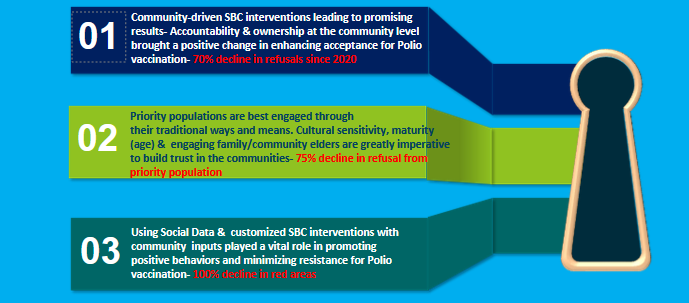
Previously, the approach was to address refusals by the Pashtun community as one entity, which means that messages engaging political leadership were mostly targeting Central Khyber Pakhtunkhwa (KP), but these messages were not working in those areas where there are communities from FATA and Quetta blocks and even from some of the blocks from Afghanistan. UNICEF began to realise that most of the refusals are from Mashud or Afridi tribes and/or the Akakhil from Afghanistan, as well as from Suliman Khel and Quetta blocks. Thus, UNICEF started identifying real opinion leaders from those specific tribes. When UNICEF engaged those tribal, political, and religious leaders that belong to their sect, as well as those doctors and faith healers they believe, then UNICEF started getting some results in those areas: minimising more than 70% of refusals.
Notably, such efforts cannot simply coalesce around one (OPV) campaign; the community engagement must continue throughout the year to ensure 100% of results in every polio vaccination campaign.
Among the audience questions and observations raised was one concerning the root causes of refusals in slum areas, based on the social data Uddin has collected and/or reviewed. He responded that the idea of a Western conspiracy (e.g., that OPV may cause infertility, perhaps purposefully) has fueled much of the Pashtun mistrust. The need for basic facilities in slum areas is so great that the people can grow suspicious about the push for polio vaccination to the exclusion of other services. Uddin commented on the role religious leaders are playing in addressing some of this suspicion. UNICEF has created a guide for these leaders that focuses on promoting health-seeking behaviours. They can use this guide in the work they do in the community. In addition to participating in door-to-door vaccination sessions, mobilisers have been present outside churches. In some of the places where there were refusals, UNICEF engaged the Madrasas or religious leaders to talk about OPV during religious services by saying there is a disease that's in the community and that most people need to be vaccinated.
Click here, and then click on the Part 1 video recording, to locate and watch Uddin's presentation (beginning at approx. 56 minutes into that recording).
Poliokit.org, January 5 2023. Image credit: Jahan Uddin
- Log in to post comments