










































Challenges Facing Vaccinators in the 21st Century: Results from a Focus Group Qualitative Study
GSK (Wiot, Prugnola, Di Pasquale); Cello Health (Shirley); University of Limerick and the University Hospital Limerick & University Maternity Hospital Limerick (Philip)
"Supporting and equipping vaccinators is critical to the continuing success of vaccination programs..."
The 21st century vaccination landscape is characterised by ever-increasing access to information, rising levels of vaccine hesitancy among patients and healthcare professionals (HCPs), and increasing requirements for efficiencies in healthcare delivery and documentation of healthcare interventions by HCPs. Considering that the frontline vaccinator has been shown to be a strong influencer of vaccine uptake and is typically an HCP who is committed to vaccinating and advocating vaccination, this qualitative study investigated perceived gaps between the expectations of HCPs in their role as vaccinators and the reality of the world they operate in.
Sixteen groups that included a total of 75 nurse and physician vaccinators participated in individual and focus group discussions in 2018 between October 16-27 in the United States (US), Germany, and the United Kingdom (UK), and November 13-17 in India.
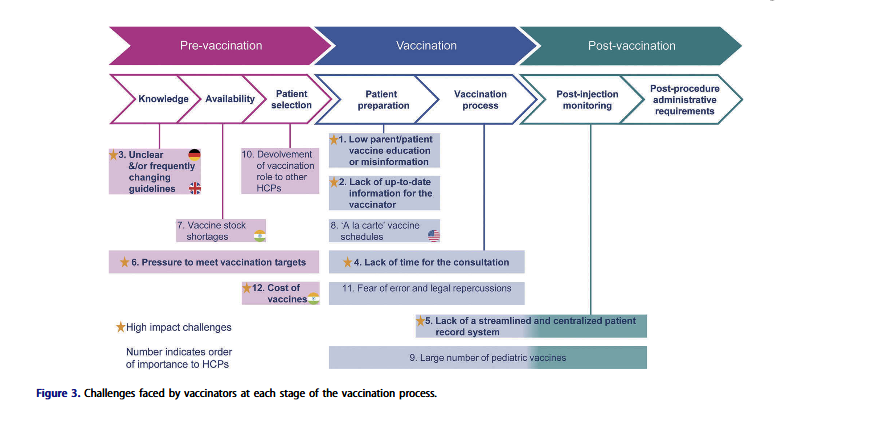
Vaccinators identified challenges during all stages of the vaccination process - from the background period prior to seeing a patient, during the pre-vaccination consultation phase, administration process, and during the period after vaccination. (See Figure 3, above.)
More specifically, the discussions revealed a disconnect between how participants viewed their role as HCPs, and more specifically as vaccinators, and the realities of real-world practice. The reasons underlying this disconnection were similar across different professional groups and between individual countries. Low patient-level vaccine knowledge, patient miseducation, untimely vaccine information, frequently changing vaccine schedules, the increasing number of vaccinations available, lack of centralised record systems, pressure to achieve vaccination targets, and in some instances vaccine costs all impacted the efficiency and enthusiasm of HCPs. They spent "extensive time" educating and convincing parents to accept vaccination associated with a sense of loss of trust, experiencing a "battle" against vaccine misinformation and substantial paperwork. HCPs expressed feelings of guilt, frustration, and disillusionment due to the loss of patient centricity and the feeling they should be doing more for their patients.
Communication-centred solutions proposed by the providers included improving patient-level information through a multifaceted patient education approach that challenges vaccine misinformation and provides patients with the information they need to make informed decisions by:
- Providing patient-directed information leaflets at each vaccination;
- Creating waiting room videos on the importance of vaccines and on local vaccine schedules;
- Educating new parents during prenatal and antenatal contacts (seen as particularly relevant in Germany and the UK);
- Including vaccine education in the school health syllabus (seen as particularly relevant in India);
- Developing positive public vaccination health campaigns; and
- Implementing television and radio campaigns advocating the importance of public immunisation.
In light of the finding that new vaccines, new indications, changes to schedules and rapid global dissemination of vaccine information have left some HCPs feeling poorly informed and ill-equipped to address questions, concerns, and misinformation coming from parents/patients, participants in the focus groups proposed helping ensure HCPs are confident in answering patient questions and addressing objections through:
- Access to transparent, reliable and timely vaccine information/education for HCPs, via:
- Representatives (an important information source in the US, the UK, and Germany);
- Podcasts, webinars, and emails;
- Forums for online peer discussions; and
- Scientific congress presence by vaccine manufacturers with symposia and masterclasses (seen as particularly relevant in Germany).
- Provision of clear but flexible guidelines and targets (including insurance requirements in the US) that are compatible with the real-world healthcare system. That is, affording HCPs more autonomy about which patients should or should not receive specific vaccines.
Study participants stressed that patient- and HCP-focused communication and education must be seen to be "independent", free from bias, and easily accessible.
In conclusion: "Findings from this survey may stimulate reflection on why vaccination practice is not as smooth as expected and help identify solutions that can be integrated into daily practice."
Human Vaccines & Immunotherapeutics, 15:12, 2806-15, DOI:10.1080/21645515.2019.1621147.
- Log in to post comments