










































A Communication for Development Approach to Eradicating Polio: India Succeeds
UN System in Asia & Pacific (Gupta); Indira Gandhi National Open University, or IGNOU (Bansal); Indian Institute of Management (Agarwal)
"The findings stressed the need for clear, concise and appropriate communication on the threat perceptions of the Polio virus by using innovative and sustained IPC [interpersonal communication] methods complemented with use of electronic media campaigns."
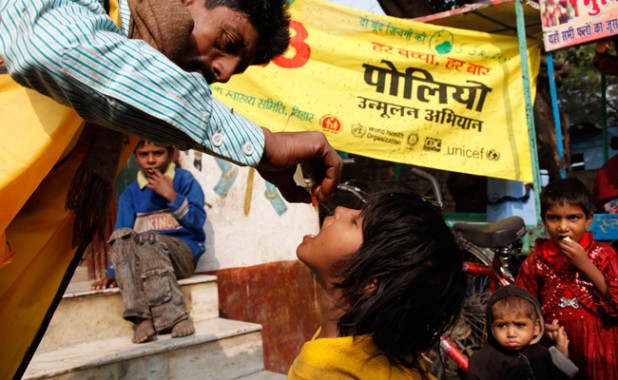
Effective communication for development (C4D) can be described as a powerful "vaccine" for preventing communities from various diseases, including polio. India has been hailed as a success for eliminating polio from the country by not only using epidemiological data but by applying multiple communication channels to promote oral polio vaccine (OPV) drops. This study ascertained whether the communication and social mobilisation interventions were designed based on specific community needs and existing risk factors. This analysis could contribute to overall communication planning so that India continues to be vigilant and renews its strategy and energies in keeping the country polio free.
The paper opens with an overview of the fight against polio in India. During the late nineties through 2001, the path ahead hinged on whether knowledge, attitude, and behaviours were given the place they deserved in an initiative dominated largely by epidemiological variables for disease eradication. The underserved communities - putting aside a resistant attitude and factors that shaped it - were by their economic and social conditions a group that fell on one end of the normal distribution curve. In the context of Diffusion Theory, they were the "laggards" in a chain of behavioural adoption, where no amount of general media outreach or publicity efforts could induce adoption of a new practice (accepting OPV drops for their children) unless extraordinary efforts were made.
The Social Mobilization Network (SMNet), through an aggressive interpersonal communication (IPC) approach, demonstrated that such behaviour-practice changes were indeed possible. In short, synergistic communication activities integrating social mobilisation, interpersonal communication (IPC), gender and culturally sensitive interventions, mass/folk media, and political advocacy were found to have helped in accessing the unreached and vulnerable population groups in India, especially with a fluctuating, diverse, and challenging socio-economic environment.
The communication interventions under the programme, when technically studied at various stages of their evolution, were found to be employing 3 primary theoretical conceptual frameworks in strategic health communication, namely: Theory of Diffusion of Innovations (Rogers, 2004); Theory of Planned Behaviour (Ajzen, 1991); and Stages of Change Theory (Prochaska & Norcross, 2001). An overarching approach derived from the Socio-Ecological Model (SEM) served as a common denominator of communication design under the communication for polio eradication initiative.
Despite attaining the certification of a polio-free nation in March 2014, risk remains - not only because of the risk of importations from neighbouring countries, especially Pakistan and Afghanistan, but also due to factors like poor routine immunisation, poor sanitation, high incidence of diarrhoea, and poor nutrition among children below 5 years of age.
The research methodology included both qualitative and quantitative methods of data collection from 3 suburban clusters of the National Capital Territory (NCT) of Delhi, India - largely inhabited by migrant population groups from polio-endemic states, i.e., Uttar Pradesh and Bihar. The quantitative data were collected on a structured interview schedule that was administered to 200 female caregivers to children under 5 years of age. The qualitative data were collected through 3 focus group discussions (FGDs) among the women.
Selected findings:
- Only a quarter of respondents reported accessing newspapers, whereas daily exposure to radio was reported by 38.6% respondents and television by 68%. The majority of respondents did not access government-owned broadcast media (e.g., Doordarshan (TV) and All India Radio); instead, their media habits indicated frequent access to private FM radio stations and private satellite TV.
- Most respondents (88.7%) reported that television was their primary source of information on polio. However, the information they gathered on polio was largely (73%) about announcements on the National Immunisation Days (NIDs), Sub-National Immunisation Days (SNIDs), and mop-up rounds; these announcements did not contain information on polio prevention, sources of infection, etc.
- Health workers, the second most popular source, was reported by 61.5% of respondents. Almost all respondents claimed that health/social workers visited their homes during the last month, mostly sharing information about polio (96%), routine immunisation (71%), and handwashing and cleanliness (48%). However, upon further analysis, it was found that the health information provided by the providers, largely the vaccinators, was weak in substance and did not encourage the community to practice adherence to routine immunisation, exclusive breastfeeding, or even good sanitation behaviours. The main message shared by the visiting providers was on the need for continuous polio vaccination; they did not provide knowledge on any risk factors that lead to spread of polio virus among children, as the most vulnerable group.
- FGD participants said that none of the messages on routine immunisation and polio vaccination were disseminated through Panchayat-level leaders (locally elected or municipal councilors), though the national polio programme has laid significant emphasis on this intervention.
- 100% of respondents were aware of polio as a disease among children. However, some respondents who claimed to have known the causes and source of polio transmission had incomplete or incorrect knowledge. For example, barely 5% of respondents could recall the correct mode of polio virus transmission.
- Similarly, when questioned on whether polio can affect children in their community, nearly half of the respondents (51%) were unsure, a third said that it can, and 16% said that polio cannot affect the children in their community. Further probing and analysis showed that these responses were reflective of a poor understanding of polio, its causes, spread, cure, and the risk factors involved.
- It was found during FGDs that the usage of words such as "polio ki dawaa" - i.e., the polio medicine - in the national polio eradication programme has led to widespread misconceptions regarding the vaccine, wherein people believe it to be capable of curing polio as opposed to merely playing a role in preventing the disease.
- None of the respondents knew the harmful effects of missing a round of the polio drops. When questioned on what must be done if a child missed a dose, a majority of respondents (77%) said that one should take the dose from any nearest health centre, while 64% said that one should do nothing. This may be due to the high frequency of immunisation rounds, which may have had led to the parents and caregivers to believe that a few missed doses did not make a difference. These findings are reflective of a lack of clarity about how the poliovirus spreads and what can be done to prevent polio transmission.
- 24% of respondents mentioned they were on some occasions advised not to go for OPV for their children, either by their neighbours (67%), relatives (29%), spouse (17%), or religious leaders (17%). Of the 67% who were discouraged by neighbours from continuing with OPV drops, only 2% adhered to such advice. However, this 2% may have had a large impact on the number of ultimate refusals by further convincing their neighbours and family, while also increasing the risk to entire neighbouring populations through their unimmunised children.
- With regard to washing hands with soap and clean water, 61% of the respondents said that it was important, 31% were not sure, and 8% felt that it was not important. Of those who said it was important, 61% said that it was important to wash hands after defaecating, 32% said it was after washing a child's bottom, and 18% said before eating and 12% before cooking in the kitchen, respectively. From the perspective of the polio programme, this is alarming, as the polio transmission route of oral-faecal is largely contained through sanitation and handwashing practices; a single "missing link" in the prevention cycle could lead to a major epidemic of virus spread again.
Some recommendations based on the findings:
- The communication content produced by the polio eradication programme should not be restricted to only OPV promotion in communities; it must also emphasise risk factors that are responsible for polio transmission.
- There is a need for a focus on audio/visual communication of messages on public health issues, with emphasis on private channels in urban and suburban clusters and metro cities across the high-risk areas.
- More focused and community-owned IPC (including counseling) should be made integral to the programme's strategic health communication.
- The demand-generation strategies (through strategic health communication) and the associated supply-chain services (quality, affordability, safety, and accessibility) should be well matched by the programme managers - i.e., programme convergence and coordination in the field.
- A more focused social-inclusion analysis is needed with regard to the migrant settlers. The polio virus does not distinguish between the economically rich and poor, yet poverty perpetuates enabling conditions that spread bacteria and viruses. Thus, poverty, social exclusion, vulnerability, and gender disparity are some of the many socio-economic parameters that are responsible in making some communities at risk of polio.
The study concludes that, for behaviours to change, cultural taboos, societal norms, and structural inequalities need to be taken into consideration, including special emphasis on migrant settlers. Communication strategies have to be cognisant of and in tune with the policy and legislative environment and also linked to service delivery aspects for the most vulnerable and socially excluded.
Interações: Sociedade e as novas modernidades 38 (Jun. 2020), 162-80. DOI:https://doi.org/10.31211/interacoes.n38.2020.a6 - sent from Deepak Gupta to The Communication Initiative on July 9 2020. Image credit: Gates Foundation, flickr
- Log in to post comments