










































Community Action Groups (CAGs): A Polio Best Practice
"Community engagement is an essential component in any social development programme and to ensure that, it would be better to utilise existing networks and community institutions."
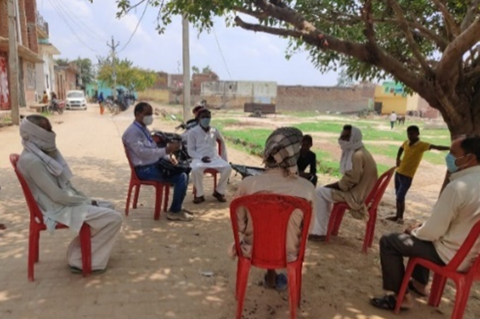
In 2020, CORE Group Polio Project (CGPP) India institutionalised the voluntary efforts of its informal network of polio influencers to form Community Action Groups (CAGs) that work to address immunisation and other issues arising during the COVID-19 pandemic. The initiative is taking place in selected areas of 12 districts in Uttar Pradesh (UP), India.
Over the past 20 years, the CGPP staff working for polio eradication created a large network of community influencers who support health workers in immunisation, especially for polio campaigns. During 2019-2020, the CGPP staff were scaled back due to fewer polio-specific activities, but current staff and former polio influencers maintain an informal, un-funded network. CGPP staff concerned about the potential negative impact of COVID 19 on immunisation and public health in general recognised an opportunity to engage this informal network. CGPP's Block Mobilization Coordinators (BMCs) contacted the influencers to form CAGs, with 5-6 members in each, with the goal of creating an enabling environment for the health workers and COVID-affected persons and their families.
The CAG is a community-focused approach that works to address issues like vaccine hesitancy during polio immunisation campaigns. CGPP observed the falling immunisation coverage as COVID-19 disrupted immunisation and health services. CGPP staff also recognised that COVID-19-affected people suffered from stigma and community shunning, as well as fear of using health services (including immunisation), and they identified many similarities to what the project and influencers had worked to address for polio. Seizing the opportunity, the CAGs mobilised to actively combat fear and stigma related to COVID-19.
Operating with no external budget and only voluntary participation, a CAG often includes village heads and leaders, health workers, schoolteachers, religious leaders, ration dealers, shop keepers, and local quacks/doctors. These group members are accessible to the community for discussing any issues related to immunisation and COVID-19. They not only inform and educate the community about COVID-19 and other health issues but also provide support through tangible action.
CAGs meet regularly, every alternate week or so, and identify families that need support. They then develop a plan to carry out the following tasks/responsibilities:
- Placing special emphasis on childhood immunisation (as sessions were disrupted during lockdowns) - thus motivating parents to take their children to the health centres to catch up on their routine vaccines - and tracking the parents whenever SIA (Supplementary Immunisation Activity) rounds are held.
- Promoting health-seeking behaviour by dispensing critical information for the prevention of disease, especially COVID-19, thus preventing and addressing stigma.
- Supporting the COVID-19-affected person/family in availing health and other essential services, as well as arranging for essential supplies at their doorstep.
- Supporting frontline workers in the promotion of health and delivery of healthcare services such as immunisation, health surveys, etc.
- Being accessible through phones.
Immunisation and Vaccines, COVID-19
Context:
According to CGPP India, the COVID-19 pandemic has created a devastating impact on health systems and on communities by creating panic and anxiety among people stemming from ignorance and misinformation. This has led to stigmatisation of confirmed/suspected cases and their families, reflected by social boycotting, loss of livelihood, and inability to access essential services. This fear has led to people not coming forward for testing and treatment and being reluctant to go to quarantine facilities.
The other adverse impact of the pandemic has been a disruption of childhood immunisation services beginning in March 2020. That resulted in more than 2 million fewer children under 5 years of age receiving their polio vaccines, leading to increased vulnerability to all 3 types of polioviruses. This situation was also accompanied by a decline in sensitivity of surveillance for polioviruses. These factors could lead to a lowering of population immunity against polioviruses and could also cause an emergence of vaccine-derived polioviruses (VDPVs).
Key Outcomes/Impacts:
Since April 2020, about 500 CAGs have been formed, covering more than 300 villages/urban areas from selected blocks of 12 UP districts (Baghpat, Bareilly, Mau, Meerut, Moradabad, Muzaffarnagar, Rampur, Saharanpur, Sambhal, Shahjahanpur, Shamli, and Sitapur). The CAGs have helped many community members by demystifying their queries and concerns related to polio, other routine immunisations, and COVID-19, and they have assisted almost 4,000 COVID-19-affected families in getting food and healthcare services. Parents have been counseled to take their children to health centres and outreach sessions as routine immunisation services have been restored.
CGPP functionaries have observed that CAG activity has helped in converting families refusing to vaccinate their children, as well as in reducing stigma and discrimination associated with COVID-19 and building confidence among community members to deal with the pandemic.
Scale-up Options:
The CAGs have definite objectives and operational guidelines that can be modified for use by states. For example, the National Health Mission (NHM) can add/modify VHSNC (Village Health Sanitation and Nutrition Committees) guidelines to include CAGs to support various health programmes like immunisation and water, sanitation, and hygiene (WASH). Government frontline workers (FLWs) like Anganwadi workers (AWWs), accredited social health activists (ASHAs), and Sanginis can be oriented on objectives, participants, and processes of CAGs so as to initiate them in their own areas.
Key Takeaway:
If community leaders with social accountability support government programmes, then goals can be achieved.
CGPP is funded by the United States Agency for International Development (USAID).
Email from Rina Dey to The Communication Initiative on February 11 2021.
- Log in to post comments