










































Contagion, Quarantine and Constitutive Rhetoric: Embodiment, Identity and the "Potential Victim" of Infectious Disease
Seattle University
"Everyone who is born holds dual citizenship in the kingdom of the well and in the kingdom of the sick. Although we all prefer to use only the good passport, sooner or later each of us is obliged, at least for a spell, to identify ourselves as citizens of that other place." - Susan Sontag
This paper explores the role of "discourses of identity" in infectious disease public health rhetoric in the United States (US). Julie Homchick Crowe observes that, at the onset of the polio, HIV/AIDS, and COVID-19 pandemics, the public associated each disease with particular populations - low-income and immigrant families, the gay community, and the elderly, respectively. So, Crowe asks, how did members of the public who saw themselves as not being at risk for these diseases get repositioned as susceptible? To answer this question, she offers two main arguments: (i) Public health experts don't simply attempt to persuade us to change our behaviour in these cases but, rather, call us to both inhabit and resist the identity of potential victim; and (ii) when the rhetoric shifts to articulate that these illnesses do not just impact marginalised populations but can, in fact, infect anyone, the articulation of potential victim becomes one inseparably tied to wealth, whiteness, heterosexuality, and youth, reinforcing assumptions about whose bodies are valued and whose are not.
To illustrate the role of the potential victim identity in infectious disease rhetoric, Crowe analyses fragments of language used by US public health experts, victims, and advocates when the risks to the public were at their height - that is, prior to the establishment of the vaccine for polio, treatment for AIDS, and the COVID-19 vaccine. In each case study, she unpacks how "constitutive rhetoric" of the potential victim is ideologically tied to presumptions about what kinds of victims are considered worthy of attention and care. (Constitutive rhetoric is a theory of speech regarding the ability of language and symbols to create a collective identity for an audience and to extend a call to action.)
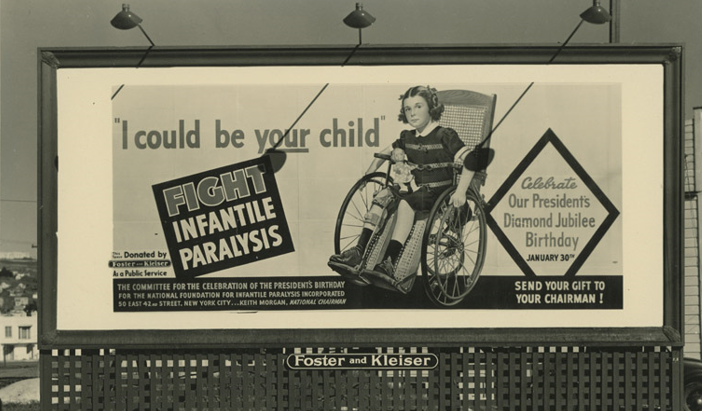
Crowe first discusses the assumptions of victimhood, filth, and polio in the early 1900s. Polio was initially associated with the "urban poor" due to the persistence of the filth theory of disease and its ideological implications that associated disease with marginalised populations. While initially, wealthier families saw their homes and neighbourhoods as safe harbour from the disease, as early as 1912, it became clear that even these populations could be potential victims. In some cases, renowned community members were named in the media when their families were affected by polio, further reflecting a new understanding that the disease could strike anywhere. Franklin Delano Roosevelt came to be seen as an embodiment of the polio victim for both adult and wealthy populations. "The identity of victim - once a shameful indicator of filth - became a sanitized symbol for the need to fundraise, do research, and develop a vaccine, and ultimately functioned as a warning to the public to not become like the victims they now pitied instead of scorned."
Crowe's analysis of HIV rhetoric begins with a look at the initial days (early 1980s), when scientists and outlets frequently used language that tied the disease to the identities of its victims - at that time, mostly homosexual men. Her discussion shifts to the case of Ryan White, the young hemophiliac who contracted HIV via blood transfusion, and Mary Fisher's speech to the Republican National Convention in 1992. In both cases, this embodiment of victimhood shook the perception of HIV as a "gay disease" in ways that called for everyone to reconsider their own identities as potential victims. Crowe explores "how ideologically-driven the constitutive identity of good victims like Ryan White or heteronormative victims like Mary Fisher reflects cultural presumptions about who gets care and what illnesses demand our attention."
Finally, she offers a discussion of how the identity of potential victim has figured differently in the case of the COVID-19 pandemic. "As scientists and doctors quickly learned in 2020, the disease was particularly ruthless with the elderly", who "also contributed to a narrative of invulnerability for those who didn't look like them. To add to this narrative of invulnerability, news coverage in March and April 2020 also showed crowded spring breaks where young people decried fear over the virus..." As knowledge about how to protect ourselves progressed, "Wearing masks, staying home, and keeping physical distance all became calls to become and signifiers of the socially responsible citizen who was asked to act not just because the virus might attack them and that they might be potential victims, but because their actions might protect others."
When US President Donald Trump was infected with COVID-19 in the autumn of 2020, "one might think his embodiment of the disease, like with Roosevelt and polio, would reframe how the public saw potential victimhood. But his remarks and actions - even as someone in his seventies and therefore more susceptible to the disease - minimized the virus and framed public health measures as an overreaction." Declining trust in the US regarding COVID-19 information from outlets like the media, public health organisations, the White House, and other sources - as well as the presence of an "infodemic" in the form of YouTube videos, anti-vaccine memes on social media, and more - have served "to promote fear - not of getting sick but of limits to our autonomy" in the form of public health mandates for masks and vaccines.
Crowe draws two central conclusions from the case studies:
- "In cases where diseases appear to target particular populations, other groups still need to be invited to see themselves as potential victims given the fact that they can still carry and spread the illness, let alone suffer health consequences themselves. What we see in the above cases, then, are constitutive appeals that effectively ask us to do what we can to remain how we are rather than engage in behavior that makes us become victims, showing us that the constitutive function of this rhetoric names us as potential victims and asks us to remain in the identity of non-victim at the same time. The tensions within these cases of health prevention rhetoric augment our understanding of both public health rhetoric and constitutive rhetoric. It also, by extension, helps us better understand how calls for behavior-change repel off of science denialists and conspiracy theorists - for many, such calls are not just about actions, but identities as well."
- "[W]hen we see constitutive rhetoric function to articulate potential victimhood for affluent, white, heteronormative or young people, we see how calls for action, research, and policy are responses to the concerns of those at the center, not the margins, of society. To create action, it seems, we have had to repeatedly show the privileged that they can be victims as well - and the requisite to do so has had devastating consequences."
In conclusion, Crowe's analysis of constututive rhetoric in the cases of polio, HIV/AIDS, and COVID-19 have revealed how "the awakening of potential victim reveals hegemonic assumptions about whose bodies are valued and whose are not."
Journal of Medical Humanities https://doi.org/10.1007/s10912-022-09732-7. Image caption/credit: Billboard sponsored by the National Foundation for Infantile Paralysis (later called the March of Dimes), California, United States, 1942. Courtesy of the Franklin D. Roosevelt Library. (Image in the public domain)
- Log in to post comments