










































"Does Pakistan Still Have Polio Cases?": Exploring Discussions on Polio and Polio Vaccine in Online News Comments in Pakistan
University of Kansas (Ittefaq, Baines, Abwao); Jacksonville State University (Shah); University of Lahore (Ramzan)
"...online news comments are a place to understand people's reaction to a public health issue."
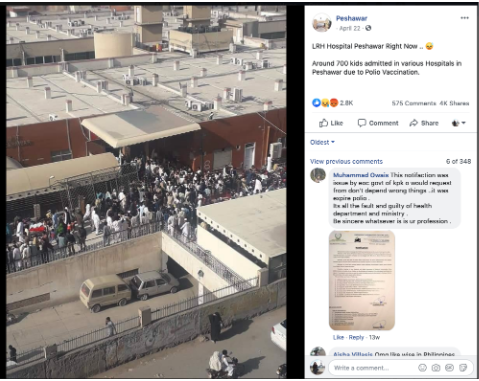
Polio vaccine hesitancy and resistance remain high in some areas of Pakistan. For example, following rumours that spread through social media in April 2019 claiming that the polio vaccine had resulted in the sickness of schoolchildren, a mob attacked and set fire to a small hospital in the Peshawar district. In response, online readers started discussions to engage with this news story. This study investigates readers' discussions in the English version of the Pakistani Dawn media group (Dawn.com) to investigate people's perceptions of polio, including but not limited to the Peshawar incident.
Using thematic analysis, the researchers analysed 2,216 comments made by readers in 111 polio-related news stories published on Dawn.com from January 1 2012 to March 1, 2020. Seven major themes, along with sub-themes, emerged from the analysis of the comments:
- Reasons for and challenges resulting in the failure to eradicate polio - e.g., "I will not allow my children to take polio drops if...not manufactured in Pakistan [April 24 2019]." One of the major reasons commenters mentioned to explain why the government has failed with polio campaigns, especially in rural areas, was indoctrination from religious extremists who spread misinformation through religious teachings and social media.
- Proposed solutions and policy changes to eradicate polio - e.g., "Our religious leaders can play a big part positively in this campaign [April 24 2019]." Commenters suggested the imprisonment of parents who refuse to vaccinate their children, the creation of awareness among Pakistani people by the media, and the implementation of celebrity endorsement.
- Misinformation - e.g., "No doubt, social media is the home of false, fraud and futile media outlets bent upon spreading fake news [May 11 2019]." Indeed, some commenters believe there is "no polio in Pakistan" and spread fake content about the vaccine. However, other commenters identified the misleading content and pointed out the false claims about polio and polio vaccination to others.
- Criticism, frustration, and shame - e.g., "It is ridiculous that something as simple and basic as polio drugs is not accepted. Let us all stand up and make Pakistan a polio free nation [April 24 2019]." Many individuals stated that the government's lack of political will and misplaced health priorities, as well as people's lack of awareness regarding the effectiveness of polio vaccination, are responsible for placing Pakistan in a position where the country is not yet polio free.
- Comparison of Pakistan to other countries - e.g., "India has done an exemplary job in polio eradication. Pakistan needs to learn [January 11 2020]." Commenters suggested that Pakistan can be successful if it implements similar strategies to eradicate polio and asks for help regardless of "political and diplomatic relationships".
- The internet as a public sphere - e.g., "As a medical professional, what I would like to emphasize is that a significant portion of the population is not vaccinated in Pakistan [November 26 2019]." In this public space, people shared facts and figures on the number of polio cases in Pakistan, as well as their stories and experiences with polio.
- Suffering, empathy, and appreciation - e.g., "I salute all you Polio workers. You risk your life to save the next generation from becoming disabled. You are courageous, you are the true Mujahideen. May Allah protect you and your families [December 21 2013]." Commenters in this theme highlighted the suffering of children due to polio. They expressed their empathy with polio workers who face difficulties and are even killed by militant groups who are against polio vaccination.
Thus, this study not only validated previous research on reasons, challenges, and issues related to polio vaccination but also found new issues in online news sites concerning misinformation on polio and polio vaccination in Pakistan. Since the Peshawar incident, the government of Pakistan has launched the Perception Management Initiative (PMI) and blocked more than 700 social media pages related to anti-vaccination propaganda.
The researchers suggest that additional studies could explore the spread of misinformation on social networking sites and investigate how to counter it. Future research might also compare news articles with online comments to understand the relationship between the news story content and the types of comments generated by the readers. Framing of news and comments can be studied in the future. Finally, a longitudinal study to understand media content could be helpful in designing media and communication campaigns to create awareness about polio and polio vaccination among rural and tribal communities.
In conclusion: "Dawn's readers view this [polio] as a problem of future generations, and see it is a very complex issue in Pakistan. Currently the biggest challenge to eradicate polio in Pakistan is misinformation on the internet. The government of Pakistan needs a multi-systematic and comprehensive plan to counter misinformation from online platforms."
Vaccine. 2021 Jan 15;39(3):480-86. doi: 10.1016/j.vaccine.2020.12.039. Image credit: First Draft
- Log in to post comments