










































"Down the Rabbit Hole" of Vaccine Misinformation on YouTube: Network Exposure Study
Texas A&M University (Tang, Costantini, York); The University of Texas Health Science Center at Houston (Fujimoto, Amith, Tao); Texas Children's Hospital (Cunningham, Boom); University of Texas (Xiong)
"Empirical studies have shown that both echo chambers and filter bubbles deepen the ideological divide among the public..."
YouTube's search and recommendation algorithms expose viewers to repetitive, homogenous content that may reinforce biases and misconceptions. Meanwhile, research has shown that consumption of antivaccine social media content could negatively impact vaccine attitudes and consequently vaccine uptake. This study explores YouTube viewers' exposure to vaccine-related information and misinformation to determine to what extent, if any, YouTube's search and recommendation algorithms create a "rabbit hole" that impacts the information to which they are exposed.
As explained here, users interact with the YouTube platform in two ways: Direct navigation occurs when users are directed to watch a YouTube video from another website or social media platform; alternatively, users can search for videos based on keywords (goal-oriented browsing). In both cases, YouTube presents users with a set of recommended videos based on the user's prior viewing behaviours as well as covisitation counts. Thus, the first research question (RQ1) is: When YouTube users start their viewing with provaccine or antivaccine keywords, or an antivaccine seed video, to what extent will they will be exposed to pro- and antivaccine content? RQ2 is: What is the degree of exposure of pro- and antivaccine videos, as well as other videos unrelated to vaccines, to additional antivaccine videos?
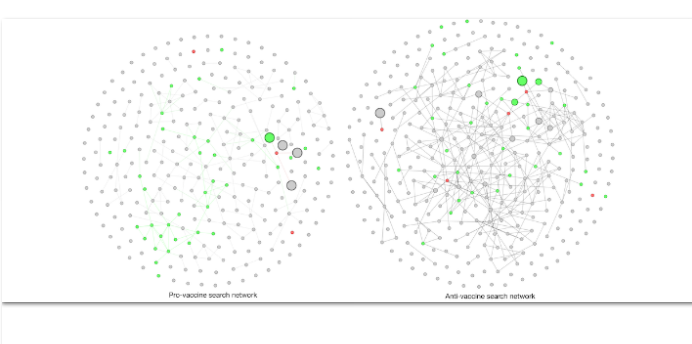
Four networks of videos based on YouTube recommendations were collected in November 2019: 2 search networks were created from provaccine and antivaccine keywords to resemble goal-oriented browsing, and 2 seed networks were constructed from conspiracy and antivaccine expert seed videos to resemble direct navigation. Video contents and network structures were analysed using the network exposure model (NEM), which measures the degree to which a node in the network is exposed to other nodes with a certain attribute.
In the 2 search networks generated from provaccine and antivaccine keywords, a majority of the vaccine-related videos were provaccine. Most of these vaccine-related videos were created and uploaded by credible sources such as governmental agencies, hospitals, and academic institutions. In contrast, viewers were much more likely to be exposed to antivaccine information in the conspiracy seed network and in the antivaccine expert seed network. Approximately half of the vaccine-related videos in the 2 seed networks were consumer-generated.
Some salient findings:
- Viewers are more likely to encounter antivaccine videos through direct navigation starting from an antivaccine video than through goal-oriented browsing.
- When users start with a keyword-based search on YouTube, they are likely to reach provaccine videos posted by credible sources such as government agencies and hospitals, regardless of whether they used provaccine or antivaccine keywords. This finding suggests that YouTube has taken some measures to promote provaccine videos from credible sources in their search function.
- Even if users watch a provaccine video, they have a relatively high chance of being recommended an antivaccine video. A viewer could have a roughly 2 to 12 times chance of being recommended an antivaccine video depending on the networks than any other video. Antivaccine videos are much more likely to lead to more antivaccine videos. Such patterns were statistically significant in the 2 seed networks but not in the 2 search networks, which is likely caused by the low percentages of antivaccine videos in the 2 search networks.
- 2%-6% of the videos in these networks were about autism but did not contain any vaccine-related information. This means that when users watch autism-related videos, they might be directed to vaccine-related videos or even to antivaccine videos. This could potentially contribute to the spread of misinformation about the vaccine-autism link.
- Health videos that discuss nonvaccine health topics (e.g., diet, holistic medicine, cancer), especially those that contain misinformation, have some vulnerability to antivaccine videos through recommendations.
"Overall, individuals watching YouTube videos through a goal-oriented search have a lower chance of encountering vaccine misinformation due to efforts from YouTube; however, antivaccine misinformation still exists and users have a chance to encounter these videos or other misinformation content through direct navigation."
Journal of Medical Internet Research (JMIR) 2021 (Jan 05); 23(1):e23262.
- Log in to post comments