










































The Effect of Trust and Proximity on Vaccine Propensity
University of Idaho (Justwan, Baumgaertner); University of Utah (Carlisle); Independent Researcher (Carson); University of Texas (Kizer)
Despite the success of vaccination against measles, or perhaps in part because of its success and the perceived absence of threat of infection, there is growing vaccine hesitancy both in the United States (US) and globally. Several empirical studies demonstrate a link between geographic proximity to virus outbreaks and perception of risk, which is a factor in vaccine decision-making. The link, though complicated, is consistent with the expectation that perception of risk increases as (psychological) distance decreases. This paper studies the effects of trust in government medical experts and proximity to a recent disease outbreak on vaccine propensity. More specifically, the researchers explore how these variables affect attitudes with regards to measles in the US.
Of interest to the researchers is the issue of trust in government, science, and medical officials, which has been shown to affect risk perceptions with regard to environment and health issues. Confidence in organisations such as the Centers for Disease Control and Prevention (CDC) is a predictor of vaccination behaviour, since these entities are understood to provide consistent and positive cues to citizens about issues related to vaccine safety, vaccine risk, and vaccine effectiveness.
Their investigation is also shaped by theoretical and empirical work on the relationship between proximity and risk perception. Construal Level Theory (CLT), developed by Liberman and Trope, specifies 4 key dimensions of distance in terms of their mental construal: (i) spatial or geographical distance; (ii) temporal distance; (iii) distance between the perceiver and another individual or group; and (iv) hypotheticality, e.g., how certain it is that an event will happen. Events that are psychologically more distant are represented by more abstract high-level construals, whereas events that are psychologically close are represented with more construals that include specific contextual details. Moreover, these dimensions are closely linked, so that remote locations will tend to bring to mind the distant future rather than the near future, and unlikely events rather than likely events.
The study uses data from an original survey data, conducted in January/February 2017. Notably, there were 2 measles outbreaks in the US between January 2016 and January 2017, the start of the survey. Both of these cases were covered extensively by various news outlets, so it is likely that manyrespondents in the dataset were aware of these outbreaks.
The researchers asked respondents (n = 1,006) to imagine that they are currently missing the immunisation for measles. Then then inquired how unlikely or likely (on a scale from 0-4) the respondent would be to get vaccinated in each of 2 different hypothetical scenarios: (a) if there was no immediate risk of getting infected, and (b) if there was an outbreak of the disease in their community. They also assessed (i) respondents' proximity to one of the recent US measles outbreaks, and (ii) how much they trust government medical experts (such as the CDC) regarding questions about health, with responses ranging from strongly distrust (1) to strongly trust (5).
The main empirical findings were as follows:
- Contrary to the researchers' expectations, an individual's proximity to a recent measles outbreak has no independent effect on vaccination attitudes.
- In keeping with previous studies in the field, trust in government medical experts is strongly and positively related to vaccination attitudes. More specifically, respondents who "strongly trust" and "somewhat trust" organisations such as the CDC are significantly more likely to hold favourable views about measles vaccination than respondents in the base category. By contrast, citizens at the low end of the trust spectrum tend to be skeptical about immunisations.
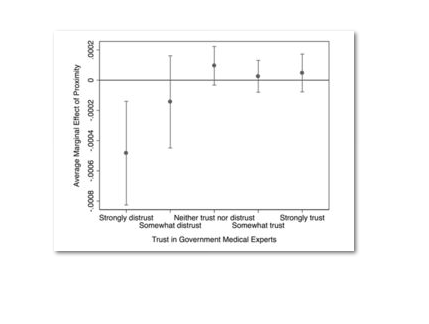
- There was a significant interactive relationship between proximity and trust in governmental medical experts. While distance from a previous measles outbreak has no effect on vaccination attitudes for respondents with medium or high levels of trust, the variable exerts a negative effect for subjects with little confidence in government medical experts. In other words: Low-trust individuals who live farther away from a recent measles outbreak harbor less favourable views about vaccination for this particular disease than low-trust respondents who live close to an affected area. For low-trust individuals who live far away from a recent measles outbreak, the predicted margin of expressing favourable vaccination attitudes is only 15.4%. This implies that citizens who are skeptical of the CDC and similar institutions base their vaccination decision-making to some degree on whether or not a given disease occurs in close vicinity to their community.
The researchers note that it is possible that other medical experts, such as primary care physicians, school nurses, or midwives, instill greater trust in the minds of the public than do government medical experts and therefore might be better suited to encourage vaccination behaviour. They cite 2 studies in Italy finding that vaccine hesitancy is more common among those who do not trust paediatricians, among those who receive their information through mass media, and among those who agree with political leaders who oppose vaccination. Furthermore, over half of the parents surveyed in one of those studies expressed a desire for more information about childhood vaccinations. Such research highlights the need and opportunity for healthcare workers - not only in the US but elsewhere - to improve public trust in scientific information about childhood vaccinations. Another suggestion made here is that the news media could take an active role in communicating health information regarding infectious diseases and vaccination protocols.
Among the avenues for future research raised by the present study, in the researchers' estimation, is investigation of potential cross-disease spillover effects. This study looked at "if/how a person's distance from a recent measles outbreak affects attitudes with regards to that particular disease. However, it is possible that a particular public health crisis raises the salience and perceived danger of various infectious diseases simultaneously, thereby affecting mass attitudes more broadly. Given these considerations, the literature on individual-level vaccination behavior constitutes fertile ground for future research."
PLoS ONE 14(8):e0220658. https://doi.org/10.1371/journal.pone.0220658
- Log in to post comments