










































Establishment and Use of Polio Communication Network in Response to Polio in Outbreak Countries of the Horn of Africa: 2013-2014
United Nations Children's Fund (UNICEF) Kenya (Haydarov, Anand, Merdekios, Abrar); University of Nigeria (Igweonu); World Health Organization (WHO) Kenya (Jemimah); WHO Regional Office for Africa - AFRO) (Okeibunor); WHO Horn of Africa Coordination Office - HOA (Sam Okiror)
"...designed to meet local communication needs with local solutions..."
Between 2013 and 2014, the Horn of Africa (HoA) countries experienced a severe wild poliovirus (WPV) outbreak that was attributed to weak social mobilisation, poor outreach to pastoralists, and lack of systematic use of data for planning. In response, the HoA polio response team set up the Polio Communication Network (PCN). This paper documents the establishment and contributions of the PCN in the outbreak countries of Somalia, Kenya, and Ethiopia from 2013 to 2015.
UNICEF, one of the key partners in the outbreak response, led the process of establishing the PCN with the objective of increasing positive polio knowledge and behavioural outcomes in communities. The PCN built communication capacity and commitment at local levels, engaged specialised partnerships for social mobilisation (such as influential local leaders and community groups), and used data for action. It also identified, addressed, and preempted refusals to vaccinate, no matter how small the number, as a matter of urgency. The PCN worked with local structures, including regional communication coordinators at different administrative levels in the outbreak countries. To facilitate ownership, local innovation, and commitment, the PCN used a bottom-up development model for microplanning.
The PCN also partnered with relevant religious bodies. For example, given the influential role of faith-based organisations (FBOs) in opinion and behaviour formation, as well as their capacity to reach the people in great numbers (including pastoralists), relevant FBOs were engaged to partner with UNICEF on the project. The main objective of this partnership was enhancement of community awareness of, demand for, and uptake of polio vaccination, while building the capacities of FBO leaders using participatory mechanisms.
In the different outbreak countries, messages on polio and child survival were developed and reinforced with religious teachings from the Quran or the Bible. Cascaded trainings were conducted on programme interventions and messages. Representatives of the FBOs participated in the planning, implementation, and evaluation of the polio supplementary immunisation activities (SIAs). In fact, more broadly, research, monitoring, and evaluation data were used to inform and improve communication interventions during the polio outbreak response in the outbreak countries of the HoA.
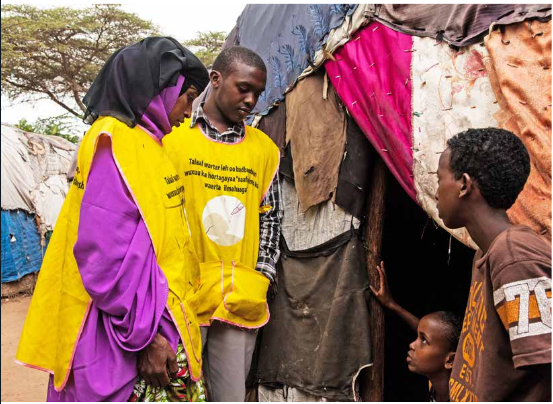
Social mobilisation committees (SMCs), comprised of diverse membership of locally influential persons such as religious leaders, administrators, health personnel, and women leaders, were formed at different administrative levels. The PCN supported the SMCs with training and capacity building and monitored SMC engagement in health and other topics.
In partnership with Jigjiga University, the Somali Regional Health Bureau and UNICEF conducted a qualitative case study of polio "zero-dose" children in February 2014 that aimed to document the sociocultural, religious, behavioural, service-related, and other factors that could influence polio vaccination in pastoralist communities to further guide communication interventions implemented by the PCN. Selected findings:
- The PCN increased levels of awareness of the polio campaign and strengthened communication networks in Somalia. For example, 3,323 trained social mobilisers were equipped with flipcharts and visual aids that included topics on polio, the Expanded Programme on Immunization (EPI), and water, sanitation, and hygiene (WASH).
- The PCN engaged the Islamic Affairs Supreme Council (IASC) and zonal communication committee (ZCC) in the Somali Region of Ethiopia - For example, 1,200 Sheiks in 4,567 Mosques in 30,060 Duqsies were equipped with polio flip charts, an EPI speaking book in Somali, and flash drives including an EPI social behaviour film and audio films.
- An anthropology of nomadic pastoralism was undertaken in the HoA to explore social dynamics, health-seeking behaviours, gender roles, decision-making mechanisms, and communication channels among the nomadic pastoralists. The PCN provided direct country support to Kenya on stakeholder and clan mapping; in Ethiopia, similar support was given for outreach to pastoralist communities and integration of polio with other child survival services.
- Pastoralist-focused communication approaches involved social mobilisation flipcharts/sessions, interpersonal communication (IPC) skills training, BBC short wave broadcasts, and interactive education through mobile teams/vans and branded health products/materials.
- The PCN facilitated scale-up of the "Mtoto Kwa Mtoto" (Child to Child) approach in pastoralist primary mobile schools in Turkana, northwest Kenya. Sixty-one primary mobile schools/head teachers were engaged in the process, and over 3,772 pastoralist students were identified as missed children. Among the interventions: the orientation of teachers on health education and student outreach. This work resulted in the decline in missed children from 1.2% to 0.25% and a decrease in the number of zero-dose children (in new settlements) from 760 in June 2014 to 570 in November 2014.
In short, this report has demonstrated the contributions of PCN's context-sensitive approaches, including gains in reaching traditionally missed, hard-to-reach, pastoral communities with polio information, improved communication capacity, and successful closure of the outbreak within the expected timeline. The focus on building capacity in areas such as monitoring and data collection generated social data that led to the communication approaches making a significant impact, as reported here. The PCN contributed to a better understanding of the behavioural and environmental factors affecting the demand for, and uptake of, health services in the HoA. For instance, the study on zero-dose cases provided information to better understand why some children miss out on polio or routine immunization and how communication could address this troubling gap.
In conclusion: "The use of the PCN helped bring the 2013-2014 polio outbreak under control and illustrates how the PCN can help drive progress towards the realization of the agenda of the universal health coverage and vision 2030 agenda in the African Region and elsewhere."
Editor's note: This article is part of a special issue of the Journal of Immunological Sciences: "Response to Polio Virus Disease Outbreaks in the Horn of Africa and Lake Chad Basin".
Journal of Immunological Sciences (2021); S (002): 47-53. Image credit: Global Polio Eradication Initiative (GPEI)
- Log in to post comments