










































Factors Affecting the Implementation of Childhood Vaccination Communication Strategies in Nigeria: A Qualitative Study
Community Medicine Department, University of Calabar (Oku, Oyo-Ita); Norwegian Institute of Public Health (Glenton, Fretheim, Ames, Lewin); Institute of Health and Society, University of Oslo (Fretheim); Sociology Department, University of Calabar (Eteng); Departamento de Saúde, Direcção Provincial de Saúde de Nampula (Muloliwa); Centre for Health Communication and Participation, La Trobe University (Kaufman, Hill); Faculdade de Medicina, Universidade Eduardo Mondlane (Cliff); International Union for Health Promotion and Education (Cartier); Swiss Tropical and Public Health Institute, University of Basel (Bosch-Capblanch); Evidence-based Healthcare Program, Pontificia Universidad Católica de Chile (Rada); Health Systems Research Unit, South African Medical Research Council (Lewin)
"The role of health communication in vaccination programmes cannot be overemphasized: it has contributed significantly to creating and sustaining demand for vaccination services and improving vaccination coverage. In Nigeria, numerous communication approaches have been deployed but these interventions are not without challenges."
Noting that communication interventions have made significant contributions to the polio eradication programme in Nigeria, this paper aims to explore factors affecting the delivery of vaccination communication in that country. It describes a qualitative study carried out as part of the Communicate to Vaccinate (COMMVAC) research project, which focuses on building research evidence to improve communication about childhood vaccinations with parents, caregivers, and communities in low- and middle-income countries (LMICs). It is hoped that an understanding of challenges of communicating about vaccination in Nigeria can inform policymakers during the planning of communication interventions and when adapting these to suit local contexts.
In Nigeria, the agency responsible for controlling vaccine-preventable diseases is the National Primary Health Care Development Agency (NPHCDA). The National Social Mobilization Working Group is responsible for the development of communication interventions for vaccination programmes at the national level, while State and Local Social Mobilization Committees are responsible for coordination and implementation of communication interventions at the state and local government area (LGA) levels. COMMVAC researchers carried out the study in rural and urban settings of Bauchi and Cross River States in northern and southern Nigeria. They also conducted interviews with national-level decision makers in Abuja, the capital city. In total, they conducted 15 interviews with policymakers, programme managers, social mobilisation officers/health educators and representatives from organisations including the United Nations Children's Fund (UNICEF), the World Health Organization (WHO), and the Vaccine Alliance (GAVI). Data collection took place from January to April 2014; the researchers used the theory-informed conceptual framework SURE (Supporting the Use of Research Evidence) Framework, which provided a comprehensive list of possible factors that could influence the successful implementation of interventions.
They identified a number of themes when looking through the data, which they then organised under different categories and sub-categories:
- Financial constraints, health resources, inadequate infrastructure and equipment, and human resource issues were grouped together under "health system factors". For example: "While some respondents alluded to the fact that there was an organised structure to manage communication activities at the national, state and local levels, other stakeholders pointed out that the structure on the ground did not translate into having qualified personnel at the community level to meet the objectives of the immunization programme. They highlighted the lack of well-trained communication personnel as a barrier to the effective mobilization of communities, especially the lack of personnel at local levels. They observed that even after training, personnel at the local level may not be able to meet the desired objectives of the programme effectively because of a lack of proper supervision and monitoring at this level....Poor attitudes among health workers at the state and local government levels and a lack of commitment to social mobilization activities outside campaigns were also reported to impact negatively on communication interventions for vaccination programmes. For instance, in situations where there was a delay in funding at the national level, respondents reported that mobilizers would not begin mobilizing the communities in which they worked but would instead wait for the funds to be disbursed before initiating mobilization activities. This was said to have led to poor performance by these vaccination teams in terms of achieving vaccination coverage outcomes."
- Political factors are reflected in the finding that most respondents viewed the presence of political support as a major facilitator, noting that communication interventions for routine immunisation would be more likely to achieve their objectives if they were given similar levels of political support to that given to campaigns (e.g., mass campaigns to deliver the polio vaccine). Political support for mass campaigns tended to be stronger in high-risk states or LGAs that had national or international attention or where political leaders were given mandates to improve their vaccination coverage. Some development partners involved in the implementation of communication interventions noted that most state and local political leaders failed to show ownership of the immunisation programme. They failed to provide funds to carry out communication interventions in their states or LGAs or failed to disburse these funds in a timely manner or to train and deploy health staff and provide the materials and equipment needed to effectively deliver routine vaccination services. The reason given by some respondents included an over-dependence on development partners and the fact that political leaders are usually more interested in committing their resources to more visible infrastructure, such as roads and schools. Respondents argued that health communication, whether for routine or mass campaigns, was usually perceived as a minor service component and was not seen as important or necessary. One of the factors contributing to this problem seemed to be the assumption by policymakers that health care workers do not require training in communication skills but do require more training on technical components of the immunisation programme.
- Community-level factors were brought together the SURE framework domains of "recipients of care" and "providers of care". The research explored the attitudes of community stakeholders, finding that, in some instances, community gatekeepers were reported as having prevented campaigns from being organised in their setting and having insisted that government provide basic necessities such as accessible roads, schools, and health services before these campaigns could take place. Similar issues were raised by respondents across the 2 states. In Bauchi, this resistance was particularly seen in response to polio campaigns. One reason given by respondents was the large number of polio campaigns, which they suspected had led community members to believe that the government was concentrating its resources on polio while neglecting their felt needs. In addition, certain religious groups and anti-polio vaccine campaigners have spread rumours about the inclusion into the vaccine of anti-fertility drugs or the HIV virus as a way of checking population growth in Muslims. In Cross River, respondents reported that pockets of resistance existed among certain religious groups in some communities. All respondents indicated that the engagement of trusted and respected traditional and religious institutions facilitates the delivery of communication for childhood vaccination in both states, and particularly in Bauchi where resistant families and communities were commonly found.
In discussing the findings, the researchers say: "our study suggests that vaccination communication was poorly understood by policy makers, with little mention of capacity building in communication or communication in the wider context of social mobilization....Weak political commitment impacted negatively on communication strategies for routine immunization services and contributed to difficulties with funding, deployment and training of staff, and provision of equipment and transportation especially at lower levels of the health system. Indeed, funding was a major challenge in the implementation of most components of immunization delivery in both states." Most of the barriers to implementing vaccination communication strategies found in this study were more strongly expressed in Cross River State, and also in rural compared to urban areas. The researchers point out that a lack of communication activities outside campaigns may result in people not recalling vaccination messages about routine immunisation. The implication of this is that if messages are not given continuously, people may forget or may not attach importance to the issue. The training of health workers needs to strongly address interpersonal communication (IPC) skills, the researchers stress, so that health workers can maximise any opportunities for reinforcement on immunization and child health more generally. Such training can help to ensure that health workers provide relevant and comprehensible information in a respectful and culturally sensitive manner. The engagement and cooperation of traditional and religious leaders was seen to facilitate the delivery of communication interventions for childhood vaccination in Nigeria.
Table 2 in the document provides suggestions on areas where health systems needed to be strengthened. For example, citing a lack of community participation, they recommend considering evidence-informed and locally appropriate interventions to involve communities in planning and implementation of communication intervention for both routine immunisation and campaigns.
One potential limitation is that the study was conducted during the pre-eradication era of polio in Nigeria, when the attention of governments and international agencies was focused primarily on polio eradication. This may have skewed findings towards issues relevant to communication in the context of campaigns.
In conclusion: "Addressing communication gaps, especially in routine immunization services, will require bridging the current funding gap, addressing human resource deficits and ensuring strong political will for implementation. Facilitators for implementation of vaccination communication interventions, such as the engagement of traditional and religious institutions and the use of organised communication committees, should be strengthened."
Editor's note: Additional files include: (i) "Guide for interviews with programme managers, social mobilization officers and development partners" [PDF] and (ii) "SURE Framework of key domains for the identification of factors affecting the implementation of policy options" [PDF].
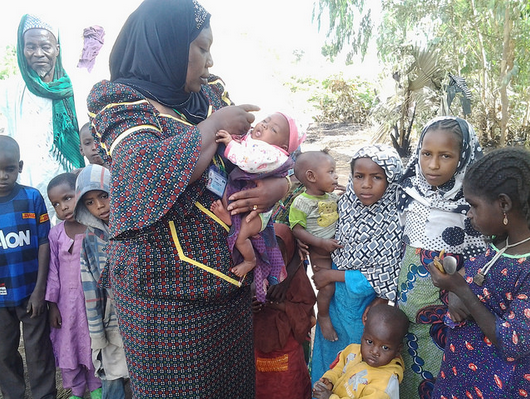
BMC Public Health (2017) 17:200. DOI: 10.1186/s12889-017-4020-6. Image caption/credit: "Nigeria FELTP resident Dr. Mariam Florence Ogo administers oral polio vaccine (OPV) to a child at an underserved farming and pastoring community in Pakka, Adamawa, Nigeria." Flickr, CDC Global/Mariam Florence Ogo
- Log in to post comments