










































Home-Based Records for Poor Mothers and Children in Afghanistan, A Cross Sectional Population Based Study
Ministry of Public Health, Kabul (Saeedzai, Sadaat, Anwari, Hemat, Hadad); Japan International Cooperation Agency (Osaki, Ishiguro, Mudassir); Tulane University (Asaba); Maternal and Child Health Consultant (Burke); UNICEF (Higgins-Steele, Yousufi, Edmond)
"WHO recommends that HBRs should be prioritised in remote, fragile settings with dynamic population movements."
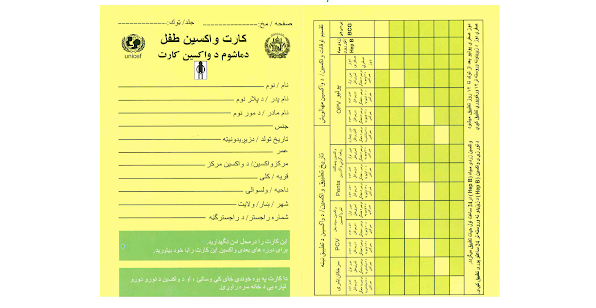
In Afghanistan, only 46% of mothers use health services for immunisation, suggesting a need for tools that can empower economically poor families to use services and take control over children's and mothers' health care. Home-based records (HBRs) are widely used globally, including in remote areas. Some countries use single "standalone" HBRs (e.g., vaccination cards), but many countries use integrated (also called combined) maternal and child health (MCH) HBRs that include health promotion messages and health records across antenatal care (ANC), delivery, birth registration, postnatal care (PNC), vaccinations, and nutritional and early childhood development services. In mid-2018, the World Health Organization (WHO) concluded that MCH-HBRs can improve communication and continuum between health service providers and can improve the communication of important health information to families. This study assesses distribution, retention, and use of integrated HBRs in the economically poorest families in the fragile state of Afghanistan.
Since January 2016, the Ministry of Public Health in Afghanistan (MoPH), Japan International Cooperation Agency (JICA), United Nations Children's Fund (UNICEF), WHO, and other partners have been working together to develop Afghanistan's integrated HBR for MCH care (called the MCH handbook). For an estimated 16,086 pregnant women and children aged less than 24 months, 21,500 handbooks were distributed by the end of June 2018. Health provider training focused on the need to: (i) provide the MCH handbook to all pregnant women and families of children under 24 months; (ii) explain the health promotion and record keeping components of the book to families; and (iii) remind families to bring the MCH handbook to all health visits.
In the pilot phase, the researchers compared the distribution of the new Afghanistan MCH handbook between the most economically poor women (quintiles 1-2) with the least economically poor women (quintiles 3-5) in Kama and Mirbachakot districts. Secondary objectives were to assess retention and to understand if there were differentials in distribution across specific strata (maternal education and age, parity). The researchers also assessed if there was variation in how healthcare providers and mothers utilised the handbook across wealth quintiles.
This was a population-based, cross-sectional study set in Kama and Mirbachakot and conducted from August 2017 to April 2018. Women were eligible to be part of the study if they had a child born in the last 6 months. The researchers found that 1,728/1,943 (88.5%) mothers received a handbook. The economically poorest women (633, 88.8%) had similar odds of receiving a handbook compared to the least economically poor (990, 91.7%) (adjusted odds ratio (aOR) 1.26, 95% confidence interval (CI) [0.91-1.77], p value 0.165). Education status and age had little effect. Multiparous women (1371, 91.5%) had a higher odds than primiparous women (252, 85.7%) (aOR 1.83, 95% CI [1.16-2.87], p value 0.009) of receiving a handbook, as did mothers with male infants (aOR 1.53, 95% CI [1.10-2.12], p value 0.011). Only 10 (0.5%) women reported they received a book but then lost it.
The majority of health records were completed, ranging from vaccination (birth dose polio vaccine [96.0%, 1551] to birth weight [63.6%, 1027]. Over 92% (1,490) of mothers reported that the health provider explained the purpose of the handbook. However, only 781 (48.4%) mothers reported that the health provider said she should bring the handbook to all health visits. Similar proportions were reported for economically poor and least economically poor mothers. Despite the lack of instruction, almost 80% (1,371) reported they took the handbook to all health visits, and 73% showed it to family and friends.
Ninety-one percent (1,564) of mothers reported they used the handbook for at least one specific purpose. The most common reason was to look at the illustrations (80.5%, 1383). In contrast, only 847 (49.3%) used the book to read healthcare messages - not surprising, due to low rates of literacy - and 912 (53.1%) used the book to review their own or their child's health records. Use was slightly lower (82.4%, 521/632) in econoomically poor compared to least economically poor mothers (95.6%, 939/982). Use appeared similar in non-educated (90.2% 1,210/1341) and educated (93.7% 267/285) mothers.
The researchers reflect on the findings, writing: "It is encouraging that we detected no differential in distribution or retention by wealth quintile." However, "findings still show that there are many missed opportunities for providing health care for mothers and children...Improved training of health care providers on all parts of MCH handbook service provision is essential."
In conclusion: "Many MCH services including vaccination, ANC and growth monitoring are well known to have the poorest coverage in the poorest families..., including in Afghanistan....Thus, it is encouraging that the MCH handbook, an integrated MCH HBR, could be implemented in the complex environment of rural Afghanistan and that it could reach high numbers of poor mothers. It also is encouraging that the Afghanistan MCH handbook appeared to be valued and used by mothers across all socio economic and education levels."
The handbook will be scaled up over the next 3 years across all of Afghanistan and will include close monitoring and assessment of coverage and use by all families.
BMC Public Health 2019 19:766. https://doi.org/10.1186/s12889-019-7076-7. Image credit: Home-Based Record Repository
- Log in to post comments