










































How Organisations Promoting Vaccination Respond to Misinformation on Social Media: A Qualitative Investigation
Macquarie University (Steffens, Dunn); Boston Children's Hospital (Dunn); The University of Sydney (Wiley, Leask); The University of Sydney (Leask)
Organisations that promote vaccination to the public on social media are in a position to address and counterbalance misinformation that may lower vaccine acceptability and vaccination rates. This study describes the strategies, viewpoints, and experiences of Australian health communicators as they promote vaccination and respond to misinformation on social media.
Using qualitative methods, the researchers purposively sampled 21 participants responsible for routine social media activity and strategy from Australian organisations actively promoting vaccination on social media, including government health departments, local health services, advocacy groups, professional associations, and technical/scientific organisations. Between November 2017 and July 2018, the researchers conducted semi-structured, in-depth interviews to explore participants' perspectives and practices. Questions for these interviews were informed by risk communication principles, which include: communicating clearly, openly, and with compassion; collaborating with credible sources; listening to and involving stakeholders as partners; and planning thoroughly and carefully. They used framework analysis to explore the data both inductively and deductively.
Participants mostly discussed experiences of vaccine promotion on Facebook. Most used Twitter primarily for purposes other than vaccination promotion, and only a handful reported using Instagram.
Based on the analysis, the paper presents 5 overarching themes, 3 of which pertain to participants' perceptions of the social media landscape and the actors in it, and 2 of which concern participants' strategies to promote vaccination and neutralise misinformation. The major themes, which are illustrated by instructive quotations from study participants, include:
- Perceived threats to trust in vaccination in the social media landscape
- Misinformation was encountered routinely, on Facebook in particular. "[C]oncerns about misinformation threatening public trust in vaccination centred on its pervasiveness lending weight to anti-vaccine claims. Participants were also troubled by misinformation appearing credible in what they depicted as a lawless environment, void of rules delineating fact from fiction..."
- Anti-science sentiment was characterised by resistance to mainstream expertise and scepticism of scientific evidence. Doubts about vaccine science's integrity were sustained by compelling narratives circulated on social media.
- There was a complex narrative. "The disparity between ideal health messages - straightforward, clear and simple - and the reality of communicating a vaccination narrative characterised by complexity and uncertainty was depicted as problematic."
- Anti-vaccine activists represented a significant threat - "[T]hey were perceived as persuasive, constructing eloquent arguments, skillfully commandeering scientific research and endorsing misinformation to support their claims."
- Constructions of their audience - "Parents, and their family and friends, were the priority audience for advocacy groups, government health departments and local health services. While professional association and scientific/technical organisation participants primarily engaged with an expert audience, they acknowledged also reaching parents." Participants cast their audience as information seekers, with hesitant parents being vulnerable to misinformation.
- Constructions of themselves and their role on social media - Participants described their role as information provider and positioned themselves as rational, objective, and evidence-based.
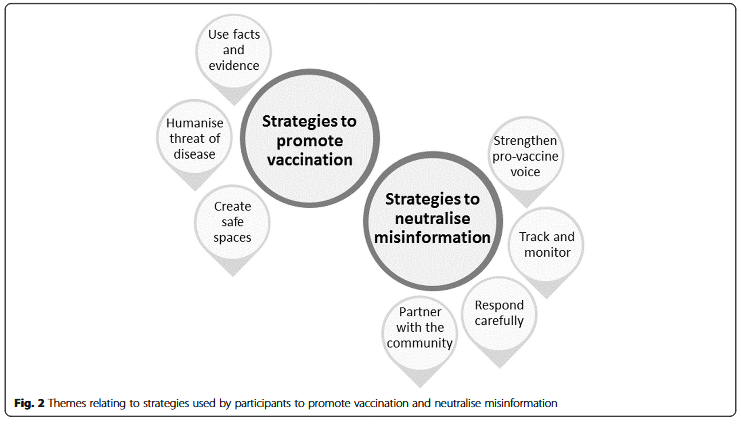
- Strategies to promote vaccination included using facts and evidence, humanising the threat of disease (e.g., through personal stories), and creating safe spaces (e.g., through private messaging and closed Facebook groups).
- Strategies to neutralise misinformation included partnering with the pro-vaccine community, responding in selective and circumspect ways, tracking and monitoring conversation, and strengthening the pro-vaccine voice (e.g., through partnerships with other vaccine-promoting organisations).
The researchers offer recommendations for communicators based on these findings, including:
- Because of the potential of misinformation to influence the silent audience, consider directly countering it by emphasising corrective information, warning of any upcoming misinformation, and explaining why misinformation is incorrect (and if possible, providing an alternative explanation), rather than simply labelling misinformation as false.
- To discourage audiences from turning to less credible sources, be transparent and forthcoming with information.
- To avoid overloading audiences, offer corrective explanations that are straightforward and succinct.
- In situations that do not warrant direct refutation, focus on empowering audiences to independently recognise and resist misinformation - for example, by exposing flawed anti-vaccine arguments.
- Because provision of information is not always sufficient, pair scientific evidence with storytelling, especially from people personally affected by vaccine-preventable diseases. ("Communicators should bear in mind the narrative structure of their stories, developing specific components such as setting, characters, plot and moral to speak to audience beliefs and values.")
- Avoid hostile interactions with anti-vaccine activists, keeping exchanges brief, ensuring they are factual and polite, and refraining from inflammatory labels or implications that the movement is more organised than it really is.
- In addition to linking up with like-minded organisations, partner with vaccine-accepting members of the public. ("[S]uch relationships are especially valuable in times of crisis. Communicators should avoid relinquishing all opportunities to respond to misinformation, however; reputable organisations are more effective than individuals at correcting misperceptions...")
BMC Public Health (2019) 19:1348.
- Log in to post comments