










































How Service Delivery Implementation Strategies Can Contribute to Attaining Universal Health Coverage: Lessons from Polio Eradication Using an Implementation Science Approach
Johns Hopkins University Bloomberg School of Public Health (Olateju, Peters, Alonge); University of Texas Health Science Center at Houston (Osaghae)
"Health care providers and community health workers...need to transform beyond providing health services (competence and knowledge) to become trust agents (morality and compassion for the people they serve) fostering community ownership and engagement while serving as pillars to strengthen service delivery."
Improving service delivery is a key strategy for achieving service coverage, one of the two components of universal health coverage (UHC). Strengthening service delivery involves a two-pronged approach: (i) building capacity of health workers and improving service readiness, availability, and quality at health facilities (supply side); and (ii) increasing access to health service through social mobilisation and efforts to bring health services to communities (demand side). This article describes supply- and demand-side strategies used to strengthen service delivery under the Global Polio Eradication Initiative (GPEI) and draws lessons that could be applicable to achieving UHC.
As reported elsewhere, GPEI efforts have contributed to broader health service delivery efforts through capacity building, micro-planning, and disease surveillance. Conversely, the GPEI has been shown to disrupt health systems, especially in countries with weaker health system infrastructure. Illustrations of the latter include conflicts between local community demands and polio immunisation targets, lack of cohesive social mobilisation and communication between the GPEI and the Expanded Program on Immunization (EPI), and diversion of operating capacity and human resources from broader health system goals to polio eradication.
Data for the study were obtained from a cross-sectional online survey that was conducted to map global and country-level implementation approaches and experiences (tacit knowledge) of the GPEI. The survey drew respondents who identified as working or having previously worked on polio eradication activities for at least 12 consecutive months between 1988 and 2019. They hailed from 7 low- and-middle countries (Afghanistan, Bangladesh, the Democratic Republic of Congo, Ethiopia, India, Indonesia, Nigeria) and from the global level across member organisations of the GPEI and international non-governmental organisations (NGOs) with GPEI experience in additional countries. The 3,659 valid responses were analysed using an embedded mixed-methods approach.
This paper focuses on respondents who were involved with implementing activities geared towards strengthening service delivery systems - defined as activities that enable vaccination at the right time, for the right populations, in the PEI implementation context. Activities included: developing infrastructure; recruiting, training, and supervising personnel; strengthening supply chains; and administering vaccines. Respondents provided information about the internal contributors, external contributors, implementation challenges, facilitators and barriers they encountered during implementation, based on the Consolidated Framework for Implementation Research (CFIR) framework, supplemented by the socioecological model (SEM).
The main internal contributor of strengthened service delivery was the process of conducting activities (48%) that were aimed at systematically increasing access to healthcare services to reach remote and vulnerable populations, such as microplanning, community inclusion, and use of geographic information systems. Working in a frontline role had higher odds of identifying the process of conducting activities as the main internal contributor (adjusted odds ratio (AOR): 1.22, p = 0.687).
Some survey respondents pointed to the fact that, in India, the training of frontline and community health workers who implemented the social mobilisation network (SMNet) programme was not limited to polio immunisation activities (spillover effects). Other studies have demonstrated that SMNet health workers were also trained to support general maternal and child health, such as by tracking children's complete vaccination history and promoting breastfeeding. Such programmes that extended beyond polio immunisation to address broader public health priorities contributed to strengthening service delivery.
The main external contributor of the GPEI to strengthened service delivery was the social environment (42.5%), especially among those whose roles interfaced directly with communities and beneficiaries. The study found that the elements of the social environment included developing high levels of trust in health workers, ensuring transparency in the vaccination process, and building community awareness.
Conversely, the most frequent implementation challenge was the external environment (56%); working in Eastern Mediterranean region was almost 4 times more likely to identify the external environment as the major challenge in service delivery strengthening (AOR:3.59, p < 0.001). Respondents cited security challenges and community resistance to polio eradication interventions as the main forms of implementation challenges experienced.
Reflecting further on strategies for addressing such challenges in the environment, the researchers stress that building trust between health workers and communities requires a medium- to long-term approach. It entails contextualising social mobilisation and community awareness activities in individual communities to improve buy-in and participation. Unlike smallpox, which involved one or two shots, polio eradication requires multiple contacts with the health system before vaccination, similar to other public health services that make up the essential health services package of UHC in many countries. Thus, when communities need multiple, repeated contacts with the health system, building trust requires communicating constantly with consistent messaging, modeling health-promoting behaviours, and understanding cultural norms.
In short, based on the findings, the researchers suggest the following priority actions to inform policymakers to accelerate progress towards attainment of universal health coverage:
- Invest in building trust between frontline health workers and the communities they serve by ensuring the community has a voice in setting their health priorities.
- Institute multisectoral expertise and leadership to address challenges external to the health system with impact on service delivery - e.g., develop collaborations with other relevant sectors of the economy such as education and youth empowerment.
- Adopt strategies to systematically reach difficult-to-reach, vulnerable populations, such as microplanning, and leverage technologies like geographic information systems (GIS) to identify and reach chronically underserved communities or to target pockets of disease outbreaks and chronic illnesses.
- Expand disease-specific programmes to support broader primary healthcare priorities - e.g., routine immunisation and surveillance of all diseases with public health significance.
- Foster holistic health integration such that other members of the community can receive some basic healthcare during immunisation campaigns - e.g., provide blood pressure measurements to parents during supplementary immunisation days (SIDs).
In conclusion: "In the context of UHC, service delivery needs to be re-imagined for implementing integrated, essential primary healthcare services that requires regular touchpoints and community ownership. To achieve UHC, this integration needs to be expanded beyond pandemic and emergency responses to incorporate basic essential services, leverage synergies provided by global polio programs to maximize capabilities, fill gaps, and transform the biggest implementation challenges into pillars for strengthening service delivery."
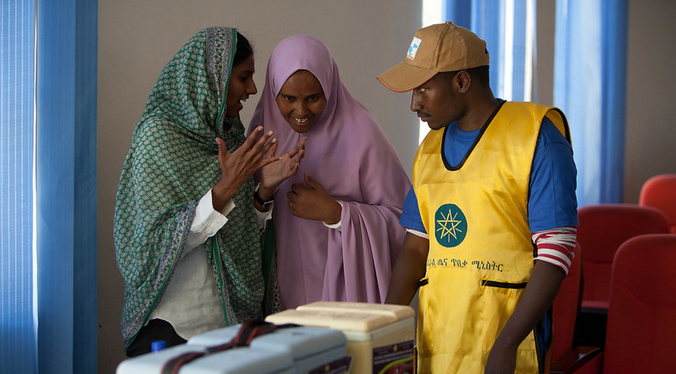
BMC Public Health (2022) 22:1271. https://doi.org/10.1186/s12889-022-13681-0. Image credit: ©UNICEF Ethiopia/2015/Getachew via Flickr (CC BY-NC-ND 2.0)
- Log in to post comments