










































Impact of COVID-19 on Routine Immunisation in South-East Asia and Western Pacific: Disruptions and Solutions
Sanofi Pasteur (Harris, Chen, Côte, Ardillon (current affiliation: Claude Bernard Lyon University), Nievera, Kandasamy, Mahenthiran, Yu, Huang, El Guerche-Séblain, Vargas-Zambrano, Chit, Nageshwaran); London School of Hygiene and Tropical Medicine (Harris); University of the Philippines-Philippine General Hospital (Ong-Lim); D'Soul Child Development Centre and Kanchi Kamakoti Childs Trust Hospital (Aiyamperumal); National University Hospital, Singapore (Chong); University of Toronto (Chit)
"...proposed solutions included targeted communication strategies to reinforce the importance of routine immunisations during the pandemic..."
The COVID-19 pandemic has necessitated lockdowns and other measures that have led to unintended health consequences, including disruption of routine immunisation services. For example, a systematic review of the impact of COVID-19 on immunisation programmes globally indicated that 40 million children in Pakistan missed their polio vaccination between April and June 2020. To help clarify the extent of the problem, this study provides an assessment of the impact of the COVID-19 pandemic on routine vaccinations in the South-East Asia and Western Pacific regions (SEAR/WPR) by country, antigen, and healthcare sector. It also identifies and ranks the reasons for disruptions in order to guide tailored efforts to address the situation and provides a list of solutions designed and implemented by countries.
Sanofi Pasteur teams from 19 countries in SEAR/WPR completed a structured questionnaire between June 24 and July 10 2020 reporting on COVID-19 disruptions for 13-19 routinely delivered antigens per country, covering the period from the start of the pandemic (February/March 2020) to June 1 2020. Vaccination coverage rates (VCRs) were classified as "reported" based on publicly available data or as "estimated" based on sales data, press releases, and/or interactions with healthcare providers (HCPs). Data were analysed descriptively, disruption causes ranked, and solutions evaluated using a modified public health best practices framework.
The results showed that COVID-19-induced disruption of routine vaccination was more widespread than previously reported, with 95% (18/19) of countries reporting vaccination disruption. When stratified by country, a median of 91% (interquartile range 77-94) of antigens were impacted. Vaccinations of infants and school-entry age children were most disrupted, and both public and private sector delivery was disrupted. Fear of infection, movement/travel restrictions, and limited healthcare access were the highest-ranked reasons for disruption. Vaccination rates had not recovered for 39% of impacted antigens by June 1 2020.
Seven countries reported within-country geographical differences in disruptions. Socio-economic and geographical disparities accounted for the differences in four countries (e.g., differences were seen in Maori populations in New Zealand, minority and low-income populations in Vietnam, and rural populations in Myanmar, Vietnam, and Cambodia). Heterogeneity in COVID-19 burden and measures, such as regional lockdowns or high transmission areas, accounted for the differences in China, India, and Thailand.
To address these shortcomings, nine major types of interventions had been initiated by four sectors (government, medical societies, HCPs, and/or industry) and reaching out to two main stakeholders (HCPs and the general public). Examples are shown in Table 3 in the paper. For instance, several countries leveraged social media and mass media to communicate to otherwise difficult-to-reach patients. They used these tools to deliver awareness campaigns on the importance of immunisation, to communicate immunisation guidelines during the pandemic, and to convey messaging on the effects of delayed vaccination via TV, radio, webinars, etc. One solution - virtual engagement (e.g., webinars, conferences, meetings, emails) to HCPs from industry - was reported to be commonly used by the participating countries.
Making suggestions going forward, the researchers observe that the demonstration that both public- and private-sector providers were impacted by routine immunisation interruptions highlights the need for private sector providers to be included in efforts to minimise disruption. ("Indeed, it had already been suggested prior to COVID-19 that cooperation between private providers and national immunisation programmes should be increased...") Also, the limited availability and quality of data on vaccine coverage rates points to the need for more robust and real-time reporting of this parameter across the different immunisation cohorts. Finally, the evidence on variations in impact by age, national income category, and within countries provides pointers for targeted action.
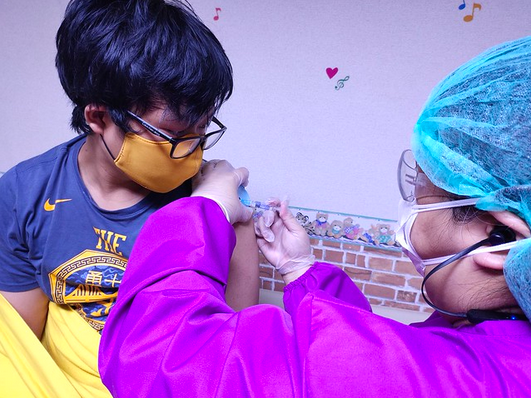
The Lancet Regional Health - Western Pacific. https://doi.org/10.1016/j.lanwpc.2021.100140. Image credit: © International Labour Organization (ILO)/Minette Rimando via Flickr (licensed under the Creative Commons Attribution-NonCommercial-NoDerivs 3.0 IGO License)
- Log in to post comments