










































Improving Polio Campaign Quality in Jordan, Somalia, and South Sudan
Nafundi
"For the World Health Organization (WHO) and ministries of health working to combat and forever put an end to the debilitating poliovirus, access to accurate and time-sensitive information makes a world of difference."
In this article, one of the founders of Open Data Kit (ODK), Yaw Anokwa, describes its use by WHO and governments in several countries across WHO's Eastern Mediterranean and Africa Regions as a key tool in mass polio vaccination campaign quality control. ODK is a free and open-source set of tools which are designed to help organisations author, field, and manage mobile data collection solutions (in particular, surveys). It is an Android-based mobile data collection tool capable of sending real-time results from the field to an online server, regardless of the availability of functional internet service. ODK provides an out-of-the-box solution for users to:
- Build a data collection form or survey (XLSForm is recommended for larger forms);
- Collect the data on a mobile device and send it to a server; and
- Aggregate the collected data on a server and extract it in useful formats.
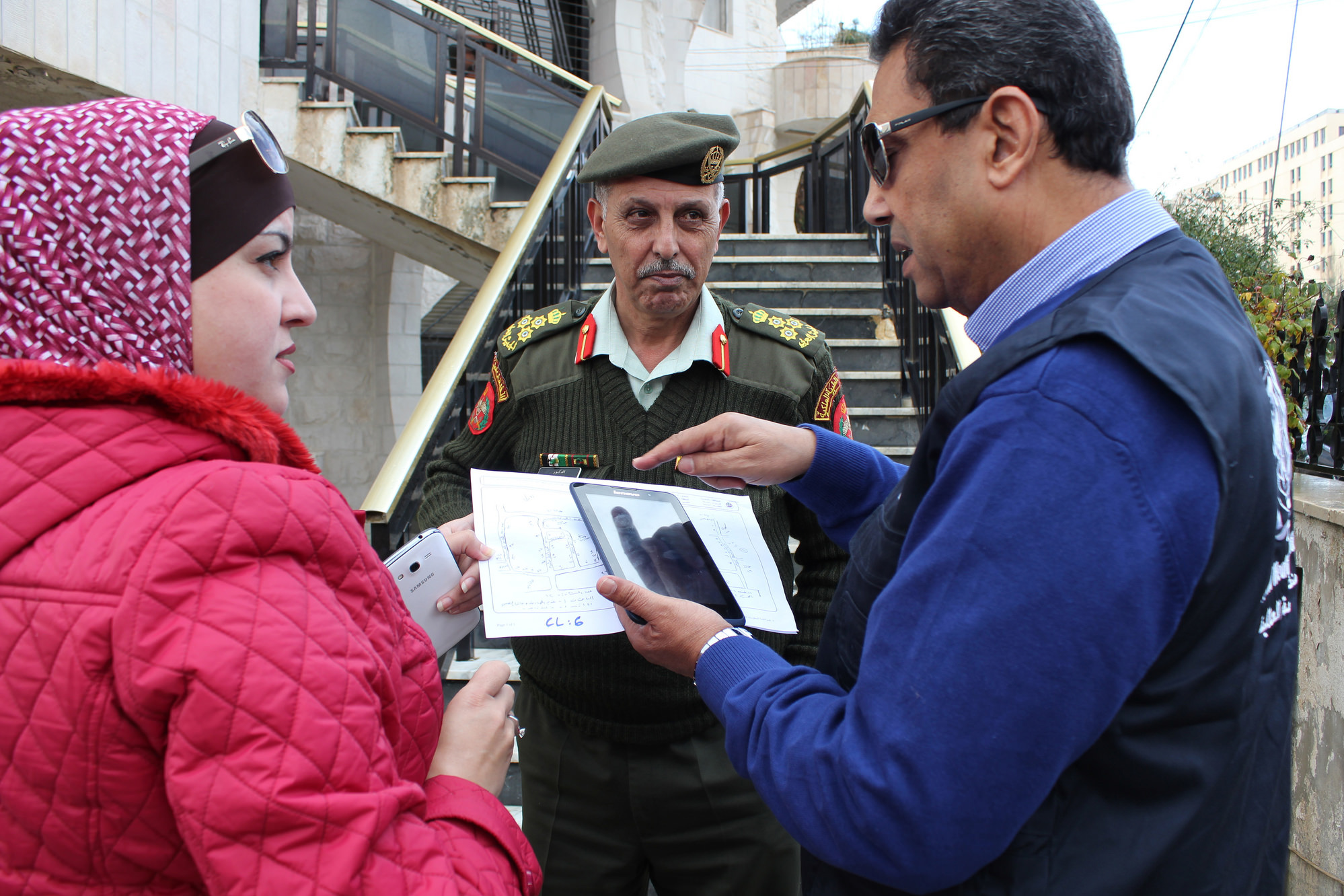
As Anokwa explains, although Jordan, Somalia, and South Sudan are now officially "polio free", they are considered to be at high risk of reinfection for reasons such as the displacement and movement of millions of people across borders. At the heart of the Middle East, Jordan hosts hundreds of thousands of refugees from Syria, a country with a shattered health system and suboptimal immunisation coverage. Since the outbreak of polio in Syria in late 2013, after 15 years of absence in the Middle East, WHO has supported the Ministry of Health (MOH) of Jordan (and other neighbouring countries) in carrying out national and subnational vaccination campaigns to repeatedly reach millions of children across the country, irrespective of nationality, with oral polio vaccine (OPV). To ensure maximum coverage during and after campaigns, independent monitors visit samples of households to gauge whether any child under five years of age was not vaccinated, and if not, why. This information, collected through a customised ODK survey, informs targeted "mop-up" campaigns to reach missed children. Reasons for non-vaccination are also recorded to inform strategic public communications. Dr. Fuad Shamsan, polio technical officer for WHO Jordan, explains: "Through campaign monitoring using mobile tablets equipped with ODK, we can easily collect geographic, demographic, and behavioral data and securely and instantly share this with relevant partners to organize swift and appropriate follow-up action. This technology has helped us determine where to focus our efforts, so that we reach as many children as possible in campaigns."
"This new system of data collection replaces a paper-based system and has had a number of benefits for the polio program [in Somalia and South Sudan]," said Mohammad Mohammedi, polio technical support officer based in WHO's Regional Centre for Emergencies and Polio Eradication in Amman, Jordan. "Given the sheer number of children that polio teams must reach, and the corresponding amounts of data to be collected, cleaned, and manually transferred into central databases, human error was considerable. ODK has helped us minimize this error through standardized method of data collection and survey responses, and has sped up information transfer making coordination of campaigns and the job of vaccinators a whole lot easier. In short, the software is saving us valuable time and helping to improve campaign effectiveness," he said.
According to Anokwa, Jordan has successfully piloted and rolled out a tablet-based, ODK-driven approach to patient data collection which allows for automatic generation of early warning alerts for cases of priority communicable diseases including acute flaccid paralysis (AFP), a major indicator for polio. As the below video illustrates, WHO Jordan has also used ODK for case-based, integrated disease surveillance of mental health, non-communicable, and communicable diseases.
[Editor's note: The ODK website includes many additional examples of deployments of ODK in countries around the world. To cite only one: the Riberalta branch of the Bolivian Red Cross and International Federation of Red Cross and Red Crescent Societies (IFRC) have used ODK to combat Zika. To complement the knowledge regarding the surveillance model for Zika, the May-June 2016 IFRC visit included a 15-hour workshop for 29 volunteers, 28 of whom were women, in Riberalta on ODK. A team of Bolivian Red Cross staff and IFRC delegates had the opportunity to collect data on 120 households in 5 neighbourhoods identified as priorities in the Bolivian Red Cross action plan for conducting KAP (Knowledge, Skill, and Practice) studies. As part of the Zika Operation in the Americas, KAP studies are a key activity for National Societies and the IFRC, as they provide data regarding the effectiveness of the response and of the information reaching the communities. In addition to socio-economic and health surveys with Global Positioning System (GPS) locations and images, ODK is being used to create decision support for clinicians and for building multimedia-rich nature mapping tools.]
"9 Data Sets to Improve Your ICTforAg Programs", ICT Works, July 11 2016; and ODK website, July 12 2016. Image credit: Emma Sykes, WHO
- Log in to post comments