










































From Intense Rejection to Advocacy: How Muslim Clerics Were Engaged in a Polio Eradication Initiative in Northern Nigeria
Federal Ministry of Health (Nasir, Mohammad); Health and Human Services, Federal Capital Territory (Aliyu); National Primary Health Care Development Agency (Ya'u, Zubair); Aminu Kano Teaching Hospital (Gadanya); University of Maryland School of Medicine (El-Kamary)
"The engagement of the traditional and religious leaders in the polio immunization campaign in northern Nigeria was vital to the success of the country's PEI and primary health care programs. The recent extension of the campaign to include polio survivors, Quranic school teachers, and entertainers, among others, is providing access to families that are hard to reach and non-compliant."
Noting that, of the several setbacks suffered by the polio eradication initiative (PEI) in northern Nigeria, vaccination rejection by Muslim clerics (imams) is perhaps the most profound, the authors of this paper explore efforts that have been made to actively engage imams in promoting uptake of polio vaccination in areas worst hit by the disease.
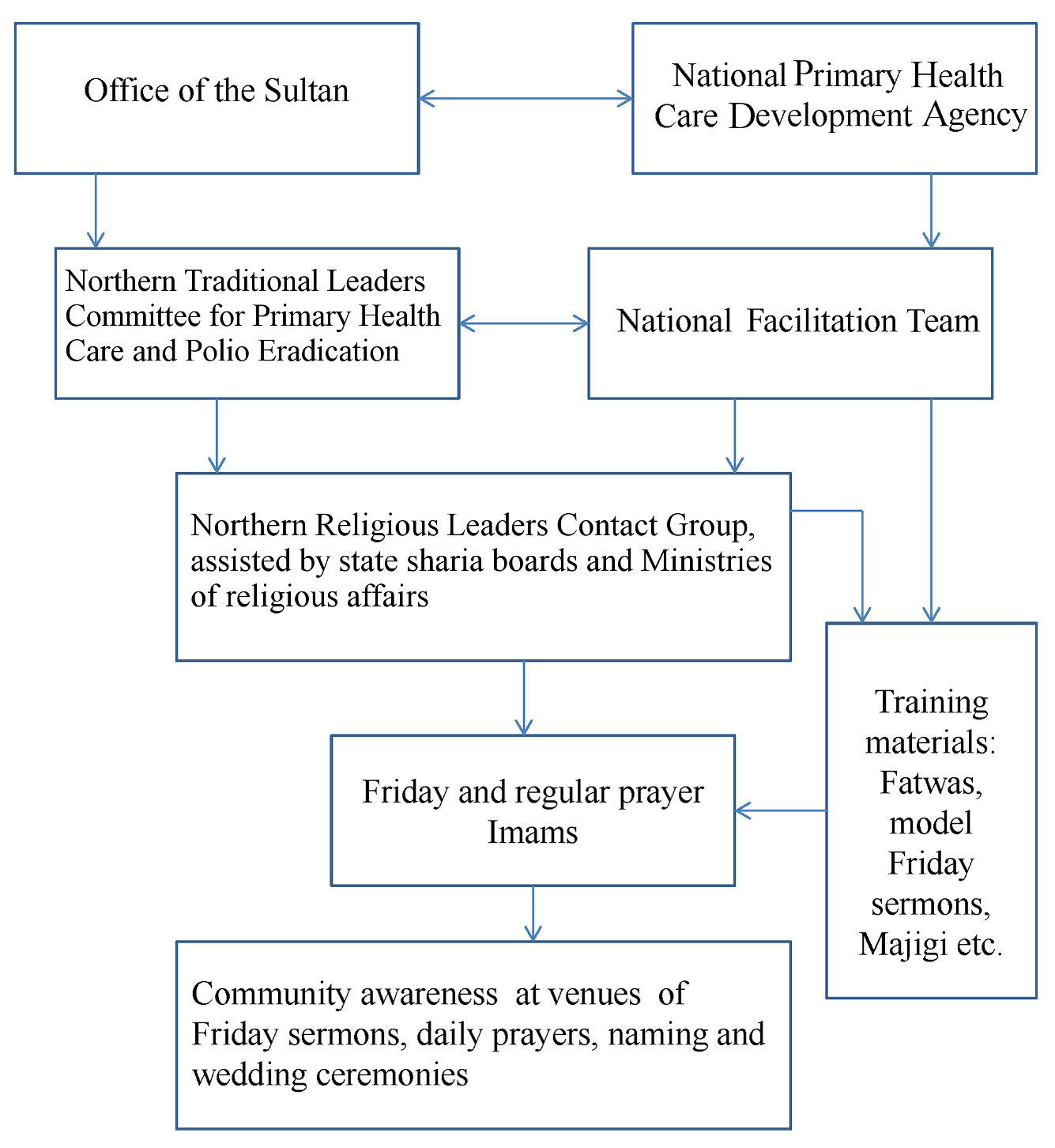
As explained here, in 2008, the National Primary Health Care Development Agency pilot-tested a polio mobilisation campaign involving a community communication and awareness enhancement methodology known as Majigi (a roadside film show) in Gezawa, Kano State, located in northwestern Nigeria. The participation of imams was solicited through traditional rulers; active participation of traditional rulers in PEI in northern Nigeria became a reality after the Sultan (the current Muslim spiritual leader in Nigeria, with a strong influence on the dominant Muslim community of the region) supported the programme. The encouraging outcomes of the Majigi campaign led to the formal launch of the Northern Traditional Leaders Committee for Primary Health Care and Polio Eradication in 2009 by the Sultan.
In 2010, the National Primary Health Care Development Agency convened a team of experts, consisting of mainly Muslim scientists, to work with the traditional leaders committee under the leadership of the Sultan to reach out to the various Muslim group leaderships. This National Facilitation Team engaged, educated, and solicited the support of imams and their community followers for the PEI. The team began with mapping out the high-risk local government areas (LGAs) within the 12 polio-prevalent states of northern Nigeria. In collaboration with the traditional leaders committee, the facilitation team established the Northern Islamic Religious Leaders Contact Group and organised training sessions for selected imams from different communities in the 85 LGAs with high polio risk. "Not all the imams contacted by the religious leaders contact group agreed to attend the training sessions. There were a few skeptics and vocal outright rejectionists, for whom the assistance of local traditional leaders was sought to approach them and invite them to attend the training program."
For those who did agree to attend, the weekly training sessions, held over a 10-week period, focused on Jumu'a imams, who give the weekly Friday sermon and lead the prayer on that day. Jointly developed by the facilitation team and the religious leaders' contact group, the materials included Islamic rulings (fatwas) on the concept of vaccination and 13 Friday sermons in Arabic and native languages on disease prevention, health, and related matters for the imams to adopt, edit, or rewrite to suit their audiences. On the topic of poliomyelitis, the facilitation team prepared Majigi sessions preceded by PowerPoint presentations and a computer simulation model of the polio virus and its routes of transmission, early signs, symptoms, and complications. Films were shown of recorded interviews and movies featuring survivors of the disease sharing their experiences and frustrations of living with deformities from the disease. There were also recorded video interviews of the survivors' care providers and advice to the community and parents on polio vaccination. At the end of the training sessions, each Jumu'a imam was requested to engage and share information with at least 5 regular prayer imams within his community. Together, the imams were expected to deliver the message repeatedly after daily prayers, as well as at public gatherings such as naming and wedding ceremonies.
In addition, local efforts - in the form of a coalition team - are being used to get children from very high-risk and resistant wards (districts) vaccinated in northern Nigeria. The campaign engages not only imams but also polio survivors, physicians, Quranic/Islamic schoolteachers, Christian clerics (for vaccine-refusing Christian communities), traditional rulers, and street entertainers (drummers). From June to July 2013, the coalition campaign team visited over 3,256 refusing households from high-risk wards in Sokoto State, leading to approximately 7,825 children vaccinated.
The authors go on to provide data and figures related to changes in the number of polio cases in Nigeria from 2009 to 2013, as well as the impact of engaging imams. Please see the paper for full details but, in short, while, "[f]ollowing the introduction of the campaign at the community level, occurrence of all types of new polio cases drastically dropped to the lowest level...[t]he decline in the occurrence of polio cases was...not consistent over the five-year period." For example, the bump in the occurrence of wild poliovirus (WPV) in 2012 may be linked to a single attack on and killings of polio vaccinators in Kano.
Looking ahead, the authors caution that: "The prevailing religious conflict in the northeastern region of the country in the polio-prevalent states of Borno and Yobe, coupled with the history of prior attack on vaccinators, could undermine the current momentum for polio eradication across northern Nigeria. Failure of vaccinators to make household visits in this region due to safety concerns may lead to explosive outbreaks similar to those seen recently in Somalia and Syria..." They suggest that, in addition to conducting door-to-door vaccination efforts, the PEI should encourage parents to take their children to local health facilities for routine immunisations (RI), including vaccination against polio. They note that reducing publicity around the PEI at the community level may reduce the risk of attacks on vaccinators; furthermore, "promoting bottom-up (rather than top-down) engagement, where the community sees polio as a social problem for which it has direct responsibility, could improve acceptance of the program". Another suggestion is to include village health committees in the coalition so that they can help drive demand, not only for polio vaccines, but also for other priority services. "Expanding activities and concerns beyond polio may help to dispel some of the suspicions around why polio has become so important, particularly in areas where strong anti-polio sentiments persist."
For further information, contact: Gambo G. Aliyu algambo@yahoo.com and/or Sani-Gwarzo Nasir drgwarzo@yahoo.com
- Log in to post comments