










































Interventions to Improve Immunization Coverage Among Children and Adolescents: A Meta-analysis
Aga Khan University Hospital (Siddiqui, Padhani, Salam, Aliani, Das, Bhutta); The University of Adelaide (Lassi); The Hospital for Sick Children - SickKids (Bhutta)
"Improving coverage requires an integrated approach that ranges from individual-level interventions to vaccine mandates at the national level."
Vaccination coverage plateaued in the decade of 2010-2020, with 20 million children globally unprotected and 10 countries accounting for 62% of unvaccinated children in 2020. The purpose of this systematic review was to evaluate the effectiveness of potential interventions to improve the uptake of vaccines among children and adolescents aged 5 to 19 years.
The researchers performed a literature search with an end date of December 2020. They included primary studies, including randomised controlled trials (RCTs) (individual and cluster), quasi-experimental studies, and controlled before and after studies (CBAs) from both high-income countries (HICs) and low- and middle-income countries (LMICs); studies comprised of hospitalised children and those with comorbid conditions were excluded. The following interventions were identified in the included studies of this review:
- Educational interventions delivered through counseling sessions, printable information materials, audio-visual aids, and the internet;
- Reminders sent through mailed letters, telephone calls, text messages, and emails;
- Interventions for providers, including physician training and reminders;
- School-based clinics to vaccinate students on school premises;
- Financial incentives;
- Policy and legislative interventions, including state-level legislation and public-private partnerships;
- Multicomponent interventions to improve coverage; and
- Multilevel interventions delivered simultaneously at different levels (e.g., to schools, providers, clinics).
The majority of the included studies (n = 81) in the review were RCTs, followed by quasi-experimental trials (n = 38) and CBAs (n = 1). Findings from the 120 studies (123 articles), of which 95 were meta-analysed, reveal that:
- Vaccination education may increase overall vaccination coverage by 19% (risk ratio [RR], 1.19; 95% confidence interval [CI], 1.12-1.26; 29 studies; 88,230 participants; low-quality evidence) compared with the control group. Subgroup analysis reveals that printed educational materials (RR, 1.20; 95% CI, 1.07-1.36; 3 studies; 1,064 participants), audio-visual interventions (RR, 1.27; 95% CI, 1.15-1.39; 4 studies; 2,542 participants), counseling (individual or group) (RR, 2.63; 95% CI, 2.19-3.16; 4 studies; 1,826 participants), and multicomponent educational interventions (RR, 1.16; 95% CI, 1.06-1.27; 14 studies; 51,955 participants) may improve overall vaccination coverage. However, websites may not have any effect on overall vaccination coverage.
- Reminders may increase overall vaccination coverage by 15% (RR, 1.15; 95% CI, 1.11-1.18; 27 studies; 450,125 participants; low-quality evidence). Subgroup analysis reveals that vaccination coverage may improve when reminders are sent through text messages (RR, 1.10; 95% CI, 1.05-1.16; 8 studies; 75,698 participants), telephone calls (RR, 1.05; 95% CI, 1.02-1.07; 6 studies; 271,253 participants), mailed letters (RR, 1.16; 95% CI, 1.07-1.26; 4 studies; 76,087 participants), both mailed and telephone reminders (RR, 1.33; 95% CI, 1.26-1.40; 4 studies; 19,347 participants), and telephone calls, e-mails, and text messages (RR, 1.73; 95% CI, 1.30-2.31; 1 study; 929 participants). Emails only and emails and text messages might not have any effect on overall vaccination coverage.
- Interventions for providers may increase overall vaccination coverage by 13% (RR, 1.13; 95% CI, 1.07-1.19; 9 studies; 50,365 participants, low-quality evidence). The subgroup analysis by intervention reveals that reminders delivered to providers through prompting/alert systems or text messages may improve coverage (RR, 1.13; 95% CI, 1.07-1.20; 6 studies; 32,997 participants), whereas educational interventions (e.g., physician training delivered through physician educators) may not have any effect on vaccination coverage.
- Financial incentives of cash and gift vouchers probably improve vaccination coverage for human papillomavirus (HPV) by 67% (RR, 1.67; 95% CI, 1.40-1.99; 2 studies; 1,188 participants; low-quality evidence) compared with the control group.
- Multilevel interventions may improve vaccination coverage by 25% (RR, 1.25; 95% CI, 1.10-1.41; 6 studies; 160,916 participants; low-quality evidence) compared with the control group. Specifically, interventions given as an educational intervention (RR, 2.01; 95% CI, 1.87-2.16; 1 study; 547 participants) and education in combination with reminder interventions (RR, 1.36; 95% CI, 1.11-1.65; 1 study; 11,326 participants) may improve vaccination coverage.
The impact of school-based clinics, and of policy and legislation, on overall vaccination coverage is still uncertain, and no impact of a multicomponent intervention on overall vaccination coverage was found.
All included studies were performed in HICs. Thus, more studies are needed that assess the effectiveness of interventions in LMICs. Also, based on the researchers' rating of most of the outcomes in the review to be low-/very-low-quality evidence, they call for more rigorous evaluations in this area.
In conclusion, educational interventions, reminders, provider-directed interventions, financial incentives, and multilevel interventions may improve vaccination coverage among school-aged children and adolescents.
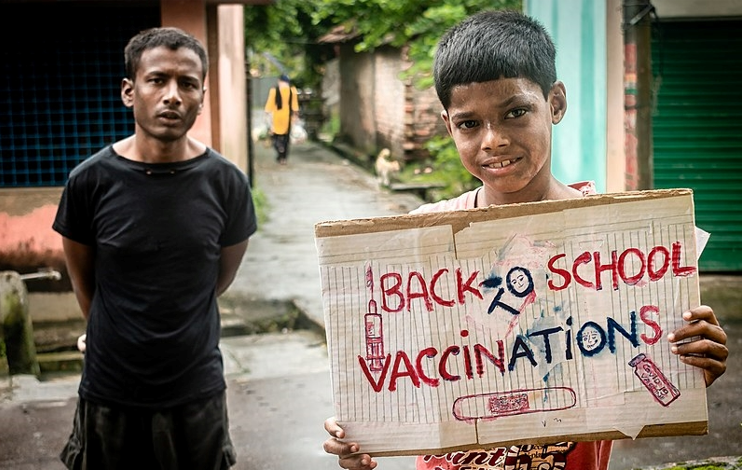
Pediatrics (2022) 149 (Supplement 6): e2021053852D. https://doi.org/10.1542/peds.2021-053852D. Image credit: Tapas Kumar Halder via Wikipedia (CC4.0)
- Log in to post comments