










































Interventions to Increase Vaccination in Vulnerable Groups: Rapid Overview of Reviews
Newcastle University (Norman); University of Manchester (Norman, Kletter, Dumville)
"Considerable evidence supports the probable effectiveness of communication in person, by phone or in writing to increase vaccination..."
Inequity in vaccination is a recognised public health issue that was amplified by the COVID-19 pandemic. Groups that are marginalised, disadvantaged, or otherwise vulnerable have lower uptake of vaccinations. This overview uses rapid but rigorous methods to systematically review evidence from over 20 systematic reviews of interventions for increasing vaccination in marginalised, disadvantaged, or otherwise vulnerable groups.
In November 2022, the researchers searched four databases for systematic reviews that included randomised controlled trials (RCTs) evaluating any intervention to increase vaccination in underserved, minority, or vulnerable groups. They used rapid review methods to screen, extract data and assess risk of bias in identified reviews. They categorised interventions as being high, medium, or low intensity, and as focusing on vaccine demand, access, or providers.
Through this process, the researchers identified 674 records following deduplication and assessed 88 full texts. They included 23 reviews, including studies in high and low or middle income countries, focused on children, adolescents and adults. Groups were vulnerable based on socioeconomic status, minority ethnicity, migrant/refugee status, age, location, or lesbian, gay, bisexual, and transgender (LGBTQ) identity. Pregnancy/maternity sometimes intersected with vulnerabilities. The researchers did not identify any reviews with RCTs focused on faith groups.
Reviews were published between 1998 and 2022; nine were published in 2021 or 2022 and 17 since 2017. Eleven reviews looked at multiple types of vaccination (of which five focused on childhood vaccinations); 6 reviews looked at influenza vaccination, 5 at human papillomavirus (HPV) vaccination, and 1 at hepatitis B vaccination. The assessment found that 9 reviews had low, 6 unclear, and 8 high overall risk of bias
The paper summarises narratively interventions for which the researchers have higher or medium confidence, grouped by intervention intensity, purpose, and type. (The intensity categorisation of high, medium, or low) is based on resource requirements for providers rather than possible patient perception regarding the intensity of receiving the intervention.) Table 3 summarises all interventions where evidence identified a benefit of the intervention; Table 4 summarises those interventions where current evidence did not identify a benefit.
In brief, evidence shows:
High-intensity interventions: increasing demand for vaccination
- Home visits for communication or education: The researchers have higher confidence that home visits for the purposes of communication by health professionals, lay health workers, volunteers, and students increase vaccination in underserved groups (11 reviews).
- Advocacy: The researchers have medium confidence that community volunteers or pharmacists advocating for vaccination may increase vaccination in some underserved groups.
- Community partnership and outreach: The researchers have medium confidence in the effectiveness of community partnership and outreach within multicomponent interventions - e.g., community involvement in motivating vaccine acceptance (4 reviews).
- School and other non-home-based, in-person educational interventions: The researchers have medium or lower confidence in this evidence (8 reviews). For example, interventions in low- and middle-income country (LMIC) contexts found positive effects from interventions for parents (pictorial information or redesigned vaccination cards alongside a verbal educational message).
High intensity interventions: increasing access to vaccination
- Home visits for vaccination: The researchers have higher confidence that vaccination during home visits (delivered by health care professionals, students, or community healthcare workers) increases vaccination compared to standard care (invitations to clinic).
- Use of different/additional locations or services or staff to deliver vaccinations: The researchers have medium confidence in effectiveness of additional clinics as part of a multicomponent intervention; they found no evidence for them as standalone interventions. They also have medium confidence in using routine/general clinic visits to vaccinate within a multilevel, multicomponent intervention.
High intensity interventions: provider-focused interventions: The researchers have higher confidence that facilitator involvement with healthcare practices increases vaccination.
Medium-intensity interventions: increasing demand for vaccination - The researchers have higher confidence that the following increase vaccination: telephone calls to remind people about booked appointments, deliver reminders about booking appointments, and provide information about vaccination processes (6 reviews).
Medium-intensity interventions: increasing access to vaccination - Some provider-focused interventions (e.g., changing provider systems to allow use of routine visits for vaccination) are likely to have increased access to vaccination.
Medium-intensity interventions: provider-focused interventions
- Case management: The researchers have medium confidence in case management within a multicomponent intervention including feedback on missed opportunities to vaccinate, tracking, triage, and flagging of vaccination status.
- Routine visits: The researchers have medium confidence in using routine visits to healthcare providers or clinics to vaccinate as part of a multicomponent intervention for childhood vaccinations and lower confidence as a standalone intervention in older adults.
Low-intensity interventions: increasing demand for vaccination - Various methods involving written material for communication and education were used. Both texts and postal communications were used as standalone interventions and as part of multicomponent or escalating intensity interventions, where it is harder to determine their impact. These multicomponent or escalating interventions showed evidence of effectiveness.
Low intensity interventions: increasing access to vaccination - Included reviews did not report on low intensity interventions aiming to increase access to vaccination.
Low intensity interventions: provider-focused interventions
- Centralised systems: The researchers have higher confidence in the effectiveness of centralised reminder/recall systems compared to practice-based reminder/recall systems in increasing the number of children up to date on vaccinations.
- Reminders: The researchers have higher confidence in reminders to physicians to vaccinate and medium confidence in the use of computerised reminders to providers to vaccinate (4 reviews).
- Personalised electronic health records: The researchers have medium confidence that their use, together with their electronic messaging features, to educate, send reminders, and schedule appointments may increase vaccination relative to control groups with only record access or with no access, including where postal reminders were used.
- Other low intensity approaches: There is low to moderate certainty evidence from the Cochrane review in influenza vaccination for older people that the following may be effective: payments to physicians; reminding physicians to vaccinate all patients; posters in clinics presenting vaccination rates and encouraging competition between doctors; chart reviews; and benchmarking to rates achieved by the top 10% of physicians.
In conclusion, the researchers "identified multiple, often overlapping reviews in a rapidly growing research field. It may therefore be useful to establish a living systematic review of trials, and to encourage trialists to collaborate actively with the reviewers."
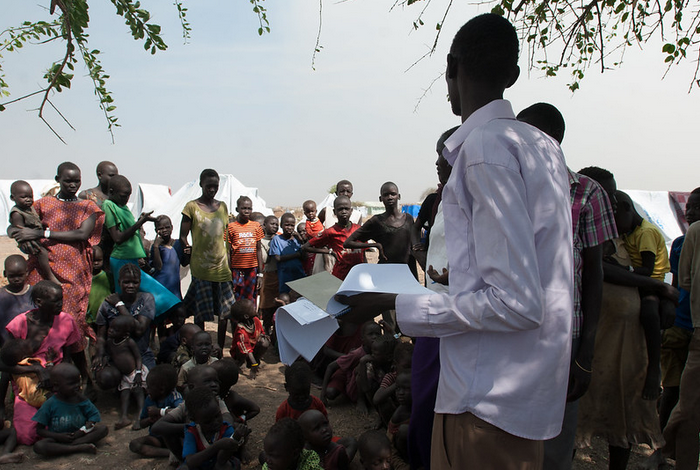
BMC Public Health (2024) 24:1479. https://doi.org/10.1186/s12889-024-18713-5. Image caption/credit: A health worker explains the importance of vaccination in Leitchour refugee camp Gambella Region Ethiopia. ©UNICEF Ethiopia/2014/Bizuwerk via Flickr (CC BY-NC-ND 2.0 Deed)
- Log in to post comments