










































Multilevel Analysis of Individual and Contextual Factors Associated with Polio Non-Vaccination in Africa: Further Analyses to Enhance Policy and Opportunity to Save More Lives
University of Warwick Medical School (O.A. Uthman); Stellenbosch University (O. Uthman, Wiysonge); South African Medical Research Council (Ndwandwe, Wiysonge); University of Ilorin (M.M.B. Uthman); University of Ottawa (Yaya); Imperial College London (Yaya); University of Cape Town (Wiysonge)
"[T]here is some evidence for a possible neighbourhood and country contextual phenomenon shaping a common children odds of non-vaccination for polio."
To maintain Africa's polio-free status, countries need to attain and maintain optimal routine polio vaccination coverage. One indicator for optimal polio vaccination coverage is the prevalence of children who have received no polio vaccination through routine services. The objective of the study was to examine the individual-, neighbourhood-, and country-level factors associated with non-vaccination against polio in Africa.
Data for this cross-sectional study were obtained from 32 Demographic and Health Surveys (DHS) conducted in 56 African countries between 2010 and 2018. The researchers applied multivariable multilevel logistic regression analyses on the data, identifying 64,867 children aged 12-23 months (Level 1) nested within 16,283 neighbourhoods (Level 2) from 32 countries (Level 3). The prevalence of non-vaccination for polio ranged from 2.19% in Egypt to 32.74% in Guinea.
In the fully adjusted model controlling for the effects of individual-, neighbourhood- and societal-level factors, male children were 9% more likely to be non-vaccinated for polio compared with female children (odds ratio [OR] = 1.09; 95% credible interval [CrI] 1.03 to 1.16). Children of women with no education (OR = 1.43, 95% CrI 1.29 to 1.59) and from economically poorest households (OR = 1.30, 95% CrI 1.19 to 1.42) were 43% and 30% more likely to be non-vaccinated for polio, respectively. Children of women not currently working (OR = 1.18, 95% CrI 1.10 to 1.28), with no health insurance (OR = 1.22, 95% CrI 1.03 to 1.44), and who do not seek healthcare (OR = 7.52, 95% CrI 6.88 to 8.21) were 18%, 22%, and 652% more likely to be non-vaccinated for polio, respectively. Children living in neighbourhoods with high maternal illiteracy rate (OR = 1.26, 95% CrI 1.17 to 1.36), high unemployment rates (OR = 1.08, 95% CrI 1.00 to 1.16), and high non-access to media (OR = 1.12, 95% CI 1.04 to 1.21) were 26%, 8%, and 12% more likely to be non-vaccinated for polio, respectively.
The study found evidence of geographical clustering in non-vaccination for polio. About 60% and 81% of the variation in non-vaccination for polio is conditioned by differences between neighbourhoods and countries, respectively. Thus, if a respondent moved to another neighbourhood or another country with a higher probability of non-vaccination for polio, his or her odds of non-vaccination for polio may increase by about 3.0- to 4.7-fold, respectively. This phenomenon of clustering behaviour has been observed by other resaerchers in Karachi, Pakistan, where low-income people from an ethnic group known as Pashtuns were less likely to participate in polio supplementary immunisation activities than low-income non-Pashtuns. Reasons commonly cited among Pashtuns for refusing vaccination included fear of sterility, lack of faith in the polio vaccine, scepticism about the vaccination programme, and fear that the vaccine might contain religiously forbidden ingredients. These findings underscore the need to implement public health prevention strategies not only at the high-risk individual level but also in high-risk neighbourhoods.
In conclusion, this study highlights "the need for strategies in routine childhood vaccination to consider contextual barriers and clustering behaviour resulting in children not receiving the life-saving intervention to protect them against polio."
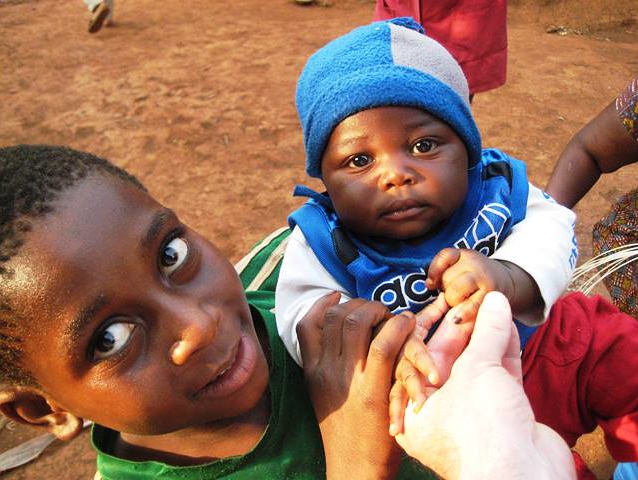
Vaccines 2021, 9, 683. https://doi.org/10.3390/vaccines9070683. Image credit: Mary Alleman/CDC (CC BY 2.0)
- Log in to post comments