










































National Routine Immunization Communication Initiative in Kyrgyzstan
"Interaction among key stakeholders...is essential to create a web of social support in favor of immunization within all systems with which primary caregivers interact." - from "Grounding Evaluation Design in the Socio-Ecological Model of Health: A Logic Framework for the Assessment of a National Routine Immunization Communication Initiative in Kyrgyzstan", by Renata Schiavo, Upal Basu Roy, Latisha Faroul, and Galina Solodunova, Global Health Promotion 2020 May 13
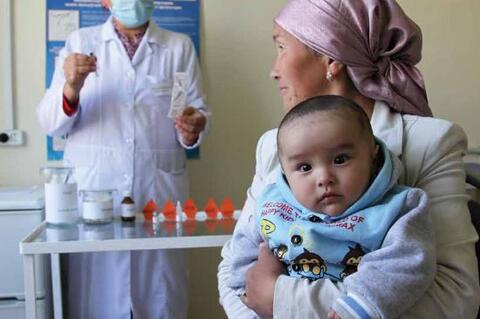
Even though Kyrgyzstan enjoys very high immunisation rates, a knowledge, attitudes, and practices (KAP) study commissioned by the United Nations Children's Fund (UNICEF) in 2017 (see Source section, below) showed that the system is witnessing a growing trend of refusals, as well as clusters of lower immunisation coverage at some of the district levels. Moreover, a 2018 Joint Appraisal report by GAVI (Global Vaccine Alliance) highlighted a decrease in immunisation rates among children under 1 year of age from 96.1% to 92% for some vaccines. In order to promote routine immunisation (RI) in Kyrgyzstan, UNICEF spearheaded a communication initiative to engage all major stakeholders and address key factors that contribute to inequities in childhood immunisation in the country.
In brief: This initiative includes fostering community engagement to give voice to local champions and engage hesitant parents and vaccine refuters, improving the quality and accuracy of media coverage via a tailored outreach to the Kyrgyz media, and strengthening the interpersonal communication (IPC) skills of local healthcare workers.
The research-driven initiative is based on the observation that parents and caregivers are often influenced by other stakeholders, like family members, clinicians, community outreach workers, policymakers, media outlets, and religious/community leaders, in their decision to accept or refuse a vaccine for their children. As for all health and social behaviours, immunisation behaviour (or lack thereof) reflects complex interactions between multiple levels of society (individual, interpersonal, community, organisational, and policymaking) and related groups and stakeholders. Thus, communicating about the efficacy and safety of immunisation is thought to require a comprehensive community- and system-driven approach that addresses misconceptions, manages hoaxes, and ultimately engages professionals and leaders across sectors, as well as the community at large (Schiavo, Roy, Faroul, and Solodunova, 2020). This approach is reinforced by a finding in the KAP study referenced above and cited below, which found that parents received their information about immunisation via medical providers, who, in turn, received information from higher-level professional organisations, indicating the complexity of interactions that influence immunisation behaviour in Kyrgyzstan.
Also shaping this initiative is a perspective that takes into account the social, economic, and environmental determinants of health, promotes health and social equity, and considers the connection between different issues, stakeholders, and behavioural and social results. Consistent with this line of thinking, the socioecological model (SEM) is at the core of UNICEF's communication for development (C4D) approach and planning framework for social and behaviour change communication (SBCC). To that end, the UNICEF RI initiative incorporates several stakeholder groups: community members (parents, grandmothers, and other primary caregivers of young children) and religious and community leaders; the Kyrgyz media; healthcare providers; and policymakers. (Schiavo, Roy, Faroul, and Solodunova, 2020)
Activities include:
- A community engagement component that aims to give voice to local champions, including community and religious leaders, and parents (vaccine accepters) who understand the importance of, and advocate for, RI, as well as to provide a platform for information dissemination among vaccine refuters;
- A media component that includes, among other activities, a workshop for key journalists and systematic media outreach to improve the quality and accuracy of RI media coverage and to promote changes in beliefs, attitudes, and behaviours among journalists on this topic;
- An IPC training module for healthcare providers and community influencers/community health workers to better equip them to educate parents and caretakers on immunisation-related issues and to promote RI amongst hesitant caregivers. (From the KAP: Most of the "influentials" when it comes to vaccine decision-making (78% of fathers and 90% of grandparents) believe that discussions with healthcare professionals would be effective for awareness-raising work with parents about the need for timely vaccination, and most of these influentials (53% of fathers and 70% of grandparents) believe awareness-raising IPC meetings can influence parents who refuse to have their children vaccinated.); and
- Comprehensive outreach to policymakers to gain their support and engagement in the initiative.
Also, there is a reminder system in place whereby healthcare professionals notify mothers or caregivers that a routine vaccination is due/scheduled. Most often, telephone is used: 58% learn about routine vaccinations by phone/SMS (text messaging). The KAP study showed that in general the notification system works: The overwhelming majority of mothers receive reminders, and 89% always receive them. However, in Bishkek and Chuy oblasts, only 12% of mothers receive reminders during the routine rounds of a medical worker. These data suggest that, for reasons of equity, healthcare providers need to play a more active role in these regions to support vaccinations.
Immunisation and Vaccines.
Context:
The Ministry of Health (MoH) of the Kyrgyz Republic (KR) is the central authority responsible for managing public health care, including health promotion, in the country. The Republican Centre for Immunization (RCI) is responsible for planning and following up on RI services, building systems for immunisation at the national and local levels, and monitoring and tracking vaccine supply and cold chain. Vaccines against 11 infections using 9 types of vaccines are provided free of charge to all citizens.
A qualitative study (see Source section, below) confirmed the findings of the KAP survey that the main reason for refusing vaccinations is the fear of side effects. The study found that negative attitudes towards vaccination in Kyrgyzstan stem from a number of factors:
- An active information campaign has been deployed against vaccination but has not yet been countered.
- Healthcare professionals do not have sufficient persuasion skills, and they are not perceived by mothers as completely trustworthy sources of information about vaccination.
- The level of awareness of vaccination among people making decisions about the vaccination of children is low.
- There is not enough critical thinking about information on vaccination, including among representatives of religious communities. The majority of study respondents said their refusal to vaccinate had no connection with their religious beliefs, but it is believed there is an intention not to mention religion as a reason and to keep it hidden instead.
Thus, the evaluation concluded that the main and necessary condition to change the negative attitude of parents towards vaccination is to ensure they have full information about all its aspects.
Programme Evaluation and Evaluation Framework:
UNICEF has also partnered with a research team for the design phase of an evaluation framework to assess the impact of the RI communication initiative described above. Grounded in the SEM, the framework recognises the interconnection of behavioural, social, and policy change, and it includes not only activity-specific indicators (process indicators) but also progress, outcome, and impact indicators to document results among key groups and stakeholders at different levels of the SEM, and, ultimately, on immunisation rates in Kyrgyzstan. The framework reflects the importance of an integrated and multilevel approach to intervention and communication design, and it integrates the SEM with a logic model that connects different components of the initiative.
Specifically, using this framework, process indicators are being measured in 2019-2020 by using qualitative methods to assess the efficiency of communication activities and understand if expected changes are starting to occur. Progress indicators will be measured in 2021 or 2022 by qualitative and quantitative methods, including in-depth interviews, panel studies, each of which will comprise representatives of a specific key group, focus groups, media monitoring and analysis, and pre-post event qualitative and quantitative assessments. Outcome indicators will be measured through the Multiple Indicator Country Survey (MICS), which is grounded in a UNICEF international household survey initiative for data collection and reporting.
The 2020 paper by Schiavo, Roy, Faroul, and Solodunova (cited in full below), introduces this evaluation framework, including implications for the evaluation of child health programmes and other public health, communication, and international development interventions.
"Grounding Evaluation Design in the Socio-Ecological Model of Health: A Logic Framework for the Assessment of a National Routine Immunization Communication Initiative in Kyrgyzstan", by Renata Schiavo, Upal Basu Roy, Latisha Faroul, and Galina Solodunova. Global Health Promotion 2020 May 13 doi: 10.1177/1757975920914550 [available by subcription or purchase only]; "Knowledge, Attitudes, & Practices towards Immunization in Kyrgyzstan" [PDF], by A. Namazova and L. Minbaeva, 2018, and "Informative Study to Examine Reasons behind Vaccine Refusals, Resistances, and Barriers" [PDF], by A. Namazova and L. Minbaeva, 2018 - both accessed on July 8 2020; and emails from Renata Schiavo to The Communication Initiative on July 7 2020 and July 8 2020. Image credit: UNICEF Kyrgyzstan
- Log in to post comments