










































The Online Competition between Pro- and Anti-Vaccination Views
George Washington University (Johnson, Velásquez, Restrepo, Leahy, Gabriel, El Oud, Lupu); Michigan State University (Zheng); Los Alamos National Laboratory (Manrique); University of Miami (Wuchty)
"Distrust in scientific expertise...is dangerous. There is a lack of understanding about how this distrust evolves at the system level..."
There is concern that opposition to vaccination with a future vaccine against SARS-CoV-2, the causal agent of COVID-19, could amplify outbreaks, as happened for measles in 2019. Online narratives - including the health dis- and misinformation that can foment vaccine hesitancy or refusal - tend to be strengthened and amplified in in-built community spaces that are a specific feature of social media platforms such as Facebook. This study provides a system-level analysis of the multi-sided ecology of nearly 100 million individuals expressing views regarding vaccination, which are among the approximately 3 billion users of Facebook.
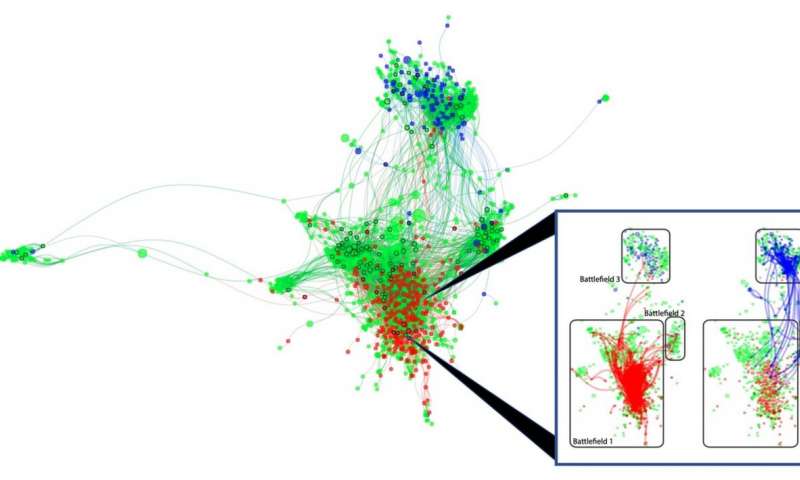
On October 15 2019, during the measles outbreak, the research team took a snapshot of the Facebook communities that were active around the vaccine topic and that formed a highly dynamic, interconnected network across cities, countries, continents and languages. The team identified 3 camps: pro-vaccination communities (coloured blue in the above figure), anti-vaccination communities (red), and communities of undecided individuals (green). Starting with one community, the researchers looked to find a second one that was strongly entangled with the original, and so on, to better understand how they interacted with each other.
They outline 7 features of this cluster network (see Figure 1 in the paper) and its evolution (see Figure 2) that explain "why negative views have become so robust and resilient, despite a considerable number of news stories that supported vaccination and were against anti-vaccination views during the measles outbreak of 2019 and recent efforts against anti-vaccination views from pro-vaccination clusters and Facebook."
- Although anti-vaccination clusters are smaller numerically and have ideologically fringe opinions, anti-vaccination clusters have become central in terms of the positioning within the network. In other words, these well-distributed, organised communities of distrust have embedded themselves with everyday Facebook communities that are totally unrelated to vaccination, such as pet lovers groups or parents' associations. This happens because of the way social media works: If communities are linked, then people in the pet lovers group, for example, can be exposed to false information and rumours coming from these other communities. As figures within the paper illustrate, anti-vaccination clusters are heavily entangled with a very large presence of undecided clusters (more than 50 million undecided individuals). This means that the pro-vaccination clusters in the smaller network patches may remain ignorant of the main conflict.
- In contrast to the common understanding of people who are undecided about vaccines as a passive background population who could be easily persuaded by the anti- or pro-vaccination populations, they are active, with the highest growth of new out-links.
- The anti-vaccination population provides a larger number of sites for engagement than the pro-vaccination population. This enables anti-vaccination clusters to entangle themselves in the network in a way that pro-vaccination clusters cannot.
- Anti-vaccination clusters offer a wide range of potentially emotionally engaging narratives that blend topics such as safety concerns, conspiracy theories, and alternative health and medicine (and also now the cause and cure of the COVID-19 virus). By contrast, pro-vaccination views are far more monothematic, typically focused on the established public health benefits of vaccinations.
- Anti-vaccination clusters showed the highest growth during the measles outbreak of 2019, whereas pro-vaccination clusters showed the lowest growth. This is consistent with the anti-vaccination population being able to attract more undecided individuals by offering many different types of cluster, each with its own type of negative narrative regarding vaccines.
- Medium-sized anti-vaccination clusters grow most. Whereas larger anti-vaccination clusters take up the attention of the pro-vaccination population, these smaller clusters can expand without being noticed.
- Geography is a favourable factor for the anti-vaccination population. Any 2 local clusters are typically interconnected through an ether of global clusters and so feel part of both a local and global campaign.
Reflecting on the findings, the researchers propose strategies to fight online disinformation, including influencing the heterogeneity of individual communities to delay onset and decrease their growth and manipulating the links between communities in order to prevent the spread of negative views.
Commenting on the study, Heidi Larson, who directs the Vaccine Confidence Project, said that one takeaway message is that "the pro-vaccine community are basically sticking to their narrative and talking to each other, and not reaching out and being responsive to the narratives that are out there among the undecided."
In conclusion, the map created by this research team reveals how distrust in establishment health guidance could spread and dominate online conversations over the next decade, potentially jeopardising public health efforts to protect populations from COVID-19 and future pandemics through vaccinations. On the positive front, public health agencies, social media platforms, and governments could use the map to identify "where the largest theaters of online activity are and engage and neutralize those communities peddling in misinformation so harmful to the public," said the lead author.
Nature (2020) https://doi.org/10.1038/s41586-020-2281-1 - sourced from "A New Study Explores The Spread Of Misinformation About Coronavirus On Facebook", NPR, May 13 2020. Also consulted: "New map reveals distrust in health expertise is winning hearts and minds online", ScienceDaily, May 13 2020, and "Anti-vaccine movement could undermine efforts to end coronavirus pandemic, researchers warn", by Philip Ball, Nature, May 13 2020 - both accessed on May 14 2020.
- Log in to post comments