










































Oversight Role of the Independent Monitoring Board of the Global Polio Eradication Initiative
"Establishing and maintaining absolute independence has been key to the IMB's work, allowing it to raise issues that other cannot (or will not) in a straightforward way."
Founded in 1988, the Global Polio Eradication Initiative (GPEI) established its Independent Monitoring Board (IMB) in 2010 to monitor and guide its progress toward stopping polio transmission globally. This article, by members of the IMB at the time of writing, describes (though does not evaluate) the work of the group to date.
As detailed here, the IMB consists of 9 members, each of whom is a public health or communications expert. They meet with senior GPEI officials every 3-6 months. Polio-affected countries and partner agencies provide written reports in advance of each meeting and make formal presentations at the meeting. The IMB also hears from a range of other experts and partners. Board and secretariat members visit polio-affected countries to observe programme activities. Within 3 weeks after each meeting, the IMB synthesises its findings into a written report, which is sent to the heads of the GPEI core partner agencies and is then made public, without alteration. Its reports provide analysis and recommendations about individual polio-affected countries. The IMB also examines issues affecting the global programme as a whole. From its first report, the IMB was clear that the programme was at significant risk of not stopping polio transmission globally by the end of 2012, as was its aim. The IMB has therefore placed considerable emphasis on communicating the need for change to the programme and its partners by providing clear descriptions of the problems and recommending solutions. For example, a May 2013 IMB report recommended "[t]hat the program construct and implement a plan to correct its crippling underemphasis on social mobilization and communications."
The IMB has been broad in its approach, both in the variety of inputs that it seeks and in looking beyond a purely epidemiological view of the GPEI's work to examine every aspect of its management. The IMB's areas of focus have included: escalating the level of priority afforded to polio eradication (particularly by recommending a World Health Assembly (WHA) resolution to declare polio eradication a programmatic emergency, which was enacted in May 2012), placing greater emphasis on "people factors" (e.g., programme staff with strong interpersonal skills) in the delivery of the programme, encouraging innovation (e.g., the potential for inactivated polio vaccine (IPV) alongside oral polio vaccine (OPV) to play a greater role in stopping polio transmission), strengthening focus on the small number of so-called sanctuaries where polio persists, urging continuous quality improvement to reach every missed child with vaccination, and promoting collaboration with the Expanded Programme on Immunization as a whole. Because the programme's operating environment is dynamic, the IMB has adapted its approach over time. For example, in 2013, the IMB particularly highlighted the importance of engaging communities to counter anti–polio vaccine sentiment and propaganda and of finding ways to address the targeted violence and bans on its operation that the programme began facing, particularly in Pakistan.
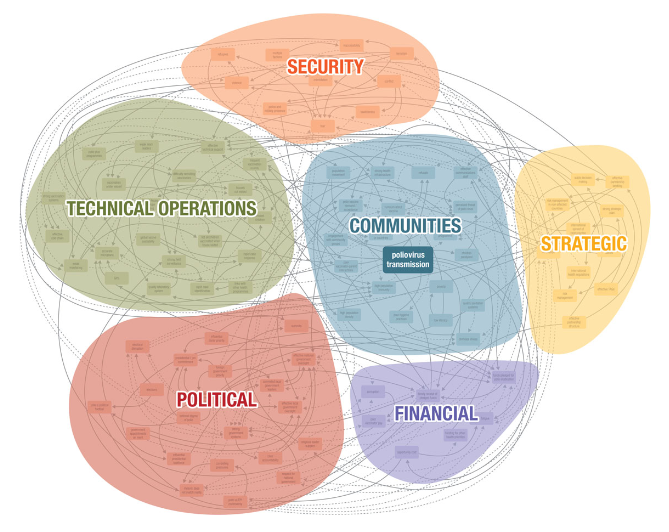
As noted here, the IMB's reports have attempted to distill such issues and challenge accepted thinking. They "are not conventional committee reports. They try to use creative devices to help communicate messages as memorably as possible....To stimulate the imagination, some reports have presented the poliovirus as being akin to a sentient being that is fighting back to ensure its survival (Figure 4). To avoid simple repetition, the reports summarize previous key messages in different ways. In June 2012, the IMB summarized the analysis from its previous reports of the changes needed within the GPEI by presenting 10 transformations required of the program (Figure 5) and assessing its progress toward achieving each....Progress was reassessed against the same yardstick in May 2013..."
According to the authors, "[t]he IMB's true independence from the agencies and countries delivering the program has enabled it to raise difficult issues that others cannot." It has challenged and required GPEI partners and countries to account for themselves on a regular basis. "Other global health programs might benefit from establishing similar independent monitoring mechanisms."
The Journal of Infectious Diseases® 2014;210(S1):S16-22. DOI: https://doi.org/10.1093/infdis/jiu181
- Log in to post comments