










































Partition and Poliomyelitis: An Investigation of the Polio Disparity Affecting Muslims during India's Eradication Program
Brown University
"The information, education, and communication activities undertaken by the Social Mobilization Network (SMNet) allowed Muslims and other disadvantaged communities to have a stake in the [polio] eradication program, build bridges, and provide other medical supplies to show the community that their overall health needs were considered..."
This research project was conducted to understand the sociopolitical and historical dimensions of the polio disparity between Muslims and Hindus in India. It was motivated by the fact that, in 2006, Muslims, who comprise 16% of the population in polio-affected states, comprised 70% of paralytic polio cases. It builds on previous work highlighting deprivation among Indian Muslims, using the theory of structural violence to systematically analyse the pathways through which Muslims' marginalisation "increased their susceptibility to polio in addition to factors of vaccine non-acceptance."
From May-August 2009, researchers conducted a qualitative study in Aligarh, Uttar Pradesh, India utilising methods of rapid ethnography (used "to understand local perceptions, attitudes, values, and experiences with illness and violence that might not be captured by more quantitative approaches"). Field methods included participant observation of vaccination teams, historical document research, and 107 interviews with Global Polio Eradication Initiative (GPEI) stakeholders and families who interacted with the polio programme.
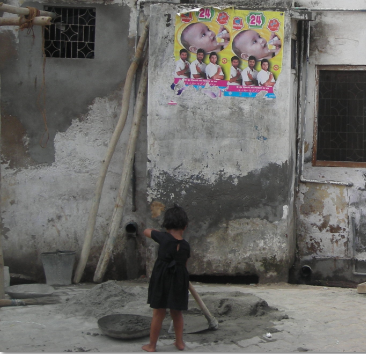
"Almost all respondents agreed that Aligarh was a highly segregated city, mostly due to riots after Partition and during the 1990s. Since the formation of segregated neighborhoods, most respondents described that 'Muslim areas' had been underdeveloped compared to 'Hindu areas,' facilitating the physical transmission of poliovirus. Distrust of the government and resistance to vaccination were linked to this disparate development and fears of sterilization influenced by the 'Family Planning Program' from 1976-1977." One finding: "Respondents felt that the neglect of Muslim slums facilitated further distrust of the government and corresponding resistance to vaccination. One male clinician in Jeevangarh explained: 'If the government had not done any "good" for them before this point, then how could the people be expected to trust the government now?"
Another selected finding: "Though the primary causes for social 'resistance' to vaccination were regarding development and illness, some continued to be based on distrust of the local government. Though much of the media attention on the polio outbreak focused on a conspiracy theory that Western governments were sterilizing Muslims, from all 107 interviews conducted and polio rounds observed, only three respondents identified or even mentioned a Western plot. Only one of these believed in the plot. At the time of this study, people who feared the vaccine might sterilize their children in Aligarh were more likely to blame the government, polio workers, or flaws with the vaccine rather than an American or Western plot against Muslims."
In conclusion, "[h]eightened awareness and sensitivities regarding communal identity in post-Partition India facilitated disharmony, conflict, and promoted the formation of segregated slums. The polio disparity is best understood in this historical context as it led to the development of structural violence. The manifestations of structural violence elucidated from this study include fears based on historical realities, distrust of government and GPEI workers, and perceived discrimination and deprivation in Muslim slums."
Looking forward, it is suggested that future health promotion efforts among this group address and rectify broader social and economic inequalities among Muslims. The United Nations Children's Fund (UNICEF)'s "Underserved Strategy" and SMNet activities (cited in the quotation above) are noted as key to the accomplishment of India being declared polio-free in March 2014. However, "[m]ore research needs to be done in this area in order to ensure that particular attention is paid to the most vulnerable, both in future global efforts to eradicate polio as well as efforts to improve health and reduce disparities in India."
Child Survival.net update sent to Soul Beat Africa on March 26 2015. Image credit: Rashid S. Hussain
- Log in to post comments