










































Polio Communications Quarterly Update: Trust
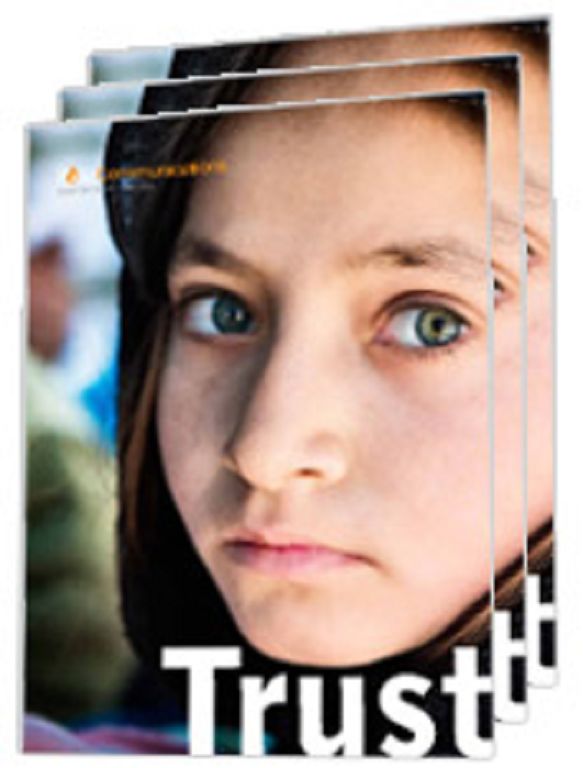
"Refusal of the oral polio vaccine and resistance to the programme is often less about polio than about the rejection of something that is perceived to be foreign and therefore untrustworthy. Building trust will be essential to opening the last of the doors that have so far remained closed to vaccination efforts."
This resource was published at the time that the Global Polio Eradication Initiative (GPEI) was getting closer to the goal of eradication - yet vaccinating every child in the "last 0.1%" of communities and households has become an increasingly difficult task. Security threats and political and cultural challenges limit vaccinators' access and make it difficult to engage with those who stand between the vaccine and the remaining children that must be reached. Published by the United Nations Children's Fund (UNICEF), this quarterly explores the communication role of building trust and opening doors in the final stretch toward eradication.
The opening and overview sections of the report provide context for the communication challenges ahead. For example, in the remaining endemic countries (Afghanistan, Nigeria, and Pakistan) - places rife with ongoing political and military struggles - the polio eradication programme "can too easily become a lightning rod, attracting the suspicion and strife that are pervasive in the surrounding environment." While local factors may contribute to refusals, the primary reasons that caregivers give for refusing OPV are similar across countries. They do not see the need for multiple vaccinations and prefer to receive other services; they do not see polio as a threat to their own children, and therefore it is not a concern for them; they do not believe the vaccine is safe; and/or they do not believe the vaccine is halal (permissible under Islam). "Within stable contexts, these concerns are often rooted in local political, social and cultural dynamics. In fact, it is often within these realms that solutions can be found to transform initial community resistance into support and involvement in vaccination efforts."
Increasing acceptance of the oral polio vaccine (OPV) in these areas is described here as being a more challenging task. With regard to building trust, 3 dimensions of trust can be distinguished: trust in the programme as a whole, trust in the frontline workers, and trust in the OPV vaccine itself. Within each of these dimensions, the report stresses that it is critical to address these 4 key principles:
- Honesty - The programme's objectives and the methods it uses to achieve them must be transparent and understood by everyone.
- Competence - People must perceive the programme, its workers, and the vaccine as technically competent.
- Morality - Vaccination must be carried out in ways that are seen as moral and in alignment with local standards; the vaccine itself must be seen as halal; and the people who serve as the face of the programme must behave in accordance with local norms of morality.
- Genuine concern for children - The people who promote and offer the vaccine must demonstrate an authentic concern for the well-being of children, both within the programme and in other contexts.
Across all areas, UNICEF-supported social mobilisation networks are utilising trust-building strategies by continuing to forge alliances with religious and community leaders as well as with other socially respected members of society. In Nigeria and Pakistan, social mapping is undertaken at the community level to identify those who are able to influence social norms and tip public sentiment in support of OPV. Vaccinators are increasingly being chosen by the local community - a process that "is more important than ever to ensure vaccinator acceptance at the household level. In some areas, social mobilizers are helping to identify potential vaccinators; this practice should be scaled up in all high-risk areas. Service delivery methods for OPV should also be reconsidered in accordance with what might be safest and most acceptable to communities that face life-threatening risks on a daily basis."
The vaccination effort in Katanga, Democratic Republic of the Congo - described here as "one of the most resistant Christian communities in the country" - provides an example of how vaccination "can be successfully brokered through a long process of dialogue and trust-building. The vaccine delivery protocol developed through consultation with an influential religious leader was unconventional, to say the least. It involved vaccinating by night, using only local volunteers, with no official monitoring. Still, the net result was that children were vaccinated for the first time in a previously impenetrable community. The creative approach to overcoming obstacles and building trust may offer lessons that are applicable in other settings with similar religious dynamics (see page 16)."
One section of the report, "Opening Doors, Saving Lives", describes how India's polio legacy now brings routine immunisation (RI) to children who were once unreached. In Uttar Pradesh and Bihar, an estimated 8% of infants who had never attended a RI session were immunised in 2012 as a direct result of targeted interventions in polio social mobilisation network high-risk areas. Strategies have included communication-centred activities such as these: conducting evening meetings during RI weeks for frontline workers and UNICEF staff; using mass media/"edutainment", such as through video shows called Ammaji Kehti Hai ("Because Mother Says") that focus on how immunisation protects children from life-threatening diseases; engaging the Islamic community (more than 4,500 mosques answered the call to promote RI during immunisation weeks); microplanning, in the form of school rallies, meetings with mothers, mobilisation of key influencers to speak with families and the tracking of resistant or reluctant families; and extending partnerships (e.g., the construction companies and brick kiln associations that were so critical to halting polio in India still serve as a network of informers on standby. They can be called upon to generate quick-time information about new settlements and newly arriving groups. Once a high-risk site is identified, it is assigned to a mobile team and monitored to ensure that RI services reach children there.)
Metrics to assess community trust more rigorously are being developed in partnership with UNICEF and the Harvard School of Public Health. At least one polio-endemic country is expected to have data for these variables by the third quarter of 2013.
Annex 1 includes GPEI global communication indicators and targets.
Editor's note: Click here to access a related PowerPoint presentation, "From Rhetoric to Action: Strengthening Communications to End Polio", delivered by UNICEF to the Global Polio Management Team (GPMT) on June 14 2013. One of the 23 slides notes that the "proportion of caregivers who refuse are only the tip of the iceberg as an indication of high-risk community sentiment and discourse about OPV and the polio programme." In that context, the presentation describes the 4 dimensions of strengthening trust summarised above. One lesson to emerge: "The polio programme needs to reposition itself as a shield to protect children, rather than a programme targeting communities." Communication is described here as pivotal to that process, but rhetoric (about communication being key to the polio programme) needs to become reality.
PolioInfo website, June 21 2013. Cover photo: A girl on the Turkham border between Afghanistan and Pakistan awaits her turn for polio vaccination.
- Log in to post comments