










































Polio Eradication: One Final Cash Injection?
University of Sussex
"Where attitudes are recognised, they are often deeply misunderstood and relegated to a lower order issue as compared to the need for securing cash injections or the need to perfect operational logistics."
In this opinion piece, Ohid Yaqub asserts that what is key to polio eradication is addressing attitudes to vaccination. He wrote it on the occasion of World Polio Day (2013), a day on which many advocates stress the need for funding to reach "the endgame (only 3 countries to go: Afghanistan, Nigeria and Pakistan)...to push us across the last mile."
To build his argument, Yaqub notes that this sense of drive is not surprising, considering the success against smallpox just over 30 years ago. Yet, he explains that polio is different from smallpox. He says: "In their zeal for eradication, some may be tempted to think that the rewards of eradication will be so self-evident that that it doesn't matter whether people wanted to be vaccinated or not, so long as we manage to inoculate them somehow. But there's a difference between the cultivation of an active demand for vaccines, and the coercion of passive recipients who merely accept vaccination (opting not to try and swim against the currents of power). Landless peasants and young mothers are likely to conform if the elite set the rules, and we can choose to exploit such social inequalities (for example, by targeting religious clerics and village elders) in order to ensure compliance. A lesser known feature of the WHO's [World Health Organization's] smallpox eradication programme is that intimidation and force was not uncommon, even at the last mile."
Yaqub explores vaccine hesitancy (which is not just limited to anti-vaccination groups, he says), observing that focusing only on vaccine uptake rates will not get to the crux of the matter: addressing underlying attitudes, which, he believes, are key to maintaining vaccination coverage in the future (crucial for polio vaccination - 3 or 4 doses are needed). There are issues of distrust. For example, in Nigeria, "many wonder why polio is being privileged with disproportionate resources when so many other cheaply treatable/preventable ailments are going unaddressed. In India, there is concern that there is no recourse for someone who suspects vaccine-related adverse reactions; those convinced that they have been adversely affected are not met with assessment, dialogue and reassurance..."
In short: "Immunisation rates and coverage simply do not say much about whether vaccination is meeting demand within a community, or whether vaccines are being pushed onto the socially weak. They merely tell us who is non-compliant, and where. They only give rise to a research agenda focused on identifying the behavioural characteristics of individuals who are likely to reject vaccination and where. From this perspective, the only policy responses are to fight misinformation and anti-vaccinationists. This is a rather blinkered view; it restricts us from examining community characteristics and considering alternative ways of engagement."
Yaqub concludes by asking some questions, such as: Do we make an aggressive polio vaccination push and accomplish coverage figures in order to eradicate, even amongst populations who may not yet actually demand vaccination and trust vaccination institutions? His opinion is that the answer depends on how much we value the need to sustain the demand for vaccine innovation, vaccination against other diseases, and healthcare delivery more generally. Indicating that there will always be the need to tackle other health problems through trusting relationships, he ends by writing: "For me", the question is not 'can we eradicate polio?', but 'can we do it sustainably?' We should not shy away from trying to answer it honestly with a new research agenda."
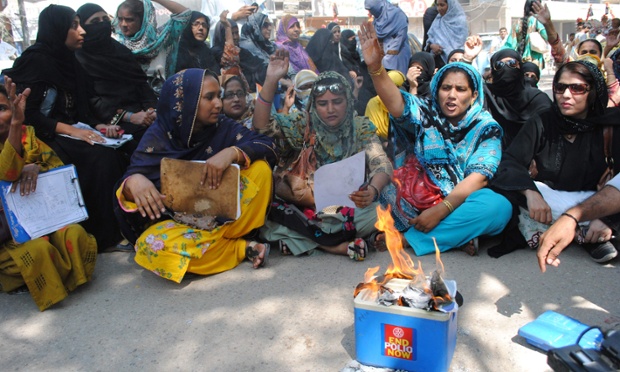
Email from Ohid Yaqub to The Communication Initiative on April 10 2015. Image caption/credit: "Health workers set fire to a polio vaccine box at protest of unpaid salaries. Outside Hyderabad Press Club, Pakistan. Photograph: rajput yasir/Demotix/Corbis"
- Log in to post comments