










































Polio Outbreak Ukraine Report 2015-2016
"This report...describes strong technical expertise, a creative and data-driven communications campaign, and vibrant teamwork in the face of uncommon political and logistical obstacles." - Giovanna Barberis, UNICEF Representative in Ukraine
From the United Nations Children's Fund (UNICEF) Ukraine Country Office, this report provides documentation and analysis of the communication response to the summer 2015 outbreak of circulating vaccine-derived poliovirus (cVDPV) in Western Ukraine. In responding to the factors underlying the low polio vaccine coverage that preceded the outbreak, Global Polio Eradication Initiative (GPEI) partners developed solutions to build capacity among health workers and educators, to strengthen surveillance, and to communicate essential information on the outbreak and vaccines to a variety of audiences. This publication summarises the factors underlying Ukraine's unique situation, the implementation of Standard Operating Procedures (SOPs) in response to the outbreak, successes achieved in increasing knowledge and vaccine coverage, and lessons learned. It is hoped that these lessons will be relevant and of use to donors, polio partners including those in the Ukrainian government, media in Ukraine and elsewhere, public health experts and practitioners, and the general public.
Beginning with a measles outbreak in 2008 in which the death of a teenager was wrongly linked to receiving a vaccine, routine immunisation coverage rates, including polio, plummeted across Ukraine between 2008 and 2014, despite consistent and concerted efforts by international partners. UNICEF, the World Health Organization (WHO), and key members of the Ukraine Ministry of Health were battling public mistrust of vaccines, misconceptions among health care providers, vaccine shortages, and a restrictive legislative and regulatory environment. On August 28, 2015, the WHO Regional Office for Europe was notified that cVDPV had been identified in two children with paralysis in the Zakarpatiya region of southwest Ukraine.
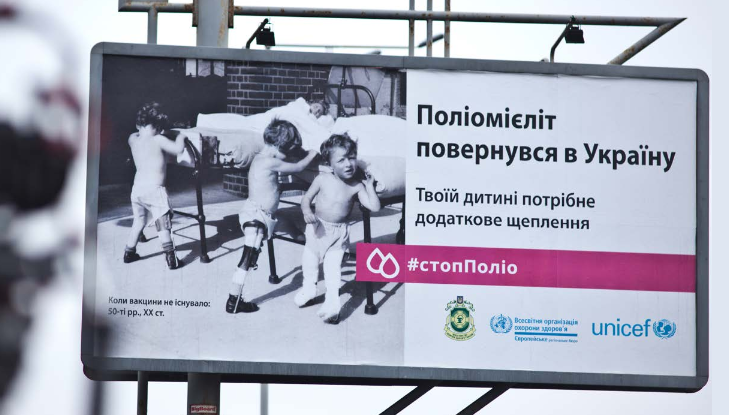
Immediately after the outbreak was declared, international partners activated pre-existing plans to implement outbreak SOPs, which were adapted to the Ukrainian context. Among the actions: UNICEF spearheaded a communications task force to educate the public, health care providers, and the media on the importance of vaccination, adapting messaging and delivery channels in response to real-time analysis of reception and impact. The team, including representatives from the Ministry of Health (MoH), WHO, Rotary, Radio Free Europe/Radio Liberty (RFE/RL), and Voice of America (VOA), launched a wide mix of communication approaches, including placards in subway cards, digital signage in supermarkets, and life-sized "pink drop" costumed characters engaging children and encouraging their parents to consult with paediatricians stationed at shopping malls and street fairs. Its distinct polio logo and slogan, adopted at the beginning of the campaign - #stopPolio - created local visual identity and a strong call for action. (See the full report for details about all of the communications and training that UNICEF undertook as part of the outbreak response.)
This nationwide communication for behaviour change campaign was designed to raise the urgency of the need for multiple vaccination rounds to contain the outbreak. UNICEF also assisted the ministry with the development of a crisis communication plan, including the designation of approved spokespersons, suggested talking points, and decision trees governing appropriate communications actions in response to a range of events and inquiries. Furthermore, to ensure local political buy-in and an opportunity for feedback into the plan, a number of briefings and capacity development activities with different government authorities and local stakeholders were organised. In addition, to help local health workers understand their roles and ensure their active participation in the response, WHO provided a technical guide for local health staff. WHO also provided specific technical assistance in other areas - for instance, to improve both acute flaccid paralysis (AFP) and environmental surveillance systems across the country.
Ukraine's formal nationwide vaccination rounds were conducted from October 19 - November 9 2015, November 30 - December 19 2015, and January 25 - February 26 2016. The three rounds encountered a number of roadblocks - Ukraine's "unique challenges" are discussed in the paper. For example, the government never declared a national public health emergency as required by the SOPs, and initiation of the first round was delayed due, for example, to lack of clear official information and vested political and business interests lobbying against international vaccine procurement. In addition, anti-vaccine rumours and frenzy continued to circulate in the media, especially social media. Mistrust (stemming in part to the 2008 measles outbreak and unfounded rumours at that time) remained a major issue. To make matters worse, the medical community was both the largest supporter and most significant opponent of vaccination, confusing caregivers and parents. The communications plan was realigned to respond more systematically to these issues as the campaign moved forward. The media mix was diversified and made more aggressive. Collaborative efforts were launched directly with media producers to bring key messages directly to parents and health care providers with more intensity. A wider array of trusted local, national, and international health care experts was harnessed to deliver this more aggressive messaging.
Thus, in Rounds 2-3, communications campaign elements included but were not limited to:
- MOH, UNICEF, WHO vaccine-promotion trips to regions, providing motivation, technical support, and confidence for health workers and parents
- Animated public service announcement (PSA) on national and regional television, reaching 92% of population
- Animated videos and banners on internet and social media, reaching more than 45% of population
- Dedicated vaccination page on parenting website, reaching millions of parents
- Outdoor advertisements reaching 60% of population
- Print materials distributed to polyclinics, kindergartens, and schools: 400,000 posters, 500,000 leaflets for parents, 200,000 children's colouring books
- Radio PSA (sound bite of TV PSA) aired on 17 stations, reaching 35% of the intended audience
- Radio PSAs featuring well-known pediatricians aired nationally and in targeted low-performing regions
- PSAs aired in closed-circuit system of subways, banner/poster advertisements in subway cars, stations, escalators reaching 1.2 million passengers daily
- Digital signs in four major supermarket chains (38 stores) reaching 3.5 million customers
- Branded stands with UNICEF doctors and "pink drop" characters at five shopping malls in three low-performing regions, distributing 44,000 leaflets to 188,000 people
- Road shows and direct mail delivery in Odesa and Kyiv, directly reaching 212,000 people
- Street fairs and festivals in low-performing regions, distributing 25,000 leaflets to 63,000 people
- Well over 100 training activities intended to enhance skills in communicating with parents and children about polio and immunisation covering 18 of the country's 27 regions, which reached almost 5,000 health workers, and 21 workshops for school and kindergarten staff, which reached 1,400 teachers in eight low-coverage regions.
- Regional media workshops, which covered 14 regions of the country and trained 50 journalists, jointly sponsored by UNICEF, Rotary, RFE/RL, and WHO
UNICEF commissioned three post-campaign monitoring reports to a local research institution to provide comparable data across a set of variables on the impact of the communications efforts. Overall, monitoring found that more than 95% of Ukrainians were aware of the polio vaccination rounds and were reached through at least one medium of a diverse media mix. Levels of knowledge and acceptance of vaccines have increased among parents and the medical community: The percentage of parents who know that polio causes paralysis, for example, more than doubled, and awareness of polio among caregivers and parents increased from 68% before the outbreak to 89% during Round 1, 91% during Round 2, and 96% during Round 3. The percentage of vaccine refusals due to fear of side effects or complications decreased from 67% before the outbreak to 38% by the third round. Crucially, vaccine coverage increased significantly: from below 17% (three doses in children under one year of age) in 2015, to 65% in Round 1 and 75% in Round 2 (age two months to six years), and 82% in Round 2 (age two months to 10 years).
A number of lessons learned from this experience are outlined; they include:
- It is challenging to facilitate the appropriate high-priority response when there are only a few cases of cVDPV. Maintaining the perception of danger from polio is key to sustaining momentum.
- Deep, informed analysis of the local political economy is essential; the politics of the situation (described in detail in the report) might have been handled more effectively and transparently at the outbreak's early stages, especially when communicating with regional and local officials.
- High-level advocacy from global donors and institutions can have a direct impact on increasing levels of immunisation coverage.
- Immunisation supply chain managers and other health workers must be adequately trained on international standards of vaccine management to ensure confidence in the safety and effectiveness of vaccines.
- Be prepared. In this case, public advocacy with donors and the government had already taken place, and a detailed internal crisis communications plan as well as vaccine supplies were ready for mobilisation. When the outbreak finally occurred, the communications team was able immediately to launch a carefully tailored and targeted response.
- The right mix of international and local expertise is essential. With unusually complex challenges in overcoming vaccine hesitation and refusal, the engagement of a private public relations firm with deep local knowledge and health communications experience proved invaluable.
- Adaptation of global guidelines to the local context is key. In Ukraine, where access to television, the internet, and social media is almost universal, parents were susceptible to misinformation and would not simply follow instructions to have their children vaccinated.
- Engage international as well as national and local media. UNICEF and WHO regional representatives were featured in international publications that received next-day play in Ukraine, legitimised key messages, and put useful pressure on government.
- Adjustments based on in-depth evidence and careful analysis are key to identifying and reaching intended audiences effectively. Quick assessment of early results is allows analytic findings to emerge in time for their immediate application.
- Investment in the training of and curriculum for health workers on the ground, using expert local speakers and opinion leaders, is a cornerstone of a long-term strategy to fight misinformation and thereby increase vaccine coverage.
On August 26 2016, a VDPV type 2 event was confirmed in the Odessa region of Southern Ukraine. The source was a healthy three-year-old girl who had been reported as fully vaccinated with two doses of inactivated polio vaccine (IPV) and three doses of oral polio vaccine (OPV). Thus, the success achieved during the outbreak response that is described in the document is fragile. Ukraine still has the lowest routine immunisation rates in the world, with the MoH reporting in August of 2016 that only 30% of children are fully immunised against measles, 10% against hepatitis B, and 3% against diphtheria, pertussis, and tetanus. According to UNICEF, maintaining the hard-won momentum and preventing a repetition of the events of 2015-2016 depends largely on sustained political commitment to the fight against polio and infectious disease in general, and more broadly to much-needed health systems strengthening in Ukraine.
Rhizome by GPEI, August 24 2017.
- Log in to post comments