










































Report of the 34th Meeting of the Expert Review Committee (ERC) On Polio Eradication & Routine Immunization in Nigeria
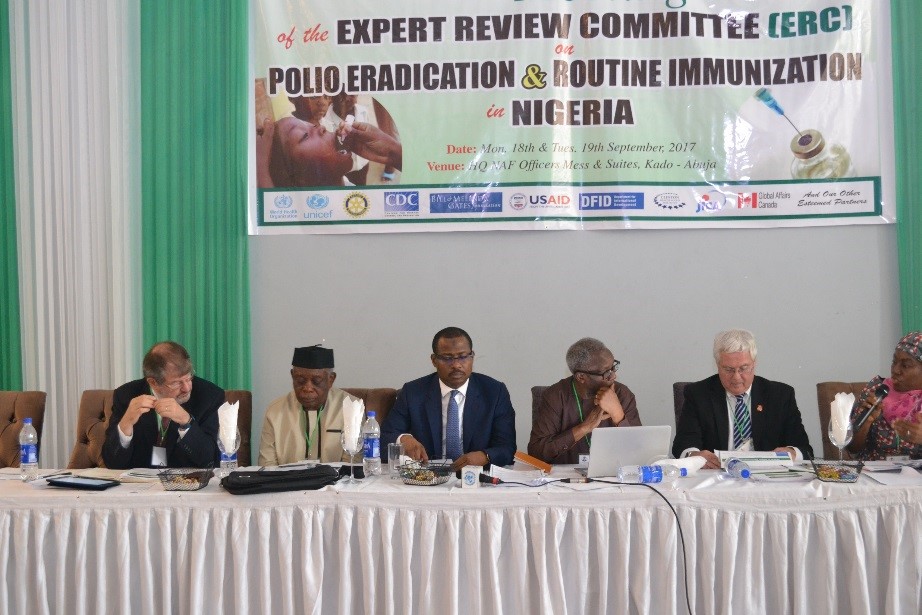
This report summarises the main findings, conclusions, and recommendations of the 34th meeting of the Expert Review Committee (ERC) for Polio Eradication and Routine Immunization (RI), which was convened from September 18-19 2017 in Abuja, Nigeria.
The context of the meeting: August 25 2017 marked 11 months that Nigeria had not detected a wild polio virus (WPV) case and 17 months without detection of WPV or circulating vaccine-derived poliovirus type 2 (cVDPV2) from environmental samples. These positive developments reflect the robust emergency response plan that was initiated following the 2016 WPV1 and CVDPV2 outbreaks in Borno and Sokoto States and VDPV2 identified from environmental samples in Sokoto State. However, although "[r]emarkable efforts are being made to manage surveillance in difficult-to-access populations...[, t]he low national routine polio immunization coverage of 33% cannot sustain high population immunity against polio."
Indeed, the ERC notes that the inaccessibility in parts of Borno State remains the major challenge to the Nigeria Polio Eradication Initiative (PEI) programme, as an estimated 162,616 under-5 children are still unreached. It however acknowledges the fact that the number of inaccessible settlements has reduced from 50% in July 2016 to 33% in July 2017. The ERC therefore urges the programme to intensify planning for Reaching Every Child (RES) and Reaching Inaccessible Children (RIC) strategies, periodically review the innovations, critically review validation of inaccessibility data, and consider demarcating settlements in the 178 inaccessible islands to estimate and reach populations living in those islands.
The report reviews developments since the 33rd ERC meeting (see Related Summaries, below), including but not limited to: massive deployment of Management Support Teams (MSTs) from government and partner agencies who were reporting on the open data kit (ODK) platform, tracking of vaccination posts to determine geographic reach, triangulation of the MST ODK reports with Vaccinator Tracking System (VTS) tracking geographic coverage, tracking "Pro-OPV [oral polio vaccine] vaccination sermons" during inactivated polio vaccine (IPV) + monovalent OPV type 2 (mOPV2) implementation days and training, and deployment of additional Traditional Birth Attendants (TBAs) and influential women to conduct house-to-house mobilisation during implementation in settlements without Volunteer Community Mobilizers (VCMs).
Also, the programme has embarked on efforts to reverse the waning political commitment through regular briefing of Governors at Nigerian Governors Forum (NGF) meetings and advocacy visits to Sokoto, Borno, Zamfara, Edo, and Commander of the Military Joint Task Force. Furthermore, Local Government Area (LGA) Chairmen from Borno and Yobe States were sensitised at separate retreats presided over by their Deputy Governors. The VCM network has been scaled up to over 20,953 in 12 States, including Taraba, and random validation of VCM micro-census data is ongoing. Tracking and vaccination of all missed children during in-between round activities is a standard practice of VCMs. In addition, the programme has introduced tracking of mosque and church announcements during Immunization Plus Days (IPDs) and peer quality data review (PDQR) to identify gaps and improve quality of data.
However, the ERC notes the low attendance of LGA chairmen at evening review meetings as well as irregular convening of the meeting of the Presidential Task Force on Polio Eradication and Routine Immunization (PTFoPE). Consequently, the ERC urges the immediate resumption of PTFoPE quarterly meetings and continuous high-level advocacy to Nigeria Governors' Forum (NGF). In parallel, the ERC urges that an intensive advocacy and communication campaign should be conducted to highlight the deaths of under-5 children in Nigeria due to low national and State vaccination coverage. In addition,
- VCMs need to reduce high routine immunisation (RI) dropout rates (OPV3 dropout is 50% in high-risk settlements) and be held accountable for performance.
- There should be scale-up tracking of newborns with zero-dose in all high-risk settlements, irrespective of VCM deployment.
- It is time to roll out the PEI Expanded Programme on Immunization (EPI) integrated communication strategy.
World Health Organization (WHO) Nigeria website, September 24 2018; and email from Richard Banda to The Communication Initiative on September 24 2018. Image credit: WHO Nigeria
- Log in to post comments