










































The Role of UNICEF's Intervention Programs in Improving Polio Coverage During the Humanitarian Crisis in Yemen
Universiti Malaysia Sarawak
"Deploying and supporting many mobile medical teams and cover[ing] their salaries or possible additional personnel costs such as incentives is a necessary measure to meet the high demand for immunization services to the population who have been cut off."
The armed conflict that began in Yemen on March 26 2015 has almost destroyed all pivotal health infrastructures, adversely affecting children who are in need of immunisation against diseases such as polio. Due to the poor quality of healthcare services, Yemen's immunisation coverage rate against polio dropped to 65% in 2016, which is far below what is considered an acceptable vaccination coverage rate of 85% (globally). The United Nations Children's Fund (UNICEF) is one of the agencies that provides humanitarian assistance to children and mothers in Yemen. This research assesses the major interventions UNICEF uses to deliver immunisation services, including polio vaccines, to children. It focuses on issues faced in remote and rural areas in terms of delivering and receiving immunisation services during the humanitarian crisis in the country.
In 2016, the Ministry of Public Health and Population (MoPHP) declared that it could no longer cover operating costs and keep providing services to the population, which led to the closure of many of the health facilities (HFs) in the country. In addition, many of the HFs were targeted by airstrikes or bombardment, causing casualties among health workers and forcing many to leave the country. The health staff who are still working in the country (although not being paid) are struggling to provide essential healthcare services despite the shortages in medicines, essential supplies, power, and fuel to power generators. Consequently, many primary health services such as immunisation have been disrupted.
Therefore, UNICEF has dispatched mobile and outreach teams in Yemen during the crisis. These teams deliver vaccines to hard-to-reach areas and among internally displaced persons (IDPs) to ensure that all children are vaccinated. In addition, they are the primary source of health education and immunisation information for most parents in Yemen. In order to increase demand for immunisation, the health workers have to correct the misinformation that the population in those areas have regarding the safety and the effectiveness of polio immunisation. UNICEF supports these teams with training and monthly incentives to encourage them to keep providing services - also supplying the teams with multiple vaccines and cold boxes in which to store them.
This study used quantitative and qualitative research methods to explore the effectiveness of UNICEF's interventions to raise Yemen's polio immunisation coverage rate. The sample was taken in Amanat Al-Asimah governorate, where 431,000 people have been displaced from all other governorates since the beginning of the conflict. Those IDPs are in urgent need of humanitarian assistance, especially adequate access to health services. The quantitative research focused on the household beneficiaries who received immunisation services through HFs or mobile immunisation teams. The qualitative method collected data related to the health situation in general and immunisation coverage rate in the targeted areas through focus group discussions (FGDs) and structured interviews with key informants.
In general, the fieldwork showed that UNICEF's immunisation interventions have had a positive impact on the overall access to immunisation services and the beneficiaries' health. However, the research found that there are complex challenges that weaken these interventions and limit the efficiency of their services. Insufficient immunisation services in rural areas, the economic situation, and the high cost of transportation to the nearest HF are among the complications that people face when they seek health services. Meanwhile, the health workers in the HFs often ask the beneficiaries for a "service fee" as a consequence of MoPHP's failure to pay their salaries. The study also revealed that there is a lack of access to the HFs to receive the most important polio dose, which is the first one.
Through the FGDs, it was evident that respondents with limited education were unwilling to complete their children's immunisation schedule after the third dose due to their perception that their children were already fully immunised against polio. The responsibility of taking the child for immunisation often fell on the women's and young girls' shoulders. However, due to the conflict, the road became unsafe for females, and the transportation fare became prohibitively expensive. Therefore, the respondents skipped some of the scheduled doses while waiting for the mobile immunisation teams to reach their areas instead of going to the HF. The mobile immunisation services are also popular among slum dwellers, Al-Muhamasheen (a minority group in Yemen), and IDP camps, where living conditions have continued to deteriorate.
Research findings indicate that the MoPHP is also facing a challenge regarding the monitoring and evaluation (M&E) system within the country. The district health centres are supposed to collect immunisation data and send it to the MoPHP regularly in order to enable the MoPHP to evaluate the immunisation interventions' performance. There is a concern that the absence of updated and reliable data as a whole will affect the improvement of the national immunisation programme. Therefore, the study recommends strengthening the immunisation information system at all levels: M&E, on-site supervision, and disease surveillance.
In conclusion: "Notwithstanding the challenges and conflicts, the MoPHP and UNICEF have done a good job by providing immunization services in Yemen. However, as the strategies unfold over the years, new challenges will arise and new strategies will be needed....The researcher hopes that this study provided a better assessment regarding the major interventions that UNICEF uses to deliver the immunization service including polio vaccines to children during the current humanitarian crisis in Yemen."
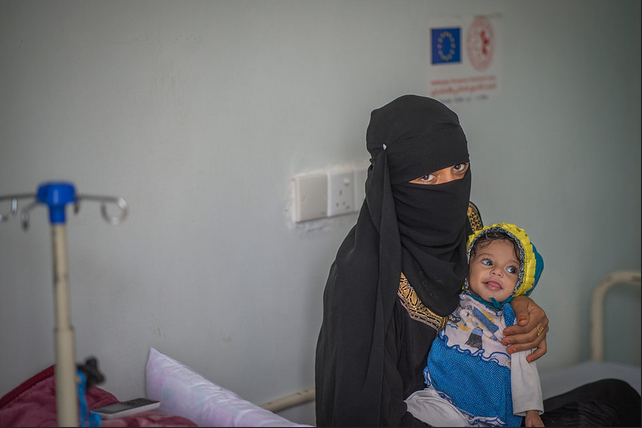
International Journal of Academic Research in Business and Social Sciences 11(2), 572-86. http://dx.doi.org/10.6007/IJARBSS/v11-i2/8403. Image credit: © European Union 2018 (photo by: Peter Biro) via European Civil Protection and Humanitarian Aid Operations on Flickr (CC BY-NC-ND 2.0)
- Log in to post comments