










































Scaling Up the Discovery of Hesitancy Profiles by Identifying the Framing of Beliefs Towards Vaccine Confidence in Twitter Discourse
University of Texas at Dallas (Weinzierl, Harabagiu); University of California, Irvine (Hopfer)
"...as the method was successfully applied for two different vaccines, it highlights its portability for considering confidence across vaccines and deriving vaccine-specific hesitancy profiles."
Twitter has become highly influential and relevant to shaping attitudes towards vaccination. The social media platform allows people to express their beliefs about vaccine confidence or hesitancy, their trust or mistrust in vaccines, and their stance on civil rights and vaccination mandates. This study uses Natural Language Processing (NLP) techniques to explore how vaccine hesitancy is framed in Twitter discourse and to identify hesitancy profiles for two vaccines for which there remains substantial reluctance among the public: the human papillomavirus (HPV) and the COVID-19 vaccines. These hesitancy profiles could inform public health messaging approaches to effectively reach Twitter users and, it is hoped, to shift or bolster vaccine attitudes.
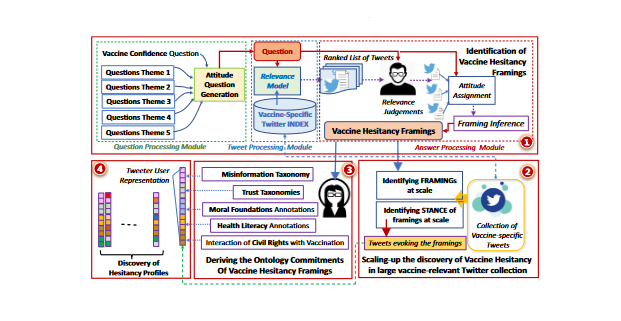
The paper presents a Question/Answering (Q/A) solution for the identification of hesitancy framings, enabled by the questions introduced in Rossen et al. (2019) as the Vaccine Confidence Repository (VCR). Q/A is an established NLP framework that consists of the automatic processing of the question language, which enables the identification of its answer in large collections of documents. When the questions are complex, the answer is automatically processed by summarising multiple passages deemed relevant to the question. Given that large collection of tweets discussing either the COVID-19 or the HPV can be retrieved from the Twitter API, questions targeting the confidence in vaccines (available from the VCR) can be used in a Q/A system operating on the index of tweets to capture the framing of vaccine hesitancy.
The questions from the VCR were informed by Kata's (2010, 2012) content analysis of antivaccine websites, which identified six classes of content attributes related to vaccine hesitancy or resistance: (i) concerns about the safety and effectiveness of vaccines; (ii) the consideration of alternative medicine; (iii) the interaction of civil liberties with vaccination programmes; (iv) reference to conspiracy theories; (v) the influence of morality, religion and ideology; and (vi) the usage of misinformation and falsehoods. In the study reported in Rossen (2019), 3-4 questions were generated by researchers targeting each of the classes of content attributes reported by Kata (2010, 2012), producing the VCR. Instead of soliciting answers from Twitter users, the present study uses this methodology to (a) retrieve the tweets that answer the same questions and (b) infer from them vaccine hesitancy framings.
The study is based on 422,078 tweets discussing the HPV vaccine authored by 192,487 users and 5,865,046 tweets discussing the COVID-19 vaccine authored by 2,268,358 users. In Step 1, the researchers identified the vaccine hesitancy framings for either the HPV or COVID-19 vaccines as answers to questions asking about confidence in vaccines. Step 1 of the method produced 113 framings (COVID-19) and 64 framings (HPV), which answer research question 1 (RQ1): How is confidence in the HPV and the COVID-19 vaccines framed in the Twitter discourse? One key finding (see Figure 3 in the paper for more): Misinformation is pervasive in the framing of confidence in the HPV vaccines. Step 2 scaled up the discovery of vaccine hesitancy by automatically discovering (a) all the tweets that evoked any of the hesitancy framings identified in Step 1 and (b) the stance of the tweet author towards the framing.
In Step 3, ontological commitments of the hesitancy framings identified in Step 1 are derived. First, the framings are categorised and then taxonomies of misinformation or trust are derived, while also recognising the hesitancy framings in the implied Moral Foundations (MF) provided by the Moral Foundations Theory (MFT), health literacy, and impact of civil rights on vaccine hesitancy. The results of Step 3 involve the creation of several taxonomies, answering RQ2: What specific misinformation about the HPV and COVID-19 vaccines is propagated on Twitter? Ten misinformation themes were discovered in the Misinformation Taxonomy for the HPV vaccine, illustrated in Table 6, while nine misinformation themes were discovered for COVID-19 vaccination, illustrated in Table 7. Although higher-order themes were similar across vaccines (with HPV vaccination having one additional promiscuity theme), of the 33 concerns, only 7 were shared across vaccines. This finding suggests that misinformation is tailored to worries that are vaccine specific. Two different trust taxonomies (see Tables 8 and 9) discovered for each vaccine provided the answers to RQ3: What trust issues are associated with the HPV and COVID-19 vaccines in Twitter conversations? Finally, Step 3 also produced annotations of the implied MFs, answering RQ4: What moral dimensions characterise the confidence in the HPV and COVID-19 vaccines on Twitter? An overall finding for RQ4 is that the most common approach by which each vaccine is morally framed in public discourse shifts depending on the vaccine.
The results of Step 4 are the vaccine hesitancy profiles discovered for each of the two vaccines, answering RQ5: What hesitancy profiles can be discerned from Twitter for the HPV and COVID-19 vaccines? Table 10 lists the hesitancy profiles and their characteristics for the HPV vaccine, while Table 11 lists those for the COVID-19 vaccines. The discovery of these profiles was made possible by (a) the automatic recognition of all tweets from that evoke any of the hesitancy framings; and (b) the automatic identification of the stance the tweet authors have towards the evoked framings.
Qualitatively, vaccine confidence for both HPV and COVID19 was expressed in framings covering a range of themes. In so doing, the study has uncovered not only vaccine confidence themes on social media but also users' stances toward those vaccine confidence themes across millions of users at scale. Quantitatively, the study found a larger number of hesitancy framings for the COVID-19 vaccine (113 framings) than for the HPV vaccine (64 framings), which may reflect the fact that, in Twitter discourse, people have a greater number of vaccine confidence issues for the COVID-19 vaccine than for the HPV vaccine. The vaccine hesitancy framings allowed the researchers to discover not only the fact that the distribution of framing categories varies between the vaccines, but also the fact that Twitter discourse about vaccine confidence is impacted not only by misinformation but also by the erosion of trust in vaccines. Moreover, the empirically derived taxonomies of trust in the COVID-19 and HPV vaccines reveal a number of findings. For example, trust in vaccines was expressed across both HPV and COVID-19 vaccines at the individual level (e.g., confidence in vaccine over natural immunity), the family level (e.g., vaccination protects families), and the system level (e.g., government provides and makes transparent vaccine information). Thus, a social-ecological framework contextualised trust at multiple levels on Twitter.
Based on the researchers' use of the implied MFs in understanding vaccine confidence and hesitancy framings on social media, clear moral attitudes emerge within the hesitancy profiles across both the HPV and COVID-19 vaccines. The main profiles are:
- Promoters of both the HPV and COVID-19 vaccines tend to strongly accept framings that espouse Care, Authority, Loyalty, and Fairness, with rejection of Subversion.
- Misinformers of both the HPV and COVID-19 vaccines tend to adopt framings in stark moral contrast to Promoters, whose moral foundations of Betrayal, Harm, and Subversion oppose those moral stances of Loyalty, Care, and Authority, respectively. Misinformers tend to have much stronger moral stances than Promoters, which indicates morality plays a key role in the motivation of those spreading misinformation at scale.
- A similar pattern is found when comparing the Skeptic profiles, where moral foundations of Subversion, Betrayal, and Harm are adopted towards both the HPV and COVID-19 vaccines.
- Slightly differing moral profiles across vaccines are found when comparing the Trusters of the HPV Vaccine to those who are Ambivalent about the COVID-19 vaccine. The two groups share in their adoption of Authority and Fairness moral foundations, but the HPV Vaccine Trusters adopt Care, while the COVID-19 Vaccine Ambivalent adopt Harm.
- The Debunkers share in rejection of Subversion but differ across other moral foundations. HPV Vaccine Debunkers equally tend to reject Degradation, Subversion, and Authority, while COVID-19 Vaccine Debunkers focus much more on rejecting Subversion, with a secondary focus on Harm and Fairness.
Thus, HPV and COVID-19 vaccine hesitancy profiles highlight a constellation of accept and reject stances across various vaccine hesitancy framings, which can inform future messaging campaigns. The potential range of messaging targets spans inoculating against specific misinformation to tapping into moral frameworks to finding ways to bolster trust or debunk messaging that erodes trust. Interest to public health interventionists involves strategically reaching out to profile members whose stance suggest their vaccine attitudes are amenable to change, or alternatively, whose vaccine attitudes may already be positive but need strengthening. With this goal in mind:
- Promoters (21%) and Debunkers (32%), who make up more than half of the HPV vaccine users, express to a large degree support for vaccination in their high motivation to vaccinate, their trust, their vaccine literacy, their support for mandating vaccination, and their appeal to moral frames of care, authority, and loyalty (in the case of Promoters). These users may respond to authoritative appeals, mandating vaccination, and trust appeals that emphasise the importance of public health.
- For COVID-19 vaccine profiles, on the other hand, whose stance may also already be positive but in need of strengthening, Promoters make up a much smaller subgroup (9%) while Debunkers make up 35%. Bolstering positive vaccine attitudes may be achieved with trust messaging that emphasises the importance of vaccinating for public health (i.e., the collective) and motivating vaccination by emphasising moral values of care (preventing harm) and (for Promoters) authority, loyalty, and fairness. By contrast, for Debunkers, who make up a substantial subgroup (almost 200,000 users), an emphasis on moral messages may boomerang.
- Trusters are likely to respond favourably to messages that build trust. These users are literate and their motivation to vaccinate can be tapped possibly through moral value appeals of care, authority, and fairness. Avoiding messaging that emphasises vaccine mandates is warranted for this subgroup, given Trusters' weak yet existing stance on civil rights above all, irrespective of public health circumstances.
- The Ambivalent, who make up the largest subgroup (48%) of COVID-19 vaccine hesitancy profiles with 267,087 users, are on the fence. This subgroup may benefit from significantly bolstering trust and motivation coupled with inoculating against misinformation and utilising moral appeals of authority and preventing harm. Both Trusters (HPV) and the Ambivalent (COVID19) are ripe for receiving inoculation messages against misinformation across vaccine safety, effectiveness, the testing process, transparency, ingredients, and adverse reactions.
- The Skeptics (13% for HPV; 7% for COVID19) exhibit frame-stance scores that are accepting of most misinformation and erosion of trust framings. These users are illiterate and strongly de-motivated to vaccinate; moral values of subversion, harm, and betrayal resonate, as does civil rights above all, irrespective of public health circumstances. Reaching these users presents more challenges, though they exhibit weak frame-stance scores on many fronts - suggesting these could be targeted to shift vaccine attitudes.
In conclusion, this study's "methodology sheds light on what has been known but rarely modelled in this detailed, in-depth manner, namely the heterogeneity that makes up vaccine attitude profiles. Furthermore, this novel modeling approach captures user stance toward vaccine framings that uncovers the attitude orientation and informs messaging that can tap into which vaccine attitudes may be accessible....These results begin to disentangle the complex attitudes shaping vaccine attitudes. Furthermore, such a person or user-centered approach to characterizing vaccine hesitancy profiles recognizes the importance of uncovering subgroups with similar vaccine hesitancy stance across multiple ontological dimensions. The patterns of vaccine hesitancy framings across multiple value frameworks inform public health messaging approaches to effectively reach profiles with promise to shift or bolster vaccine attitudes."
Journal of Behavioral Medicine https://doi.org/10.1007/s10865-022-00328-z.
- Log in to post comments