










































Shared Understandings of Vaccine Hesitancy: How Perceived Risk and Trust in Vaccination Frame Individuals' Vaccine Acceptance
University of Trento
"Paying more attention to how people develop certain worldviews, and how these are structured, can support the development of more systematic ways to help people understand the benefits of immunization."
Previous research has framed vaccine hesitancy as a property of a heterogeneous group of individuals, ranging from total acceptance to complete refusal. Using data from a survey on a sample of Italian citizens, this paper examines this heterogeneity, using individuals' cognitive variation as a launching point to map clusters of individuals who share similar cognitive schemas (wider epistemologies and worldviews) on vaccine uptake. Three research questions frame the paper:
- Relying on measures of perceived risk and confidence, do groups of individuals show different shared cognitive schemas on vaccine acceptance?
- Does the group partitioning of Q1 also represent a source of social distinction or stratification?
- Is there a different association between core predictors of vaccine hesitancy and the willingness to vaccinate in each group?
In providing background, the researchers note that past studies have identified various elements empirically proven to affect vaccine uptake. A growing trend suggests that, whereas in the past vaccines were mostly refused by lower-educated people, today's hesitant individuals might also be well-educated people who have sought health information on user-generated websites rather than from traditional evidence-based sources. This paradigmatic change necessitates a look at how individuals select, retrieve, and use information to develop beliefs and attitudes on vaccine-related issues. Given that there exists no method or form of evidence guaranteeing the way we judge certain evidence to be convincing, the problem might move from what people believe to how people construct meaning and share a similar epistemology with other individuals.
In addition, research has shown that the way individuals perceive the risk of vaccine preventable diseases (VPDs) and trust vaccinations are principal components in determining vaccine uptake or refusal. These elements stand at the centre of several health-specific behavioural theories that are often used to frame vaccine hesitancy. Nearly all theories focus on two dimensions of risk perception: the perceived severity of disease and the perceived likelihood of contagion.
Between September and November 2019, an original online survey was administered to 1,008 Italian citizens between 20 and 64 years old who participated in an online panel. The main predictor variables measured the perceived risk of VPDs and confidence in vaccination. The survey measured four distinct risk perception concepts: severity of VPDs, the likelihood of contagion, susceptibility to VPDs, and feeling at risk. The researchers then used Goldberg's relational class analysis (RCA), which is a graph partitioning method based on the assumption that individuals are related to one another to the extent to which they construct meaning in a similar way. As a measure of schematic similarity, Goldberg proposed a metric he called relationality, which measures whether the components of two vectors of the same set of variables follow a similar pattern. Intuitively, two individuals are as schematically more alike as their response pattern is closer.
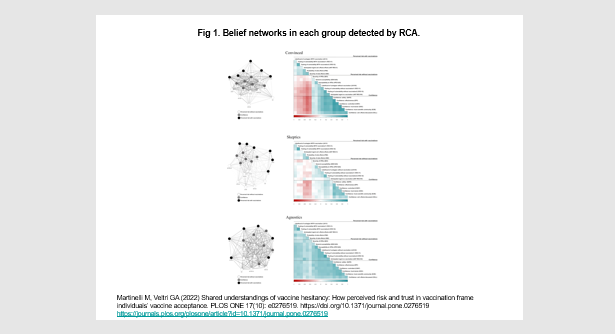
The results showed the existence three groups, characterised by a different articulation of predictors of vaccine hesitancy, revealing different understandings of vaccine uptake:
- Convinced (27.7% (n=279) of the sample): show lower perceived risk with vaccination and higher confidence and risk perception without vaccination, or vice-versa. For individuals at the extreme of this group's continuum, vaccination can be interpreted as a protective or endangering practice, an element that reduces or increases perceived risk. For this reason, individuals in this group appeared to be firm in their belief about the positive or negative effects of vaccination.
- Skeptics (45.5% (n=457) of the sample: frame their representation of the vaccination issue as revolving around the contraposition between confidence in vaccination and the presence of side effects. The heterogeneity between individuals in this group seems driven by a different perception of collateral effects and an unclear position about vaccination effectiveness in reducing the risk of VPDs.
- Agnostics (26.6% (n=268) of the sample): include, at the extremes of this group's continuum, individuals with higher confidence and higher risk perception with or without vaccination, and vice-versa. Individuals in this group appear not to recognise vaccination as a useful tool, whether they perceive VPDs as dangerous and whether they trust vaccination.
The researchers then analysed within-cluster characteristics and showed that cognitive segmentation was connected to different levels of perceived risk, confidence, and support for vaccination. They write: "Prior research often treated vaccine hesitancy as if all individuals saw vaccination with the same eyes. RCA, on the contrary, allowed us to appreciate three systematic differences in the way individuals frame this issue by showing that individuals differ not only in 'what' they think but also in 'how' they think, revealing different interpretative and epistemic frameworks of the same social object."
The analysis further showed that cognitive clustering entails a mean of social stratification that is correlated with individuals' educational levels. Individuals with the highest educational level had a lower relative risk ratio of belonging to the Skeptics group or the Agnostic group, compared to the Convinced group. So, it appears that a higher educational level is associated with a cognitive schema where vaccination is valued more highly.
Finally, the predictors of vaccine hesitancy are articulated differently in each group. In the Convinced group, higher confidence levels are associated with a lower probability of being vaccine hesitant. For Skeptics, higher levels of perceived risk of VPDs without vaccination were associated with a lower likelihood of being vaccine hesitant. In the Agnostics group, confidence in vaccination appeared not to be significantly associated with the probability of being vaccine hesitant.
Thus, "these findings suggest the importance of considering an individual's cognitive characteristics in vaccine hesitancy research and in developing strategies to increase vaccine acceptance. If systematically different worldviews underpin the recognition of different elements as relevant to one's propensity to be vaccinated, developing effective strategies to increase vaccine acceptance might require diversifying interventions based on the articulation of elements in different subgroups of the population....Effective communication strategies to foster vaccine acceptance should consider that the ways people interact and react to public policy interventions might be conditioned not only by people's socio-demographic profiles but also by their cultural and cognitive schemas."
In conclusion: "the ways people acquire, interpret, and use information might be an additional key to understanding peoples' worldviews and fostering vaccine acceptance."
PLoS ONE 17(10):e0276519. https://doi.org/10.1371/journal.pone.0276519.
- Log in to post comments