










































Strategies Intended to Address Vaccine Hesitancy: Review of Published Reviews
Institut National de Santé Publique du Québec (Dubé, Gagnon); Dalhousie University, Canadian Centre for Vaccinology, IWK Health Centre (MacDonald)
"Given the paucity of information on effective strategies to address vaccine hesitancy, when interventions are implemented, planning a rigorous evaluation of their impact on vaccine hesitancy/vaccine acceptance will be essential."
This review of published reviews aims to complement the systematic review on strategies to address vaccine hesitancy commissioned by the Strategic Advisory Group of Experts (SAGE) Working Group on Vaccine Hesitancy. [See Related Summaries, below.] To identify relevant literature reviews or meta-analysis reviewing interventions to address vaccine hesitancy and/or to enhance vaccine uptake, a search was conducted in the electronic databases PubMed, EMBASE, Global Health, CINAHL, PsycINFO, SocINDEX with Full Text, and ERIC for the period January 2008 to November 2014. The search strategy was built using a combination of keywords (principal terms and synonyms) for four concepts: (1) interventions, (2) beliefs, attitudes, and knowledge, (3) vaccination and (4) review. The search strategy yielded 15 literature reviews or meta-analysis that met the eligibility criteria.
For example, two cluster-randomised trials were included (one in India and another in Pakistan) that compared interventions that were designed to reach communities through routine immunisation (RI) practices. These trials showed low certainty evidence that interventions aimed at communities to inform and educate about childhood vaccination may improve knowledge of vaccines or vaccine-preventable diseases among intervention participants (adjusted mean difference 0.121, 95% CI: 0.055-0.189). The study from India showed that the intervention probably increased the number of children who received vaccinations (RR 1.67, 95% CI: 1.21-2.31; moderate certainty evidence). The study from Pakistan showed that there is probably an increase in the uptake of both measles (RR 1.63, 95% CI: 1.03-2.58) and diphtheria, pertussis (whooping cough), and tetanus (DPT) vaccines (RR 2.17, 95% CI: 1.43-3.29) vaccines, but there may be little or no difference in the number of children who received polio vaccine (RR 1.01, 95% CI: 0.97-1.05). There is also low certainty evidence that these interventions may change attitudes in favour of vaccination among parents with young children (adjusted mean difference 0.054, 95% CI: 0.013-0.105), but they may make little or no difference to the involvement of mothers in decision-making regarding childhood vaccination (adjusted mean difference 0.043, 95% CI -0.009-0.097).
Three reviews focused exclusively on interventions implemented in low- and middle-income countries. The conclusions of these reviews indicate that face-to-face education, information campaigns, household visits, incentives, or training of health-providers may increase childhood vaccine uptake in low- or middle-income countries settings, but many of the studies reviewed were at high risk of bias.
Only two of the reviews identified directly targeted strategies to address vaccine hesitancy (defined as voluntary refusal or delay in acceptance of recommended childhood vaccines while vaccination services are available). Two major influences on vaccine hesitancy emerged from the review: the influence of social norms and the interactions with health-care providers. The role of social norms is developed through social networks, through which parents gather information and form opinions about vaccination. "[P]eople who are opposed to vaccination often take disproportionately more space in the discussions about vaccination in the public forum and too often the voices of parents who are in favour of vaccination are not heard. Some interventions capitalising on the influences of social norms and social networks have been implemented to address vaccine hesitancy (e.g. peer-to-peer communication valuing fully vaccinated communities or vaccine 'champion' parents to talk with vaccine-hesitant parents, development via social media of a community of parents who vaccinate or of a community of parents whose children were affected by a vaccine-preventable disease, etc.)....However, the effectiveness of these interventions remains to be evaluated. From another standpoint, the interaction between patients and health-care providers is the cornerstone of maintaining confidence in vaccination....Whereas communication frameworks often suggest discussing vaccines in a participatory and open manner, recent research by Opel et al. found that more firm, presumptive discussion styles might be more effective in improving vaccine acceptance..."
Vaccine hesitancy can be seen not only towards routine vaccination but also in mass vaccination campaigns in high-, middle-, and low-income countries. The Working Group noted several successful mass campaigns, such as: the polio elimination campaign in India (although the reaction to the mass polio campaign approach has also provoked distrust in some countries), polio virus containment in Israel in 2013, and the meningococcal A campaigns in several countries in the African meningitis belt. "In each case, the vaccine-preventable disease was well known and feared. Cases were well publicised. Political and religious leaders from all levels were actively involved. Communities were directly involved in helping with the campaigns and access to vaccination was made as easy as possible. Social norms of acceptance were publicised. All of these appeared to increase vaccine acceptance, although hesitancy was not measured and their impact on it is unknown. More evaluation of successful mass campaigns is needed to determine whether there are particular hesitancy determinants that are more common in mass campaigns in particular settings and what strategies are most effective in addressing them."
Based on their review, the authors conclude that there is no strong evidence on which to recommend any specific intervention to address vaccine hesitancy/refusal. For instance, there is mixed evidence on the effectiveness of interventions involving face-to-face communication interventions, health-care provider training, community-based actions, and communication using mass media. Many traditional educational tools (e.g. information pamphlets) had little or no impact on vaccine hesitancy; furthermore, some communication interventions could even reinforce vaccine hesitancy, as shown by a study in the United States using four interventions to refute claims of a link between the measles, mumps and rubella (MMR) vaccine and autism, based on current public health communication. The study showed that none of the interventions significantly increased parental intention to vaccinate and decreased the intention to vaccinate among parents who had the least favourable attitudes towards vaccines. "This highlights the importance of carefully designed public health messages, and that messages need to be tailored for the specific target group, because messaging that too strongly advocates vaccination may be counterproductive, reinforcing the hesitancy of those already hesitant."
The authors note that the conclusion from some of the reviews indicates that interventions using mass media are difficult to evaluate and are not well-suited to experimental design; other types of evaluation are subject to various forms of bias due to potential confounding factors that limit the quality of the evidence available. They explain that, when communication interventions are part of multi-component strategies, "it becomes almost impossible to evaluate their direct impact on vaccine uptake." In developing communication interventions to address vaccine hesitancy, the use of the internet and social media is often recommended, but few web-based strategies have been evaluated. Limitations of this type of strategy include difficulties in "attracting" vaccine-hesitant individuals and the exclusion of individuals without internet access or who have low literacy levels. There are, however, advantages, such as the ability to personalise messages. "The emergence of social media as a source of online health information combined with decreasing rates of vaccination mean that it is critical to understand how social media can influence parents' decision-making processes, and to develop communication strategies about vaccination."
The Working Group also discussed the role of childhood beliefs about vaccination in shaping adult vaccination acceptance. "Historically, children have not been systematically educated in schools about vaccines, so that some of the adult population may not appreciate their benefits for health and societal value for their children and for themselves. While other opportunities to learn about vaccines exist (e.g. from media, information pamphlets, health-care professionals), these routes may be missed by many in the population. In contrast, older generations understood the value of vaccines within the context of personal experience with vaccine-preventable diseases and/or the disease impact on other children and therefore as adults they did not need to be taught about the risks of these diseases and the benefit of the vaccines. Now many vaccine-preventable diseases have declined or disappeared as a result of high vaccine uptake, thereby negating the personal experience route for education about the benefits of vaccination. Ensuring education and knowledge about vaccines in younger individuals (children, adolescents, young adults), possibly through school-based programmes, may provide a good opportunity to encourage future vaccine acceptance by parents and adults and minimise the potential for development of hesitancy, although research is needed to evaluate this strategy in the short and longer term."
The Working Group argues that, to be effective, interventions should be developed using a planning framework, such as the WHO Guide to Tailoring Immunization Programmes, and should be based on a theoretical model. They contend that the use of a combination of different interventions appears to be more effective than single-component interventions. "Interventions are most likely to succeed when they are based on empirical data and situational assessment - both to have a detailed level of understanding of the vaccine hesitancy situation (susceptible populations, key determinants of vaccination, barriers and enabling conditions, etc.) and to properly evaluate the impact of the intervention.... The development of culturally adapted and personalised interventions has been shown to be effective in enhancing compliance with preventive behaviours, including vaccination."
In conclusion, the Working Group emphasises the importance of understanding the specific concerns of the various groups of vaccine-hesitant individuals. "Given the paucity of information on effective strategies to address vaccine hesitancy, whenever interventions are implemented, planning a rigorous evaluation of their impact on vaccine hesitancy/vaccine acceptance is essential, as is sharing of lessons learnt."
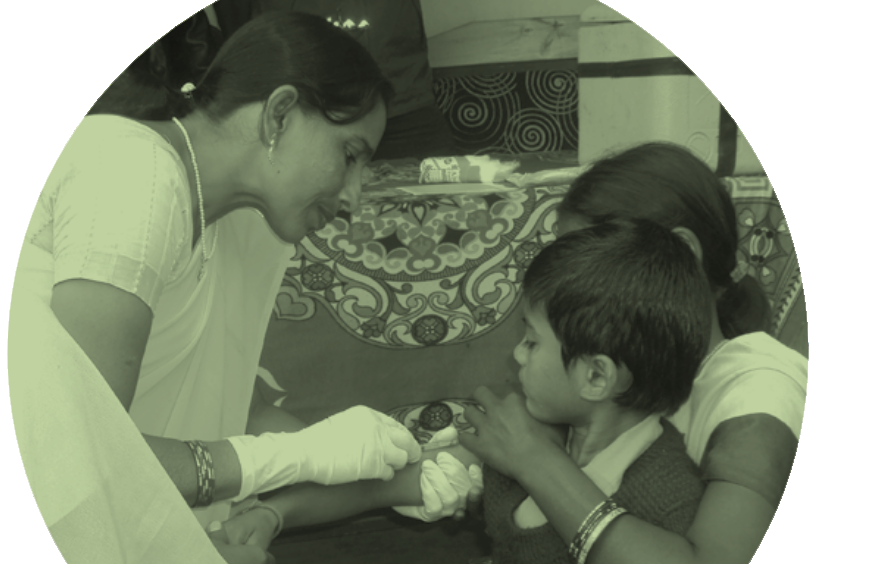
Vaccine Volume 33, Issue 34, August 14 2015, Pages 4191-4203 - sent via email from Michael Favin to The Communication Initiative on August 18 2015. Image credit: Measles and Rubella Initiative
- Log in to post comments