










































Tackling Inequities in Immunization Outcomes in Conflict Contexts
Equity Reference Group for Immunisation (ERG)
During periods of conflict, vaccination rates tend to fall quickly. Considering that 40% of the 20 million unimmunised children in the world live in fragile or humanitarian settings, this is a matter of concern for the senior experts in global health who make up the Equity Reference Group for Immunisation (ERG). They note that, in recent years, conflicts have become more common, longer lasting, more disruptive, and detrimental to health service provision. In that context, with support from PATH, members of the ERG conducted a literature review and 110 individual expert interviews to highlight new approaches and technologies for addressing immunisation inequity in conflict settings.
The ERG looked at 6 primary challenges of maintaining immunisation services during conflict: loss of infrastructure; health personnel retention; safe delivery of services; displacement of populations; and mistrust and disinformation. With regard to the latter, the ERG notes that building trust is crucial in conflict settings, where rumours can reduce vaccination uptake or put health workers at risk, as happened during the polio eradication effort in Pakistan. Some countries have a delicate political environment, where trust is much easier to lose, and this precariousness can increase the challenge of operating vaccination programmes.
After linking to key protocols and guidelines, the ERG reviews recommended practices. For example, the polio campaign led the way in negotiating access in difficult areas, demonstrating both the promise and difficulty of these negotiations. The ERG notes that these negotiations require sustained contact and communication with various levels of government or similar outreach in the case of rebel groups/non-state actors. Negotiation is more effective if there is already a sense of trust and acceptance in the community. On the theme of trust, when communities and countries are embroiled in conflict, traditional authorities may be weakened, reprioritised, or mistrusted by some communities. Thus, community engagement - whilst important in all contexts to ensure there is awareness of, demand for, and utilisation of immunisation services - becomes even more vital during conflict. Community health workers, community leaders, and religious leaders become critical change agents to continue immunisation services. This also includes investment in women's networks, shown to help caregivers prioritise immunisation of their children.
The ERG examines some of the gaps in our knowledge, such as how to increase demand for vaccination at the community level. Similarly, there is also inadequate understanding of how to combat misinformation campaigns - e.g., via social media - that make vaccination seem dangerous. Rumours can be particularly damaging in conflict settings, as has been seen with recent violent reactions to the polio campaign in Pakistan.
The ERG investigated novel interventions or approaches, particularly from outside the immunisation sector, that could address challenges to achieving equity in conflict settings. They focus on community-level policies and practices that can be implemented today, while acknowledging that national policy, governance, and financing influence the power communities hold. The report identifies 6 categories of intervention, with ideas categorised with different icons as having been tried but needing to be either further strengthened or new and needing to be explored. Communication-centred strategies examined include:
- Motivating health workers via improved communication and feedback - "Communication with health workers can be challenging in conflict settings, leaving health workers to operate in a vacuum with little formal feedback. Improved data systems allow for better feedback loops, such as the creation of dynamic dashboards to show comparisons between districts. Improved communication technology, such as WhatsApp, allows for regular communication. This increased communication means that up-to-date contact sheets, listing health worker phone numbers or email addresses, should be the norm rather than the exception. If communication is interrupted during periods of conflict, health workers may need to operate with limited supervision and governments should prepare for this by emphasizing high-quality staff training to increase autonomy."
- Using technology to collect timely and actionable data and to identify populations - The ERG notes that tracking populations requires some caution: In areas of active conflict, information on population counts and movements is highly sensitive and could be used by military forces to target those same groups.
- Increasing community engagement - In conflict settings, non-governmental organisations (NGOs) and other groups tend to be more isolated from the communities they serve and therefore less aware of immediate concerns with regard to food, water, and shelter. Reaching out to communities enables better understanding of their perceived needs so that vaccination programmes can be coupled with demand-driven interventions. Examples:
- Outreach to communities can take traditional forms, such as stakeholder focus groups and qualitative interviews.
- Women can inform the vaccination planning process using women's fora and outreach through other community mechanisms. Mothers can take a role in the design of immunisation education materials, and communicating effectively with mothers requires materials that are tailored to the local context, especially when working with displaced groups, which may be minorities or otherwise marginalised people.
- Outreach can be accomplished through media communication. For example, a community radio programme with a call-in portion offers a more dynamic way for communities to admit to any fears/misgivings and advocate for other helpful programmes.
- The polio eradication programme in Afghanistan, which has faced high rates of vaccination reluctance and refusal, has found support from local religious leaders who travel by motorcycle to encourage families to vaccinate their children. These so-called "mobile mullahs" help explain that vaccination is permissible under Islamic religious law and help dispel anti-vaccination rumours.
The ERG recommendations (see the chart on pages 21-23) reflect the framework for action pictured in figure 3 on page 19. They seek to identify (1) the problem (challenges) being addressed; (2) the innovative interventions necessary to reduce inequity; and (3) the change agents that can act. The ERG recommendations are categorised in 3 ways: (1) Act now. Evidence exists to support the idea, but with minimal implementation. (2) Continue doing. Interventions that are working well and should persist. (3) Test before acting. Interventions that require further study to assess and test value. An example of an "Act now" recommendation is that immunisation programme managers should work with humanitarian agencies - for instance, by participating in gender coordination mechanisms on the ground. As noted here, communicating clearly with mothers is essential for ensuring their support and demand for vaccination. (See Annex 3, which charts out various intersections of inequity with gender.)
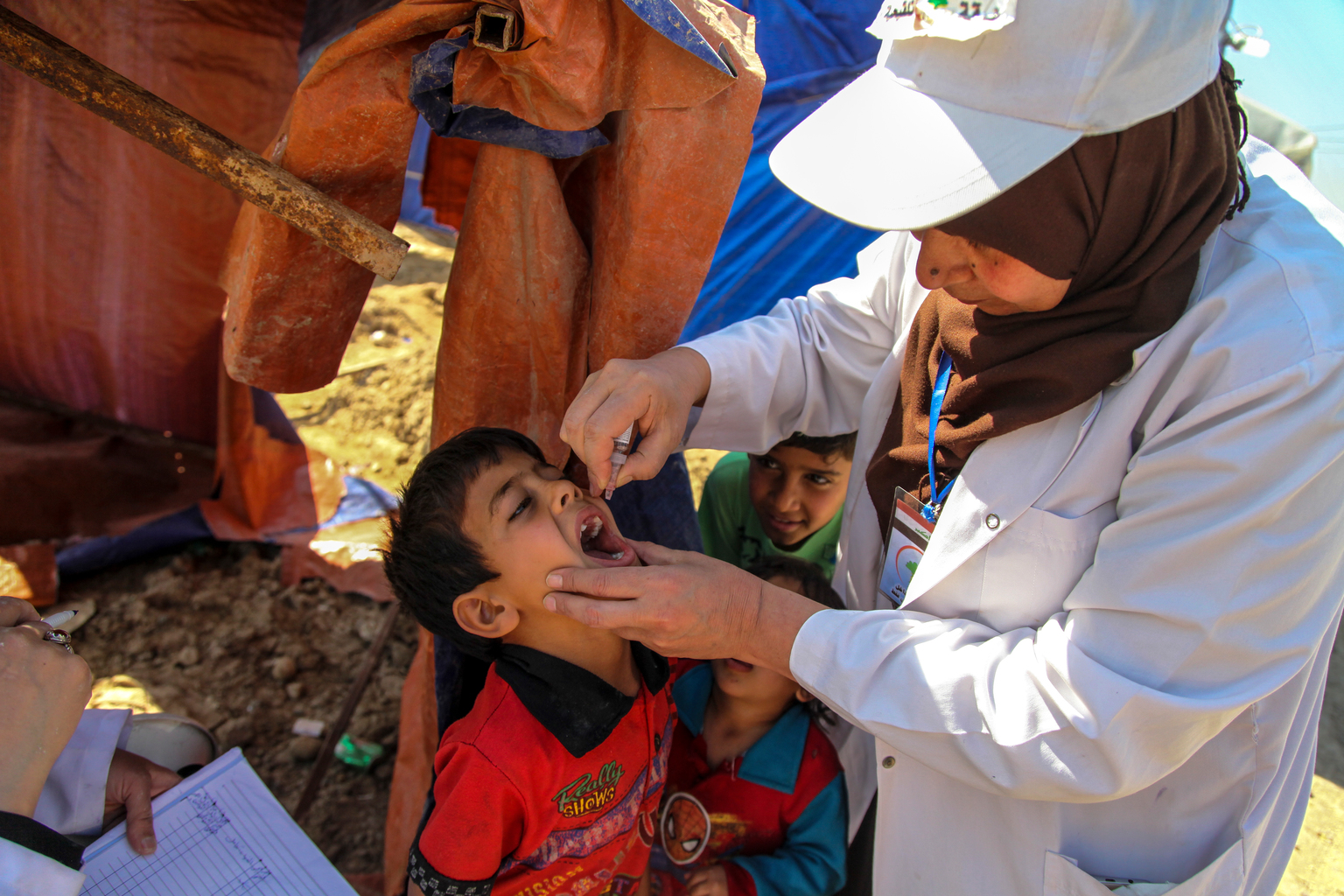
Email from Alyssa Sharkey to The Communication Initiative on May 2 2019 and ERG website, May 3 2019. Image caption/credit: A child receives a dose of oral polio vaccine from a health worker in Baghdad's Al-Takya Al-Kasnazaniya Camp for displaced Iraqi families. UNICEF/UN017005/Khuzaie
- Log in to post comments