










































Trust in Government, Social Media and Willingness to Vaccinate
"Demonstrating links between trust and vaccine uptake highlights the importance of rebuilding trust in South Africa. This is particularly true because where trust in government institutions is low, people might seek information elsewhere, including on social media."
Studies have shown that institutional trust (the belief in the reliability of institutions), such as trust in the government or scientific community, is crucial in influencing public compliance with public health measures and vaccine acceptance. These studies indicate that vaccine hesitancy persists even after scientific misinformation has been corrected. Measles and mumps outbreaks and the increase in zero-dose and under-vaccinated children (UNICEF, 2023) in South Africa highlight the importance of better understanding issues around vaccine hesitancy in the country. This study examines the relationship between social media use, trust in information sources, beliefs about vaccination rates, and willingness to adopt vaccines against a variety of diseases using data gathered in late 2023 from 975 respondents in South Africa.
As noted here, government trust has been declining in South Africa, with Afrobarometer showing that 27% of respondents trusted the African National Congress (ANC) government in 2021. Trust in the health department is somewhat higher, at 56%. Organisation for Economic Co-operation and Development (OECD) data shows that trust levels in South Africa are lower than those in many other countries. Interpersonal trust in South Africa is also low, with only 16% of South Africans surveyed agreeing that most people can be trusted (Ipsos, 2022).
Following a literature review, the paper shares the online study's results, which suggest that:
- People who rely on social media as their primary news source are more hesitant to get vaccinated for themselves and their children. Overall, individuals who receive their news from traditional news platforms tend to have a higher number of vaccines (1.817) compared to those who rely on social media for their information (1.581). This difference is significant at a 1% level. Parents also exhibit a decreased inclination to vaccinate their children when their primary source of news is social media.
- Trust, which includes various sources including confidence in the government, is positively linked to vaccination decisions. Respondents are also more likely to trust the state's decisions regarding vaccines if they have general trust in the government (trust in state). Trust is especially important when it comes to less traditional vaccines such as COVID-19 and flu vaccines for both adults and children.
- Respondents' beliefs about the rate at which other parents vaccinate their children are positively linked to the number of vaccines administered to their own children. This finding resonates with the work of Nurmi and Jaakola (2023), suggesting that parents, when hesitant about vaccinating their children, are more likely to seek advice from other parents.
- The study notes gender differences, with South African men showing more reluctance to get vaccinated as adults. In addition, there is a negative correlation between social media use and the willingness of males to get vaccinated, but this relationship is not evident among females.
Notably, it is not possible to tease out causal associations from this type of data, meaning that all relationships identified are correlational only. However, the results highlight the need for:
- Targeted interventions to address vaccine hesitancy and to improve uptake in South Africa. Using social norms communication to spotlight the fairly high historical vaccination rates among South Africans could help to re-normalise the practice of universal early childhood vaccination and reduce hesitancy.
- Health policy that is formulated with awareness of the links between social media and government trust with vaccine hesitancy and uptake. Policies might consider, for example, leveraging social media to address misinformation with accurate and easily understandable vaccine information.
- Enhancement of the perceived trustworthiness of institutions, which could significantly benefit vaccination uptake, especially for vaccines that are newly developed. Promoting transparency and providing clear, accessible vaccine information from healthcare institutions may improve trust and encourage more individuals to get vaccinated.
In conclusion, the researchers hope that the "results offer a starting point for discussions about improving vaccine uptake in South Africa."
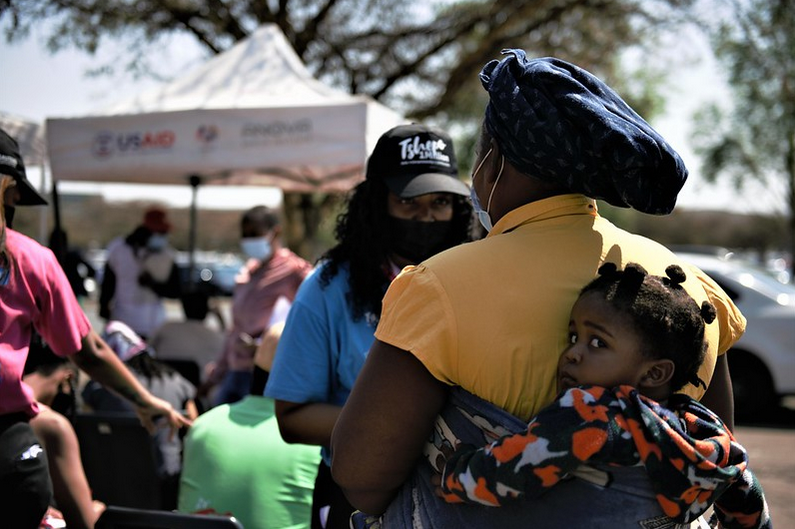
Social Science & Medicine, Volume 360, November 2024, 117302. https://doi.org/10.1016/j.socscimed.2024.117302. Image caption/credit: Mother getting vaccine from a United States Agency for International Development (USAID) mobile clinic in South Africa to help protect her family. Photo by USAID/South Africa via Flickr (CC BY-NC 2.0)
- Log in to post comments