










































Vaccines: Saving Lives or Depopulating the World? A Discourse Analysis
University of Bucharest
Parents use a variety of online resources, such as forums, websites, and social media, in order to get information and to share their experiences about vaccination. In terms of online discourses, it is possible to distinguish between supporters of vaccination, anti-vaccinators, and a third segment of people who try to attain an understanding and may be hesitant. Considering that the online discourse of people who support or oppose vaccines can be interpreted in relation to the wider cultural context in which it occurs, this study asks: How is the discourse of pro- and anti-vaccine Romanian Facebook pages constructed? What are the similarities and differences between the discourses identified on pro-vaccine and anti-vaccine pages?
The researchers use a netnographic approach, one of the advantages of which is that it can be employed as an unobtrusive method when it uses publically available data, thus avoiding ethical issues. To that end, the study only analysed Facebook posts from public pages, without interacting with the users or breaching any privacy rules.
Specifically, they analysed the discourse of 4 public Romanian Facebook pages, 2 of which support and encourage vaccination and 2 of which are in opposition to it. The data were collected using Netvizz, a data extraction application. The researchers collected the most recent 50 posts from the 4 chosen Facebook pages and then selected the 3 posts with the biggest engagement scores from each page. Engagement is defined as the total score of likes, reactions, and shares of a post.
- The first part of the investigation focused on the posts, pursuing answers to the following questions: How is the argumentation constructed in the posts, and what do the posts appeal to? Are the posts anecdotes, personal storytelling, official communication, or a combination of both? (In other words, does the discourse represent a person, an institution, or both?) Do the posts include instances of a preference for alternative medicine? Whom are the posts addressed to, if this is explicitly stated or can be deduced easily? What is the "tone" of the language (passive or active, aggressive, strong)? Is the tone of the posts serious or humorous? If humour appears, how is it used? What are the reactions to the posts?
- The second part of the analysis focused on the reactions to the analysed posts, represented by the comments left by Facebook users. Questions included: Are the comments in agreement or disagreement with the posts? What types of argumentation are present in the comments? If photos or videos are used in the comments, what do they consist of, and how can they be interpreted? What are the reactions to the comments?
The paper examines the discourse of each of the 4 pages. Brief results from 2 of them:
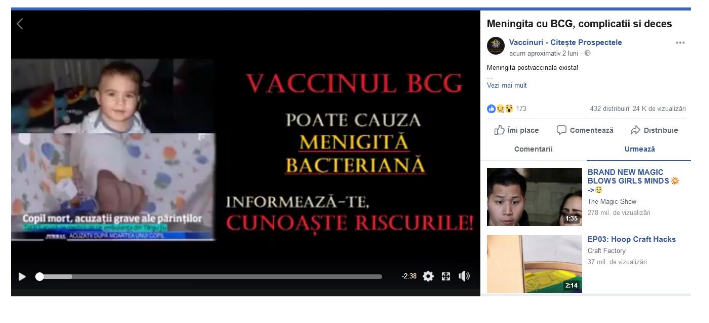
- Vaccinuri - Citește Prospectele: The most popular anti-vaccination post based on the engagement score (865) is a video from the United States (US) Centers for Disease Control and Prevention (CDC), presenting the debate and vote on the release of a new vaccine. Although the original video appeals to rationality (experts debating the topic, their arguments being constructed on statistical data and the results of controlled trials), the edited video mostly appeals to the viewers' emotions. The subtitles are sometimes written in all-capital letters, using red font and exclamation marks. The total count of reactions is 210, and there are 20 comments, most of which have at least 1 like. People combine claimed scientific information with conspiracy theory, tying to validate the latter despite acknowledging its conspiracy character. There is also an anti-feminist tendency, with some people criticising the fact that there are only women on the board.
- Proimunizare: The post with the biggest engagement score (352) from the page in support of vaccines is a photo of a graphic containing a vaccination schedule for 2018. In the post description, the page admin only mentions what the graphic represents, choosing a neutral, serious, and informative tone and approach. Since the page is created by a non-governmental organisation (NGO), its discourse is that of the institution which it represents. The few comments left come from parents who are mostly discussing obligatory and optional vaccines, requesting information about the periods and ages when they can be administered. The post has 72 likes (no other type of reaction) and 274 shares, suggesting the fact that the information from the post has been trusted and spread by other Facebook users.
Reflecting on the findings, the researchers observe that the 4 Facebook pages they studied, 2 of them pro-vaccine and the other 2 anti-vaccine, communicate the trust/distrust dichotomy as an essential component of both discourses. For instance, distrust towards the medical system is expressed in 5 of 6 anti-vaccination posts. Another characteristic of the anti-vaccine posts is the attempt to discredit official institutions/organisations that act either in the health or statistics domain, claiming that the information provided by these instances is invalid and misleading. The anti-vaccine community brings to the discussion conspiracy theories as valid arguments. Anti-vaccination pages combine (claimed) scientific sources with conspiracy theories, accusations, and a slightly expressed preference for alternative medicine (in the comments section). They also employ both emotions and rationality when explaining their position. Quite often, anti-vaccination posts employ the technique of storytelling as a means to strengthen the emotional appeal. The preference for visual materials depicting children in the anti-vaccination party can be explained by their emotional content and shock value, which are part of the accusatory rhetoric. The "atmosphere" of the comments, reflected through the reactions to the comments and the content itself, is mostly defined by sadness and anger, which are usually directed towards the institutions of the state.
Notably, some of the pro-vaccine posts aim to trigger laughter among the public, whereas other pro-vaccine posts seek to spread information in a neutral manner, appealing only to rationality. Therefore, pro-vaccine pages have different discourses. Proimunizare is more serious, having a neutral, informative tone that resembles to the discourse of an official institution, while Pro Vaccin is humorous, trying to ridicule the anti-vaxxers and targeting especially public figures from this party. On the pro-vaccination pages, the comments are either completely absent (as in the case of Proimunizare), or they suggest a state of conflict or disagreement with the information presented in the posts, as in the case of Pro Vaccin. When debates are generated in the comments section of the latter, the admin responds politely, although somewhat ironically, to anti-vaccination comments.
In conclusion: "The most prominent similarity of the discourses is the approach of trust versus distrust towards the medical system and other institutions of the state. The main differences stem from the type of arguments employed by the two parties, with the anti-vaccine pages using the storytelling technique and a mix of claimed scientific information and conspiracy theories as their main argumentation sources and the pro-vaccine pages using either official information, statements from doctors or anecdotal posts poking fun at the anti-vaccine community. The discourses of the two parties are entangled, often perpetuating each other through the types of used arguments, as well as through the debates of their supporters."
Journal of Comparative Research in Anthropology and Sociology, Volume 9, Number 1, Summer 2018. ISSN 2068-0317.
- Log in to post comments