










































In Vaccines We Trust? The Effects of the CIA's Vaccine Ruse on Immunization in Pakistan
Center for Monetary and Financial Studies (CEMFI), Bureau for Research and Economic Analysis of Development (BREAD), and Centre for Economic Policy Research, or CEPR (Martinez-Bravo); briq Institute (Stegmann)
"Despite the potential implications for human welfare, we have a limited understanding of how the disclosure of information that discredits vaccines affects immunization rates."
Confidence in vaccines is vulnerable to rumours and misconceptions. In July 2011, the Pakistani public learned that the United States (US)' Central Intelligence Agency (CIA) had used a vaccination campaign as cover to capture al Qaeda leader Osama Bin Laden. The Taliban leveraged this information and initiated an anti-vaccine propaganda to discredit vaccines and vaccination workers - trust in whom is key to vaccine acceptance. This paper quantifies the negative impact of using health services as covert for espionage by evaluating the effects of these events on immunisation rates (for the polio and measles vaccines) through a Difference-in-Differences (DiD) approach.
The paper explains the sequence of events that severely affected the population's confidence in vaccines. As part of the operations to capture Bin Laden in 2011, the CIA sought to obtain DNA samples of children living in a compound in Abbottabad, where Bin Laden was suspected to hide. Whether the operation succeeded in actually obtaining DNA samples is unclear, but Bin Laden was captured. In July 2011, 2 months later, the British newspaper The Guardian published an article reporting on the vaccine ruse and describing the collaboration of a Pakistani doctor with the CIA. The disclosure of this information caused an uproar in Pakistan and garnered criticism in the US, as well. Taking advantage of the situation, the Pakistani Taliban accused health workers of being CIA spy agents and claimed that the polio vaccination campaigns were a conspiracy to sterilise the Muslim population.
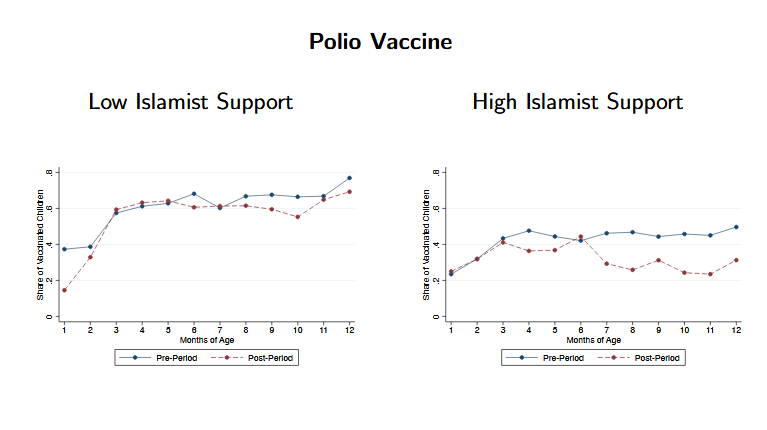
The methodology is outlined in detail in the paper, but, in short, the researchers obtained data on children's immunisation records from a large household survey. They implemented a DiD strategy using detailed data on children's month of birth combined with their district of residency. The cohort variation is indicative of the children's exposure to the new information. The researchers distinguish between fully-exposed, not-exposed, and partially-exposed cohorts, depending on the fraction of their early months in life that passed under the new information scenario. The geographic variation allows the researchers to compare the evolution of immunisation rates across regions with different levels of ideological affinity to the Taliban, which was measured by share of votes in 2008 the district of Muttahida Majlis-e-Amal (MMA), a political alliance consisting of conservative, Islamist, religious, and far-right parties of Pakistan. (Parents in districts with higher support for Islamist groups are more likely to have been more exposed to the anti-vaccine propaganda campaign. Furthermore, it is likely that parents with an initial ideological affinity to the Taliban accorded greater credibility to their anti-vaccine messages.)
Based on this evaluation, the researchers estimate that a one standard deviation increase in the support for Islamist groups led to a 12-20% reduction in the immunisation rates of fully-exposed children in comparison to not-exposed cohorts. This one standard deviation increase in support for Islamist parties is associated with one extra case of poliomyelitis per year, which is equivalent to a 93% increase over the sample mean. They also provide suggestive evidence (see especially Appendix Table 13) that the reduction in the demand for vaccines is likely to be driven by the ideological affinity to Islamist groups and not by fear or intimidation of the Taliban. The results are highly statistically significant and robust to the inclusion of various controls, including district and monthly-cohort fixed effects. Furthermore, the researchers provide evidence that supports the absence of pre-existing trends preceding the disclosure of the vaccination ruse. These results are consistent with the hypothesis that the disclosure of the vaccine ruse damaged the reputation of vaccines and formal medicine, more generally.
The paper alo includes (e.g., in sections 2.3 and 8.4) anecdotal evidence suggesting that these events were a key driver of vaccine skepticism. For instance, a reporter for one of the main newspapers in Pakistan (Dawn, 2014) offers the following quote from a health worker in Karachi: "Many parents still resist the vaccine, as they believe in many conspiracies. Some think it's a Western conspiracy to sterilise the next generation, while others think that this campaign is a cover for some kind of spy programme. Many Urdu news-papers and magazines publish material to the effect that polio drops are not good for children, and then religious clerics use these articles to prove their conspiracy theories." This quote is also informative about the likely mechanism behind the study's empirical results, which are formalised in the paper's appendix.
Additional evidence supportive of decline in demand and trust identified in the study:
- The researchers show that other forms of health seeking behaviour also experienced important declines. In particular, parents were less likely to consult health workers when their children got sick.
- Using data from the South Asia Barometer, the researchers examine the effects on measures of trust on different organisations, documenting that, after the disclosure of the vaccine ruse, trust in government organisations experienced larger declines in areas with high support for Islamist groups.
- The negative effect of the disclosure of the vaccine ruse on vaccination rates is larger for girls than for boys. One of the rumours that the Taliban was spreading was that vaccines were intended to sterilize Muslim girls. Hence, the evidence is consistent with parents granting credibility to this rumour.
The presence of an active political group trying to discredit the reputation of vaccines links this paper to the literature that examines the effect of persuasive communication on behaviour. (See, e.g., Della Vigna and Gentzkow (2010) and Kamenica (2018) for literature reviews.) In order to benchmark the present study's estimates to this literature, the researchers compute persuasion rates, estimating them to range from 30.7% to 42.3%. In addition, the nature of the anti-vaccine propaganda described in the paper connects it to literature on the effects and demand of fake news and conspiracy theories. Scholars have noted that true pieces of information are frequently woven into the narratives of conspiracy theories. The present study might add to the (limited) empirical evidence about how the disclosure of information that may provide seeming proof for a component of a conspiracy theory affects support for such beliefs and subsequent behaviour.
Broader implications of the CIA vaccine ruse may be making vaccines vulnerable to future conspiracy theories, the researchers conclude.
PowerPoint presentation [PDF], Monica Martinez-Bravo and Andreas Stegmann, November 2019.
- Log in to post comments