










































New Framework Model for Communication
"The public's noncompliance with the vaccination campaign and a crisis of trust between the public and international organizations and governments are the consequence of a deficit of theoretical and applied knowledge in the area of risk communication and public inclusion through social media."
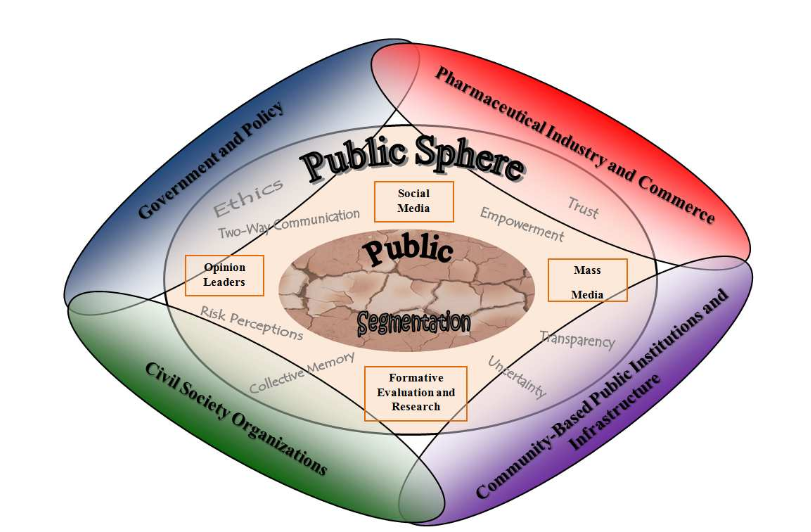
This communication planning model comes from the TELL ME (Transparent communication in Epidemics: Learning Lessons from experience, delivering effective Messages, providing Evidence) project, which aims to provide evidence and to develop models for improved risk communication during infectious disease crises.
"Generally, the framework model addresses the main research questions presented by the TELLME project: (1) How can the general population be persuaded through public health communication to take effective preventive actions during infectious disease outbreaks? (2) What are the most appropriate communication methods to deal with the complexity, uncertainty, misinformation and malicious information? (3) What are the best communication strategies to maximize compliance with vaccination, and to assist health professionals and agencies to cope with vaccine-resistant groups?
In order to establish a framework model that aims to answer the general questions, it considers the following challenges: How can the public be included in decision making effectively during the crisis? What response can be given to public health workers' concerns and fears? How can media professionals be included in risk communication to the public (not only as informers but as partners during the pre-crisis, warning, emergency, resolution and evaluation stages)? What messages/issues should be communicated to different subpopulations during pandemics? How can public sentiment be tracked during real time pandemics and respond immediately and forcefully, bring about maximum public participation and collaboration?
...Broadly speaking, the model focuses on four crucial elements that shape the distribution of information in outbreak communication:
- WHO: which actors are called for involvement at which stage?
- HOW: which communication channels are best to be used by those actors to achieve objectives?
- WHEN: which time is best to communicate messages, prior, during or after an epidemic?
- WHAT: which risk communication theories and tools ought to be considered in producing messages, for more effective involvement of the public and better level of immunization, also keeping ethics in mind?
...Risk communication models do exist. By model, we mean an effective conceptual representation of reality to help plan and execute complicated projects. However, models to date tend to be characterized by a top to bottom hierarchic nature, in the sense that the message flows from the organizations to the public. his is illustrated by the pyramid of stakeholders; the top end is reserved for international level policymaker-stakeholders....while the bottom end contains the 'general public.' Such top-down models convey the notion that information flow is unilateral....Such perceptions should be replaced with discourse that sees the public not as another stakeholder but rather as a partner, not to be patronized but engaged. Other guidelines have emphasized the importance of the public, but we give this decisive expression by situating the public sphere at the center of the model. Emerging communication technologies that allow easy, accessible and immediate public participation suggest that concerns and beliefs flow back into the decision-making process of health organizations, changing it completely. A successful public health campaign must take into an account that in the current reality, the 'health blogger' or the 'concerned mother' are sometimes as important as the healthcare official... Key components:
- The public sphere
- Segmentation
- Mass media
- Social media
- Opinion leaders
- Research
- Stakeholders
...The contribution of this model is that it can be adapted to many specific risk situations through simulations in which the ideas can be developed into concrete plans. It pinpoints misconceptions, offering a new outlook on the relationship between components involved in risk communication. Its primary goal is to map the major contenders in EID [emerging infectious disease] communication and their interrelationship. Although it provided some details on certain aspects, it is not meant to serve as a communication kit per se, but as the foundation for such a kit, and also for further research.
Further research horizons include addressing how formal health organizations and mass media should work together in times of a decentralized communication map and how to combat misinformation in the context of the model. Other issues include delving into the potential ethical and legal implications of the model, and the specific communication tools that can be used to target different profile groups."
New Framework Model for Communication [PDF] and TELLME website, both accessed on February 2 2015.
- Log in to post comments