










































Imperfect Vaccine and Hysteresis
Dartmouth College
In recent years, researchers have been working to improve understanding of the role of social factors in epidemiology. The use of behaviour-disease interaction models is one approach for studying how vaccine compliance can be influenced by a wide range of factors, ranging from vaccine scares to disease awareness. In the aftermath of a sharp decline in vaccination coverage triggered by concerns regarding vaccine safety and efficacy - e.g., the infamous measles, mumps, and rubella (MMR) vaccination and autism controversy - the recovery of vaccination rate to levels needed to attain herd immunity has been slow. This study shows that past problems with vaccines can cause a phenomenon known as hysteresis, creating a negative history that only strengthens public resolve against vaccination.
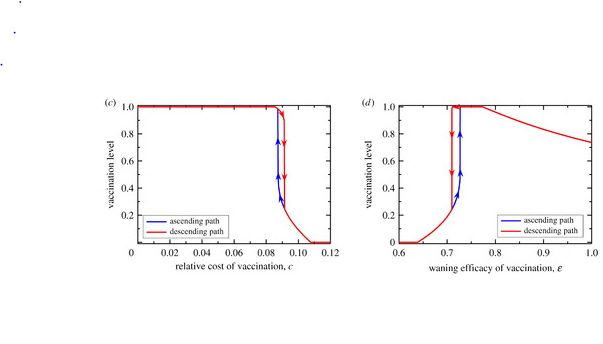
A hysteresis loop causes the impact of a force to be observed even after the force itself has been eliminated. As revealed by the bifurcation analysis detailed in the article, the hysteresis loop can be caused by questions related to the risk and effectiveness of vaccines - that is, the loop can arise with respect to changes in the perceived cost of vaccination. In the presence of imperfect vaccine, if the public perception exaggerates the real cost of vaccination, which should be quite small otherwise, the vaccine uptake can plunge from high levels into zero. Negative experiences or perceptions related to vaccination impact the trend of uptake over time - known to the researchers as a "vaccination trajectory" that gets stuck in the hysteresis loop. In this way, hysteresis prevents an increase in vaccination levels even after the negative objections have been cleared, making society increasingly vulnerable to disease outbreaks.
As suggested by the analysis, the hysteresis effect can act as a roadblock for the recovery of measles vaccination coverage, despite resurgent measles outbreaks that impose serious infection risks for these intentionally unvaccinated. The results also suggest that the effectiveness of vaccination has a substantial impact on vaccine uptake decisions, for example, whether to get flu shots. In order for the population to achieve high levels of flu vaccination, the efficacy of flu vaccine has to reach above 50%. However, such improvement of the flu vaccine efficacy may turn out difficult due to the fast pathogen mutation and adaptation.
The researchers explain that the perceived cost or effectiveness of vaccination may be determined by a concurrent dynamic of social contagion that governs the changes in public perception of vaccination risk or vaccine beliefs. In the electronic supplementary material, they show that incorporating co-evolving vaccine attitudes into vaccination dynamics can strengthen the hysteresis effect, further hindering the recovery of vaccine uptake.
However, by identifying the hysteresis effect in vaccination, the research team hopes that public health officials can design campaigns that increase voluntary vaccination rates, particularly by promoting vaccination as an altruistic behaviour that is desirable, per moral and social norms.
Proceedings of the Royal Society B 286: 20182406. https://doi.org/10.1098/rspb.2018.2406 - sourced from Science Daily, January 31 2019.
- Log in to post comments