










































Making Inroads with Mobile Populations
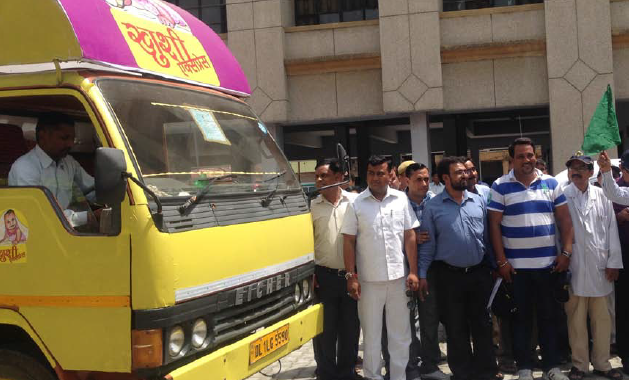
One of the key reasons polio eradication efforts in India were undermined was because of difficulties in consistently vaccinating children living in migratory families. This chapter from the document Influencing Change (see Related Summaries, below) describes a comprehensive migrant vaccination strategy developed by the CORE Group Polio Project (CGPP) to reach children of migrant labourers who travelled seasonally throughout India from Uttar Pradesh (UP) and neighbouring Bihar. Strategies such as "transit vaccination", in which oral polio vaccine (OPV) was administered to mobile and transitory populations, were also introduced.
In the initial stages of the migrant strategy, tracking and mapping of migrant communities was difficult, as there was little knowledge of the different kinds of groups and their socio-demographic characteristics. The first step was for personnel who were part of CGPP's Social Mobilisation Network (SMNet) - Block Level Mobilisation Coordinators (BMCs) and Community Mobilisation Coordinators (CMCs) - to identify key informers, who were a valuable source of information on the location and movement of migrant families in the area. The informers included landlords, shopkeepers, barbers, security guards, property dealers, and social health workers. Regular meetings were held with informants to familiarise them with their role in the polio eradication effort, as well as to involve them in helping the vaccination teams during immunisation rounds.
At the outset, efforts were focused on mapping migratory populations in the area according to the type of site - nomadic, brick kilns, construction sites, and slums. As these populations were constantly on the move, the maps were updated regularly and especially before every vaccination round. In addition to locating and mapping these populations, the BMCs and CMCs tried to collect information about the numbers, socio-economic status, language/dialect, and employers of the mobile populations. The BMCs were entrusted to initiate dialogue with owners and associations of brick kiln workers, builders, developers, and employers to allay their suspicions and to engage them as facilitators and influencers. Once these partnerships were established, some employers provided additional support to the programme by offering space for setting up vaccination booths, aiding with logistics, and motivating their workers to take part in the booth day activities and to get their children immunised.
With the help of the informants and employers, the CMCs made regular visits to the mobile sites in order to build a rapport with the community and understand their needs. After familiarising themselves with the dialect/language spoken by the community in order to gain their trust, they held several meetings with various community members to understand their reasons for non-participation in polio vaccination drives. These interactions helped the programme planners realise that migrant communities were not resistant to vaccination, but that the low participation was more due to a lack of access to information and services.
To address the low levels of awareness about health needs and services, an emphasis was placed on effective communication and outreach activities among high-risk group (HRG) communities. For example, the CMCs organised mothers' and fathers' group meetings as well as interpersonal communication (IPC) sessions to raise awareness of various health- and immunisation-related issues.
The CMCs prepared lists of eligible children so that they could be registered for the immunisation rounds in order to ensure that not a single child was left out. When new families moved into the area after the vaccination rounds, their information was documented and forwarded by the CMCs to the immunisation teams, who would visit the community to vaccinate the children. Since children usually accompanied their parents to their work sites, immunisation teams were also given information about the time when children were most likely to be available (at the worksite), either early morning or late evening.
Special immunisation teams were formed under the transit vaccination strategy to reach and vaccinate children of migrant populations at transit points such as railway stations, bus stations, check posts, border areas, marketplaces, religious gatherings, etc. CMCs would also enter buses andtrains at inter-city bus and train stations to give educational talks to migrant families and register their children for immunisation.
Specific communication messages and tools were developed for migrant communities. At first, they were provided with basic hygiene and sanitation messages, and they were given soap strips and information on diarrhoea management. Then they received information on the importance and need for polio vaccination and routine immunisation (RI). The slogan "Wherever you are, wherever you go, immunise your child against polio with two drops, every time" was developed, and families were provided with immunisation cards and card holders to help them track their children's vaccinations and to help link them to health services in the new areas they travelled to.
According to CGPP:
- More than 250,000 settlements with migrants were identified and covered by the CMCs.
- The efforts of mapping and reaching out to migrant families resulted in a decrease in the number of unimmunised children in mobile communities. Eight million children in transit were immunised in India during each round, of which 100,000 were in running trains.
- Involving key stakeholders and gatekeepers of migrant populations, such as employers, contractors, etc., helped to ensure that all children were immunised.
- For BMCs, building rapport with the employers of migrant workers was key to reaching these migrant communities.
Jitendra Awale, Deputy Director of CGPP India, is of the opinion that for any programme to succeed, it is very important to have a strong review and feedback mechanism for making mid-course corrections, if needed. He also added that one of the key aspects of working with migrant communities was the establishment of rapport with gatekeepers or informants. In addition, he suggested that with changing technology, the paper tracking system that was designed for the Pulse Polio programme should be modified to use a mobile-phone-based tracking system.
Editor's note: This is Chapter 7 in the document Influencing Change: Documentation of CORE Group's Engagement in India's Polio Eradication Programme, which is a collaborative effort of the CGPP and The Communication Initiative. Please see Related Summaries, below, to access it in its entirety.
Image credit: CGPP
- Log in to post comments