










































From Reaching Every District to Reaching Every Community: Analysis and Response to the Challenge of Equity in Immunization in Cambodia
Ministry of Health (Soeung); University of Melbourne (Grundy); World Health Organization, or WHO (Duncan); Public Health Consultant - with UNICEF from 2004 to 2010 (Thor); Public Health Consultant - with WHO from 1991 to 2008 (Bilous)
"[I]n order to reach every community, more sensitive local area planning instruments and operational strategies will be required at a sub-district level in order to promote and sustain equity in health services access and outcomes."
Studies have indicated that inequities in access to immunisation are largely related to social exposures of wealth and maternal education status, urban vs rural location, and gender. Cambodia, whose unreached populations are characterised by specific exposures of social and economic disadvantage, coheres with this picture. This case study analyses successes and challenges in relation to improving equity of access to immunisation in Cambodia and then proposes a strategic and operational way forward for Cambodia and other countries struggling with inequity in immunisation access.
Providing some background, the researchers note that both campaign delivery strategies (e.g., in the case of polio) and routine strategies have demonstrated some pro-equity effects. As an example of the latter, the researchers provide some data indicative of the impact of the Reaching Every District (RED) strategy. Launched by World Health Organization (WHO) and United Nations Children's Fund (UNICEF) in 2002, RED was designed to scale up coverage above 80% through application of 5 operational strategies, including re-establishing health outreach, implementing supportive supervision, linking services with communities, monitoring and use of data for action, and planning and management of resources.
The case study is based on information from Demographic and Health Surveys (DHS), published literature, and the findings of a November 2010 review of the immunisation programme that collected data on locations and reasons for the under-immunised status of women and children. In terms of framework of analysis, equity is conceptualised as a "measure of difference" in outcomes or impacts based on social or economic exposures; equity discourses suggest that these differences are fundamentally unjust.
In short, the review found that the national programme has evolved from earlier central and provincial level planning to strengthening routine immunisation coverage through the RED approach. However, over 20% of children surveyed were not fully immunised, primarily from communities where inequities of both access and impact persist.
More specifically, the researchers review the evolution of strategy in the national immunisation programme, which began in 1986. They note that health equity is a major policy concern of the Ministry of Health (MOH). Data from countries that conducted DHS between 2002 and 2010 contrasting immunisation coverage for the third dose of diphtheria-tetanus-pertussis (DPT3) by wealth index indicate that, in Cambodia, this gap is 21%. In terms of the regional perspective and the global median, Cambodia rates reasonably well in this immunisation equity analysis, according to the researchers. Although absolute gaps in coverage between highest and lowest wealth quintiles (21%) and highest and lowest education levels (24.7%) in particular are still highly significant, the narrowing of the wealth gaps between 2000 and 2005 demonstrated a promising trend. However, the DHS data released in October 2011 demonstrate that the equity gap for socio-economic exposures has not narrowed since 2005. As the paper outlines, there is also evidence indicating that the incidence of vaccine-preventable diseases (VPDs) is correlated to the socio-economic background characteristics of populations.
Findings from the national a review of the Cambodian Expanded Programme on Immunization (EPI) in 2010 confirm the findings of the DHS data analyses, and they uncover additional social exposures for un-immunised status. For example, "social distance" rather than geographical distance predominated as the main determinant of immunisation access. Social distance is related to the level of acceptability or affordability of people's access to health care; it can be powerful in shaping the frequency and quality of health provider and community contacts. These qualitative observations match the DHS data findings. To cite another example: Ethnicity and migration were also noted to be factors associated with low immunisation status. These included Vietnamese floating villages, remote indigenous minorities, and resident Cham (Muslim) villages. In these communities, communication barriers, mobility, and lack of trust between these sub-communities and the health system were found to be barriers to access.
Thus, one can conclude from the review that, "Although in many regards Cambodia has progressed far in conquering the challenge of narrowing the impacts of geographic distance through the RED strategy and related health system strengthening initiatives, the challenge remains on how to narrow the differences associated with social distance....The district, as an operational unit, is less well placed to undertake social analysis and action at community level than the primary care facility and community-level networks that reside near disadvantaged groups."
The implication of these findings for Cambodia and other countries, the researchers suggest, is that alternative and more sensitive community planning approaches will be required in order to recognise communities that are "hidden" or more mobile and to bring them back into the range of modern health and social services. Box 1 in the paper outlines in more detail the areas of operational focus that could be applied to a "reaching every community approach". In short, the approach entails:
- Re-focusing planning systems to better understand and respond to the needs of vulnerable communities, including "social risk".
- Building community-based monitoring systems that incorporate measurement of equity in order to strengthen service access for vulnerable social groups.
- Developing a communication strategy that involves strengthening community-level health networks by building the capacity of non-governmental organisations (NGOs), local authorities, and women's associations to extend the communication and health monitoring links with vulnerable communities.
- Modelling service delivery strategy on community needs and characteristics, implementing outreach service packages with immunisation, and strengthening demand for fixed-site services.
- Securing political commitment for the narrowing of equity gaps through targeted financing of communication and service delivery operations specifically for vulnerable groups, and agreeing on health equity targets in national and sub-national health plans.
The researchers argue that, while it is recognised that pro-equity strategies in relation to immunisation can support disease elimination and control objectives, "equity objectives have value in their own right, in so far as they contribute to the level of fairness and well being...for the society as a whole, and not only for the groups with highest risk..." This claim is in line with the Global Immunization Vision and Strategy (2006-15), which expresses the vision of WHO, UNICEF, and other partners to achieve equity in immunisation, including ensuring that new and underutilised vaccines are available to all and are distributed equitably across the social gradient.
In conclusion: "By building on the experience of RED, this shift in operational emphasis from the district to the local community area will improve equity and maximize the benefits of new vaccine introduction both in Cambodia and other countries. Making a difference in the Decade of Vaccines will increasingly require planners to focus on 'narrowing the social difference'."
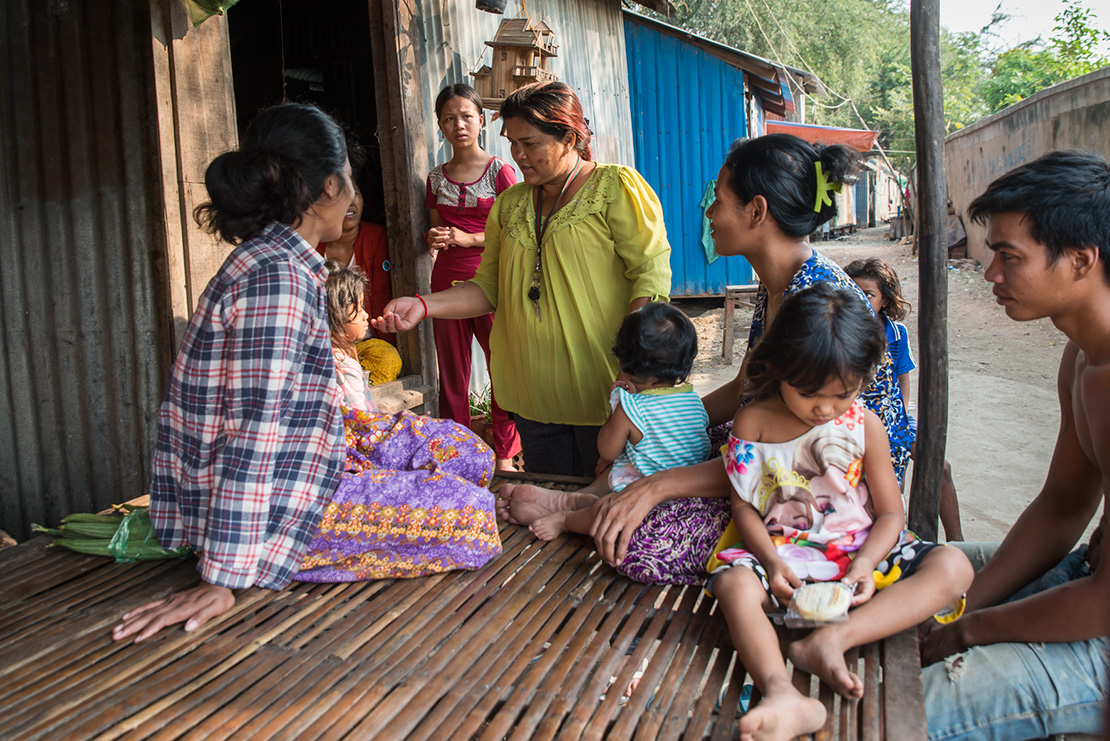
Health Policy and Planning 2013;28:526-35. doi:10.1093/heapol/czs096. Image caption/credit: "Ms. Sokly Ye goes throughout the whole vaccination process explaining it step by step, and the importance of not missing any of them in order to get a proper immunization. Svay Pak Village. Samkat Svay Pak. Kan Rossey Keo. March, 2107" © UNICEF Cambodia/2017/Fani Llaurado
- Log in to post comments