






































Adapting Home-Based Records for Maternal and Child Health to Users' Capacities
Japan International Cooperation Agency
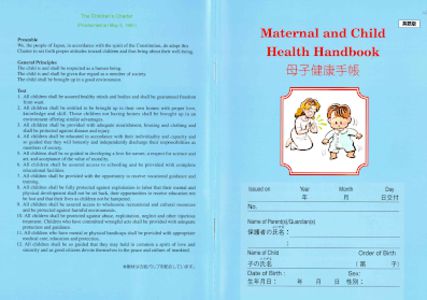
Used in over 163 countries to date, home-based records (HBRs) are documents used to record the history of health services received by an individual. A common example is child vaccination cards developed for child immunisation programmes; the child vaccination card and growth chart are sometimes integrated into a child-targeted HBR, often called the child health card or handbook. Noting that the question of why misuse or inadequate use of HBRs takes place has not yet been clearly answered, these researchers hypothesise that there is a mismatch between their expected functions and the reality of users' capacities to manage the records. In this paper, they summarise the expected functions of HBRs and propose a function-capacity conceptual framework for HBRs.
Table 1 in the paper outlines the range of functions for HBRs as reported in earlier studies. Here, the authors categorise the expected functions into 3 levels, explaining that both types of HBR users (i.e., healthcare service users and providers) potentially benefit from all 3:
- Level 1: data recording and storage - For example, by double-checking children's immunisation histories recorded in home-based records, over-vaccination can be avoided.
- Level 2: behaviour change communication (BCC) - For example, health guidance pages embedded in records (typically in integrated, rather than stand-alone records) can help mothers practise home-based self-learning and peer education for taking necessary action on maternal- and child-health-related issues. The pages also help healthcare workers to deliver educational messages and to give mothers guidance on the appropriate timing of services, such as vaccination schedules, and how to practise home-based care.
- Level 3: monitoring and referral (level 3) - This function aims to promote continuous self-monitoring, thereby empowering mothers and caregivers to recognise and address health risks via self-care or self-referral to a higher or lower level of health facility. The process of self-monitoring and self-recording on child development milestones can provide mothers and caregivers with an opportunity to increase interaction with and attachment to their children.
Figure 1 illustrates the hypothetical capacity requirements of users of HBRs in relation to the 3 levels of function. Users' capacities here encompass not only knowledge and potential abilities, but also motivation and attitudes that enable practices. Corresponding to the above:
- HBR as data recording and storage tool: At a minimum level, mothers and caregivers should be capable of carefully retaining HBRs and taking them to the points of service. However, a low level of literacy among mothers could affect receipt and loss of HBRs.
- HBR as BCC tool: Mothers and caregivers should be able not simply to read and understand the contents of guidance pages, but also to incorporate them into practice.
- HBR as monitoring and referral tool: Healthcare workers need the capacity to explain the data and health-related messages to mothers and caregivers and to translate these for appropriate clinical decisions. To record data on child development, mothers and caregivers need the capacity to objectively observe their children's behavioural and cognitive responses against the child development milestones in the HBR.
When a record designed for higher-level functions is employed in settings with users of lower capacities, policymakers may need to downgrade functions or add supplementary elements to the record and its operation. In that context, having an accurate understanding of users' current capacities can:
- Inform thinking about HBR design: Reports from Indonesia, Kenya, Uganda, and West Bank and Gaza Strip suggest that records with graphics and illustrations were more understandable and attractive to illiterate or less literate mothers and might have contributed to higher coverage and lower loss of HBRs. More user-friendly design can be effective, particularly when the health system requires level 2 functions, but users' capacities remain at the level 1 function.
- Help shape supportive interventions for increasing users' capacities to realise all levels of HBR functions: For instance, in-service training on health education methods can increase the feasibility of level 2 functions. When training programmes are not readily available and accessible, guides or manuals for healthcare workers serve as practical tools to support smoother and more efficient HBR use.
In conclusion: "Mismatches between the expected functions of records and the realities of users' capacities need to be examined for the optimal use of home-based records in maternal, newborn and child health care."
Bulletin of the World Health Organization. 2019 Apr 1; 97(4): 296-305. doi: 10.2471/BLT.18.216119. Image credit: Home-based Record Repository - Japan