











































Appropriate Vaccine Schedules for Children Younger Than 2 Years in Pakistan and Bangladesh: Lessons From a Multisite, Mixed Methods Study
IRD Global (Siddiqi, Shah, Roy, Chandir); IRD Pakistan (Ali, Dharma, Khan, Chandir); IRD Bangladesh (Roy)
"Reducing MOVs caused by complexity and changes in EPI schedules can improve immunization coverage, timeliness, and equity..."
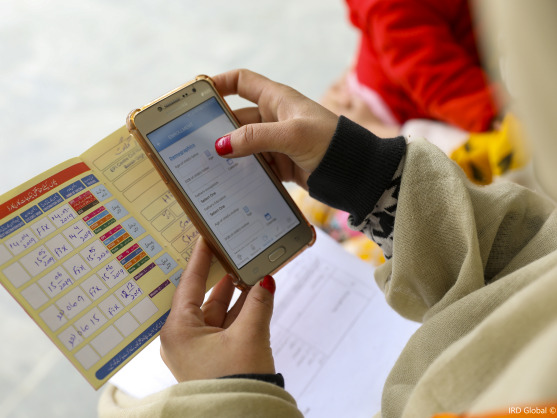
Missed opportunities for vaccination (MOVs) - that is, when children interact with the health system but fail to receive age-eligible vaccines - are a problem in many low- and middle-income countries, leading to underimmunisation and delayed vaccination of children. Lack of awareness among parents and providers, including inaccurate interpretations of complex catch-up schedules by health workers, is one of the primary causes of MOVs. Carried out in Pakistan and Bangladesh, this study assessed the feasibility of a mobile-based immunisation decision support system (iDSS) to automatically construct age-appropriate vaccination schedules for children, thus preventing MOVs.
Using open-source software, the researchers developed a multlingual android-based iDSS designed for mobile-based deployment, packaged in the form of an application programming interface (API) to function both as a standalone module and interoperable with other digital applications or platforms, such as web-based or mobile-based electronic immunisation registries (EIRs). The API shows an age-appropriate immunisation schedule (including the vaccines due at the current visit and those to be scheduled) tailored to the child and the respective country's Expanded Programme on Immunization (EPI) schedule. The iDSS prompts the vaccinator through warning messages if vaccines are being administered out of schedule to ensure that interdose gap guidelines are followed.
A sequential exploratory mixed-methods study was conducted at 6 immunisation centres in Pakistan and Bangladesh. The selected study sites had high penetration of mobile phones (>90%) and the presence of cellular networks (data connectivity) among the population. From July 5 2019 to April 11 2020, 6,241 immunisation visits were recorded from 4,613 eligible children; data were collected for 17,961 immunisation doses for all antigens. The diagnostic accuracy of the iDSS was measured by comparing the schedules constructed by the iDSS with the gold standard of evaluation (World Health Organization (WHO)-recommended EPI schedule constructed by a vaccines expert). Preliminary estimates were collected on the number of MOVs among visiting children (caused by inaccurate vaccination scheduling by vaccinators) that could be reduced through iDSS by comparing the manual schedules constructed by vaccinators with the gold standard.
For the qualitative component of the study, the researchers interviewed 16 vaccinators (11 from Pakistan and 5 from Bangladesh), who were provided with mobile phones with iDSS that they could use to schedule current and future vaccinations. Before using the iDSS, vaccinators were given a 2-day training by the study staff on using the iDSS module as part of their daily immunisation activities. After the vaccinators had used the iDSS for at least 4 weeks, the study team interviewed them.
The findings show that the highest MOVs across Pakistan and Bangladesh sites were for polio and measles vaccines, as 27.5% (383/1,391) and 5.3% (28/527) of all due immunisation doses, respectively, were missed by vaccinators.
The iDSS correctly scheduled 99.8% (17,932/17,961) of all age-appropriate immunisation doses compared with the gold standard. In comparison, vaccinators correctly scheduled 96.8% (17,378/17,961) of all immunisation doses. A total of 3.2% (583/17,961) of all due doses (across antigens) were missed in age-eligible children by the vaccinators across both countries.
In addition, the end-user feedback from a diverse set of vaccinators, who varied in terms of gender, education, age, and experience, confirms the utility and functionality of iDSS, its acceptance, and user satisfaction. Among the benefits of the technology they report is that it accurately constructs age-appropriate vaccine schedules quickly, saving time, and/or that it could serve as a channel to digitalise immunisation information systems. Only about half (9/16, 56%) of the vaccinators interviewed found the iDSS easy to use, presumably because of maintaining paper-based and electronic records simultaneously in the study. Also, 62% (10/16) participants across both sites remained confused about the age-appropriate administration of inactivated polio vaccine (IPV) and measles vaccines.
The researchers note that API-based iDSS such as the one used in this study allows flexibility to adjust to multicountry EPI schedules that change frequently and can also adapt to cosmetic user interface changes such as varying languages and displays.
In short, this study provides "evidence of the diagnostic accuracy of a stand-alone mobile-based iDSS implemented across a multicountry LMIC setting" and underscores its potential to increase immunisation coverage and timeliness by eliminating MOVs. "The findings from this study provide the impetus for rigorously evaluating the impact of iDSS through a randomized controlled trial and paving the way for a scaled implementation of this tool across LMICs."
JMIR Pediatrics and Parenting 2023;6:e40269) doi: 10.2196/40269. Image credit: IRD Global/Asad Zaidi
- Log in to post comments