










































Barriers to Immunization in the Dominican Republic and Mozambique
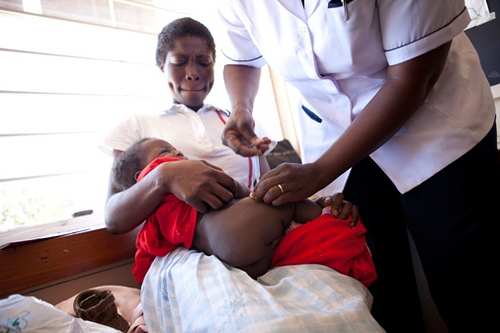
CHANGE Project (no longer in operation)
"[I]nterventions solely aimed at increasing demand - without accompanying improvements in the services offered - are likely to result in only limited increases in vaccination coverage."
This article summarises and compares national studies in two diverse countries of barriers to higher immunisation coverage. Both studies used multiple quantitative and qualitative methods, which was found to be a valuable research approach. For instance: "Examining the same question with information from various sources and using various methods was very useful. For example, over three fourths of Mozambican health workers claimed to always write the return date in the child health card, yet an examination found such annotations in only a quarter of the actual cards."
Working with the ministries of health and other partners, the CHANGE Project undertook:
- A study in the Dominican Republic in conjunction with the introduction of pentavalent vaccine. The major problem revealed was the lack of a reliable supply of vaccine, except in the capital, Santo Domingo. As noted here, although many studies have found that health workers' harsh treatment of mothers is a key immunisation barrier, in the present study, 97% of those interviewed said they had been treated well or very well, and 92% of this group said they were always treated well. That said, in focus group discussions (FGDs), "some mothers mentioned their fear of health staff who are so poorly prepared that they might give the wrong vaccine." Mothers had "very poor knowledge about the diseases prevented by vaccines. However, an equally significant finding is that this low knowledge appeared to have no significant effect on their general enthusiasm to have their children vaccinated."
One selected communication-related finding is that 17% of mothers responded that during their last visit, the health worker did not inform them about the vaccines. The child immunisation card is meant to serve as a key channel for information on where, when, and which vaccines are due. Yet, without outside assistance, many mothers - even literate ones - cannot understand basic information on the card. Eighty percent of the mothers surveyed could read, yet only half of them could look at a completed vaccination card and say which vaccines the child had received, how many immunisations the child had received, or the date of the next immunisation. "This finding is a strong argument for simplifying the card, for teaching mothers how to interpret it and for not depending only on the card to communicate this information." FGDs indicated that mothers' not bringing the card was a problem. Of the 428 children with a card at the time of their mothers' interview, 37% had their immunisations up to date.
The study findings were shared in meetings with health officials throughout the country. In addition: in-service training on immunisation was given; supervision of immunisation was systematised and better funded; and an immunisation manual for health workers was completed and distributed.
- A study in Mozambique undertaken to fill a gap in understanding of the reasons for current coverage levels. Lack of vaccine did not emerge as a major reason for non-immunisation or incomplete vaccination; rather, mothers said the major barrier was the long distance (difficult access) to immunisation services.
Selected findings related to communication include: Health workers had low levels of knowledge on immunisation ("although many expressed a keen desire to learn"), as did mothers: only 13% of mothers could correctly name 3 vaccine-preventable diseases, and 57% could not name even one. Health workers missed opportunities to vaccinate and educate (only 27% of child health cards examined had a vaccination return date written). Furthermore, 41% of mothers said that, during the last vaccination visit, a health worker did or said something that made them feel uncomfortable. Exit interviews after vaccinations showed: 43% of mothers were not told or could not remember the disease(s) the vaccine was for; only about a third were told about side effects; and a quarter were not told when to return for the next vaccination. While 87% of children had a child health card, only about a quarter of mothers can read. Furthermore, on only 27% of child health cards had a health worker written the date for the next vaccination.
"Insights from the study were used to develop new communication messages and materials to promote vaccination. In cooperation with other donors, Project HOPE and the CHANGE Project have facilitated improvements in immunization program logistics and procedures, supervision from the national EPI [Expanded Programme on Immunisation] to provinces and districts, and the finalization of an updated EPI manual."
The discussion section of the report notes that, in both countries, despite problems with the convenience, reliability, and friendliness of services, "[t]he vast majority of mothers in both countries were highly motivated to have their children vaccinated....Although mothers with better knowledge were somewhat more likely to have their children fully immunized, there is no strong evidence that the fact that many mothers did not know what diseases or have accurate information about the diseases had a major influence on their motivation." Thus, it was concluded that it is essential to increase quality and consistency of services.
Email from Mike Favin to The Communication Initiative on February 23 2015. Image credit: ONE
- Log in to post comments