











































To Boldly Remember Where We Have Already Been: Revisiting the Cutter Polio Vaccine Incident during Operation Warp Speed
Harvard University
"The Cutter Incident is valuable to revisit, not only because of its significant role affecting vaccine development in the past, but also because of its relevance among those demanding a COVID-19 vaccine today in what is the most pressing pandemic in the first quarter of the 21st century."
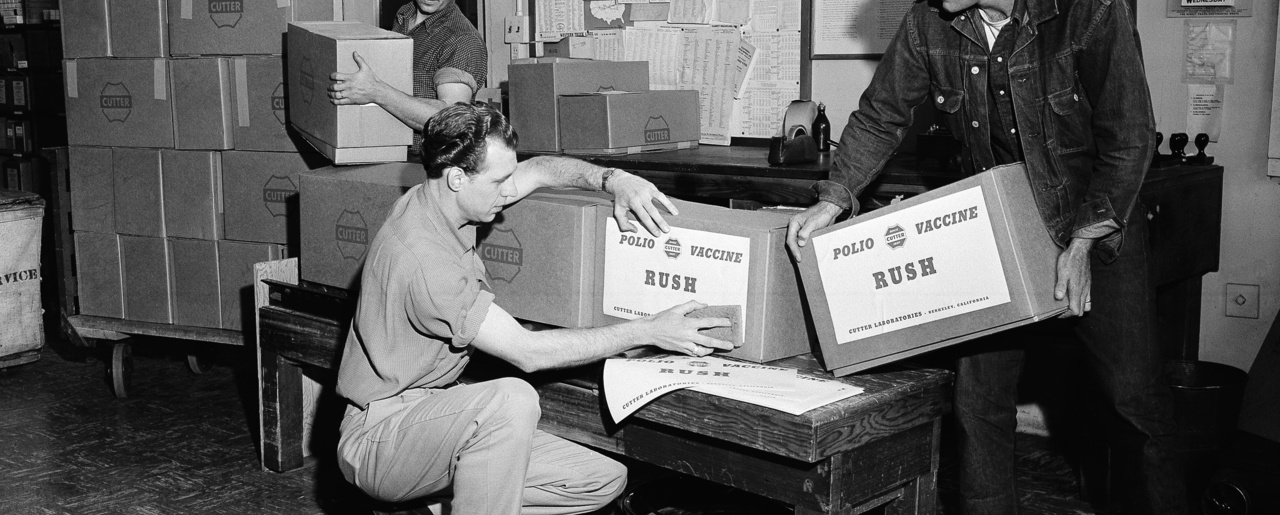
In the context of the COVID-19 pandemic, headlines such as "Mistrust of a Coronavirus Vaccine Could Imperil Widespread Immunity" indicate widespread concerns that individuals may not choose to get the vaccine, even when one is made available in the United States (US). Part of the hesitancy being expressed toward the government programme "Operation Warp Speed", a private-public partnership to create a vaccine for the SARs-CoV-2 virus and the COVID-19 disease it causes, may be due to concern about that vaccine development has been rushed for political purposes. In this context, this article revisits the April 1955 Cutter Incident in the US, when mass-produced doses of polio vaccine containing insufficiently inactivated (killed) live polio virus were released to the US public. The Cutter Incident not only resulted in disability and death but also impacted subsequent vaccine development and issues of legal liability for companies developing vaccines. This paper considers lessons learned from this incident in light of the international quest to create a COVID-19 vaccine.
The paper is organised into 3 sections, the first of which recounts the Cutter Incident. The problem centred on the fact that the vaccine the California, US-based firm Cutter Laboratories produced contained the most virulent strain, called the Mahoney strain, of the 3 types Jonas Salk discovered earlier in 1952. Because of insufficient government regulations that demanded that vaccine manufacturers adhere to Salk's guidelines for inactivating the live virus, Cutter's production failed to kill the virus in the vaccine. Nathaniel L. Moir explains that haste played a major role in the disaster; for instance, the entire discussion to license Salk's vaccine lasted a mere 2.5 hours. In the case of Salk's efforts, he and other scientists, including Albert Sabin, advanced vaccine science with great urgency because polio was a killer. However, the Cutter Incident was as well; the final toll included the infection of 220,000 people with live poliovirus, with 164 paralysed and 10 dead by the time the error was discovered.
The second section explores consequences and implications stemming from the Cutter Incident in the years following it. As shown, there were 7 reasons why the incident occurred, one of which seems to be a communication-centred one: The federal government did not know that Cutter was having problems. The warnings provided to the Laboratory of Biologics Control, the organisation responsible for licensing the vaccine for production after safety tests, were "lost in the noise". Furthermore, in the aftermath of the disaster, instead of an even greater reckoning for the federal government, Cutter Laboratories was found to be liable but not negligent because it followed protocols, faulty as they were, that were instituted according to scientific knowledge at the time. When vaccine regulation moved from the National Institute of Health to the Federal Drug Administration in 1972, vaccine regulations grew to the point that vaccines were held to a higher standard than almost any medical product created for children. As a consequence, liability-related legal issues decreased potential profits, and this factor constrained vaccine development in the US until Operation Warp Speed came onto the scene.
The third section of the paper explores the broader contemporary relevance of the Cutter Incident for vaccine development for COVID-19. It assesses liability without fault, among other consequences resulting from the incident, in the context of current vaccine development through Operation Warp Speed. As noted here, a 2003 Institute of Medicine report called the vaccine industry "surprisingly fragile", and, according to Moir, this weakness has grown over the years - necessitating large-scale and significant financial outlays to catch up through creating and funding Operation Warp Speed. Moir stresses that science "should never become politics' handmaiden, even when immense political pressure is applied to create a solution....In the end, the Cutter Incident deserves to be remembered because it shows the value of patience and it shows the importance of safe testing for a vaccine that should be equitably distributed if one is developed."
Offering recommendations based on the analysis of this history, Moir concludes: "In terms of those doubting the utility of vaccines at all, one effective way to address the stridency of anti-vaxxers' campaigns against vaccination may include simply providing clear and comprehensive information and history may help provide clarity in such an effort. Historians may contribute, therefore, to an improved information environment by highlighting how the past affects the plight of people enduring the COVID-19 pandemic today. The Cutter Incident should remind us, in the end, that one of the most consequential causes of the disaster originated in the desire and rush to create a solution."
Journal of Applied History 2 (2020) 17-35. doi:10.1163/25895893-bja10009. Image credit: Ernest K. Bennett | AP
- Log in to post comments