










































Characterizing Polarization in Online Vaccine Discourse - A Large-scale Study
Technical University of Denmark (MønstedSune Lehmann); University of Copenhagen (Sune Lehmann)
"[S]tudy of the interplay between vaccination attitudes and vaccine-related online (mis)information is essential to inform policy..., also at the community level..."
The detrimental effects of vaccine hesitancy, which can lead to reduced vaccine uptake, on public health are well described in the literature. Somewhat paradoxically, vaccination rates have declined in part due to the success of vaccines in preventing disease, leading to complacency. However, online misinformation has also been linked to decreased vaccine confidence, with social media being recognised as a contributor to the propagation of false information and fringe narratives. Using a sample of over 60 billion tweets, this study of the vaccine discourse on Twitter presents a number of analyses on the interplay between strong vaccination stances, social network structure, and the information sources shared by users in vaccine-related contexts.
The study draws on two large datasets: (i) a large, random sample consisting of approximately 60 billion tweets (Dataset 1) and (ii) 6.75 million tweets obtained via Twitter's search application programming interface (API) for tweets containing vaccination-related terms (Dataset 2). Using these datasets, the researchers construct a large network that captures interactions on Twitter, and they use machine learning methods to identify Twitter profiles with vaccine stances at the "rejection" (anti-vaxx) and "acceptance" (pro-vaxx) extremes of the hesitancy continuum. In this study, tweets expressing anti-vaccine sentiment constitute an estimated 17% of vaccination-related tweets, whereas about 3% of profiles stance are classified as antivaxx. (Details on data gathering, classification, and geolocation are provided in the paper's materials and methods section.)
Of the vaccination-related tweets, approximately 2.65 million contain external links (URLs outside of Twitter). In the top ten URLs, profiles with a pro-vaccine stance typically share content from mainstream news sites, medical or technology/science sites, and various social media sites, whereas anti-vaccine profiles tend to share content from YouTube, social media sites, and a number of sites of a commercial nature (e.g., those specialising in alternative health products) and those characterised by pseudoscience and conspiracy theories. When increasingly strict thresholds are applied - i.e., when the researchers consider only users who share very strong vaccine sentiments - the "news" category becomes more frequently linked to among anti-vaccine profiles. This finding is due to strongly anti-vaccine profiles disproportionally posting URLs that point to Fox News, a United States (US)-based multinational conservative cable news television channel.
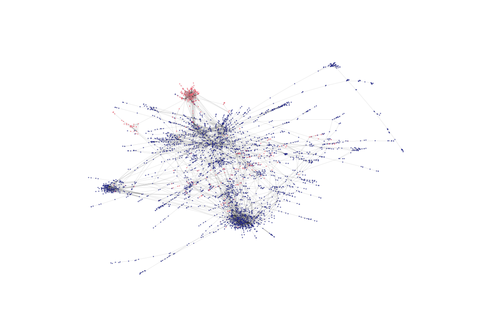
To understand polarisation and epistemic echo chambers, the researchers use Dataset 1 to construct a large network representing observed mutual interactions between profiles on Twitter. Analysis shows that users with similar stances on vaccination interact preferentially with one another (polarisation). The finding that users interact disproportionally with other users sharing their stance aligns with previous research showing that long-time anti-vaccine users of social media tend to form tightly knit clusters that exhibit a high degree of in-group solidarity and in which misinformation may thrive unquestioned.
Furthermore, the analysis shows that Twitter profiles with stronger anti-vaccine stances are exposed to increasingly atypical sources of information. This pattern is indicative of "epistemic echo chambers" in the sense that users, depending on their stance, are exposed not only to a skewed distribution of stances from other users ("network homophily") but also to information sources that are highly dissimilar to those typically taking part in the overall discussion.
Among the implications of the study's findings:
- Online (health-related) misinformation "may present an even greater problem than previously thought because beliefs and behaviors in tightly knit, internally homogeneous communities are more resilient...and provide fertile ground for fringe narratives..., while mainstream information is attenuated....Furthermore, such polarization of communities may become self-perpetuating, because individuals avoid those not sharing their views ..., or because exposure to mainstream information might further entrench fringe viewpoints...."
- Research shows that parents often base their vaccination decisions on their impression of what other parents do, so vaccine-hesitant parents who encounter a strongly anti-vaccine community might get the impression that not vaccinating is the (social) norm and opt not to. "This risk is compounded by the fact that anti-vaccine communities are highly effective at reaching out to undecided individuals..., which highlights the need to reach undecided individuals with accurate information to overcome vaccine hesitancy..."
In addition to measures such as encouraging direct communication between hesitant individuals and healthcare professionals and implementing policies that incentivise vaccination, these findings highlight the need for digital interventions to address vaccine hesitancy festering in online communities. Such interventions should be based, the researchers argue, not just on whether online content is true or false but on a "more nuanced understanding of the interplay between vaccination attitudes, social network structure, and information sources, including actors with a vested interest in promoting false beliefs. With disinformation campaigns aiming to erode consensus..., fact-checking at the level of individual stories being shared online might need to be complemented by an understanding of the complex interplay between community structure and information content."
PLoS ONE 17(2):e0263746. https://doi.org/10.1371/journal.pone.0263746
- Log in to post comments