











































Community Perception Toward Intensified Pulse Polio Immunization in Postcertification Era: A Mixed-Method Study in a High-Risk Area of Kolkata, West Bengal, India
All India Institute of Hygiene and Public Health
"[M]ore effective strategies should be formulated to strengthen the SMNet...so as to make the community more receptive toward pulse polio immunization."
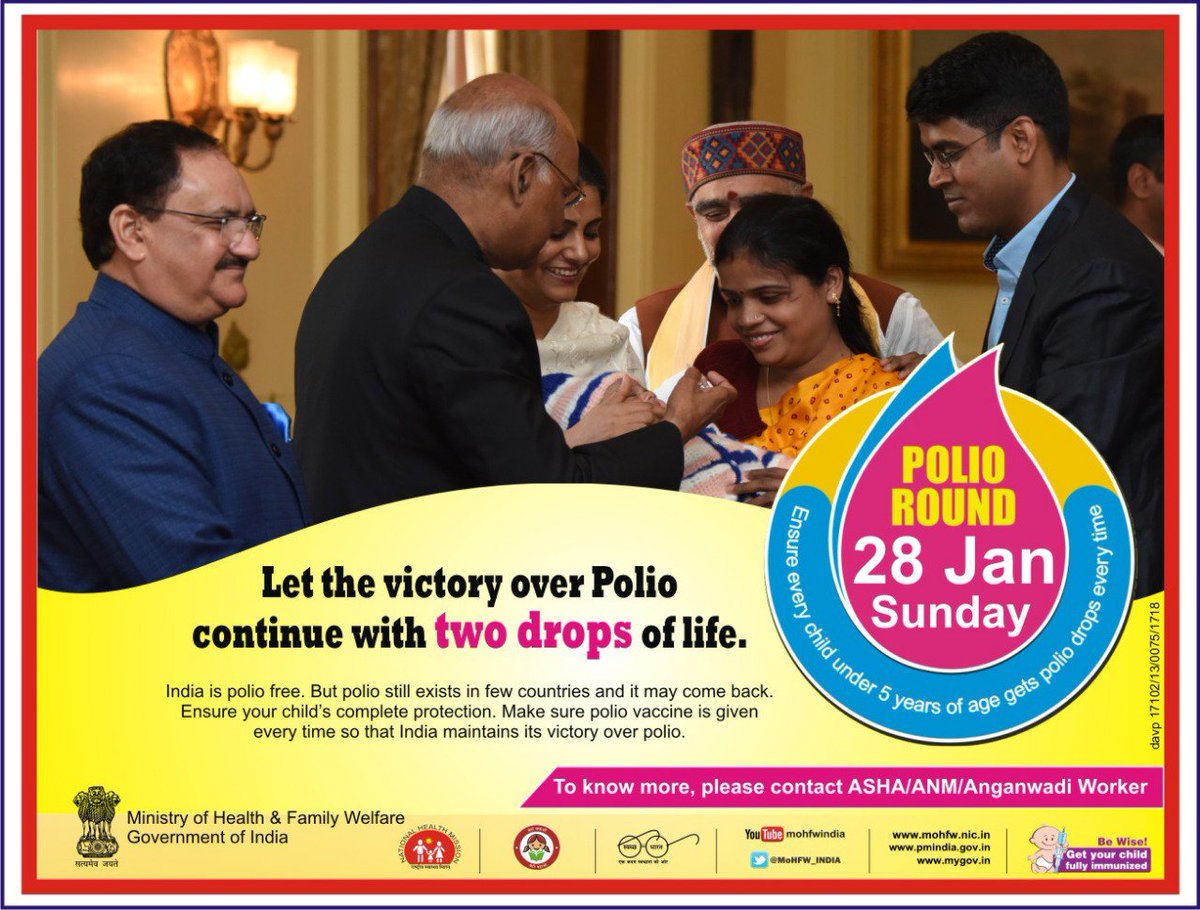
On March 27 2014, the World Health Organization (WHO) certified India as polio free. Since then, as part of Polio Endgame Strategy, national and sub-national polio rounds are being conducted to maintain herd immunity through each year, supported by strategies such as setting up the Social Mobilization Network (SMNet), mapping migrant and vulnerable populations, and introducing transit point vaccination. With years of no fresh cases of polio, some segments of the community have raised doubts over the continuation of the Intensified Pulse Polio Immunization (IPPI) programme in this postcertification era. Thus, this cross-sectional, mixed methods study sought to assess community perceptions and to understand the perspectives of various community influencers toward IPPI in a high-risk area of southern Kolkata, West Bengal, India.
Conducted from March to April 2018, the study involved surveying 104 randomly selected households followed by key informant interviews (KIIs) with community influencers who are stakeholders in the SMNet: a Madrasah teacher, the Imam of a local mosque, and the health supervisor at the urban primary health centre. Informal interactions with 4 field-level health workers were also carried out during the study process.
Of 104 respondents, 70.2% were female, and the majority (86%) were Muslims. Of all Muslim respondents, 60.7% had what the researchers deem "inadequate knowledge", and 65.2% had what they call an "unfavorable attitude" toward oral polio vaccination; proportions were "much less" for Hindu respondents. It was observed that gender, religion, and education of the respondents had a significant association with their attitude toward oral polio vaccination.
It was observed that both female and male health workers and mobilisers were involved in information, education, and communication (IEC) activities at the community level. However, male family decision makers and religious leaders were found to be insufficiently engaged during IEC activities.
After so many years of successful IPPI, inadequate knowledge (32%) and unfavourable attitudes (45%) were observed among respondents, although 100% routine oral polio vaccine (OPV) coverage was noted among studied households.
More specifically, it was observed that majority of the respondents (60.9%) did not know about disease transmission and preventability (56.5%); 87% did not know whether polio is curable or not. Of those having adequate knowledge, 60.5% agreed that it is necessary to take OPV during every IPPI round along with the routine OPV dose, whereas only 34% of those with inadequate knowledge agreed to this. Only 4.7% of respondents with adequate knowledge had the notion that even a single dose of OPV can cause serious side effects, in contrast to 11.5% among those with inadequate knowledge.
Safety concerns (5.7%), spouse/elder pressure (4.8%), and fear of future sterility (1.9%) were identified as prominent barriers resulting in hesitancy (16.2%) during the last round of IPPI in March 2018. Only 14.8% of those with inadequate knowledge mentioned religious faith as a barrier to polio vaccination. To the researchers' surprise, around 56% of those with adequate knowledge perceived polio as a rare disease nowadays and doubted the benefits of IPPI.
The KIIs revealed that interviewees felt that false beliefs surrounding the disease and resistance to IPPI rounds had decreased but that they still existed in the area, in spite of several strategies that had been in action for the past several years. Polio was not perceived as a threat by any of the key informants, and IPPI was perceived as result of government policy only. The rationale behind the IPPI was not clear to any of them; the health supervisor himself had queries: "...how does the OPV given during IPPI benefits a child who has already receive 2 doses of injectable Polio Vaccine during RI....are these supplementary doses really necessary?..." Likewise, the imam raised doubts on the benefits of repeated polio vaccination. The health supervisor mentioned work burden and remuneration of field-level vaccinators as hindering issues affecting vaccinator performance during intensified rounds. The interviewed teacher stressed on the need for educating families and children in sustaining the polio-free status of the country.
Overall, the findings suggest that poor knowledge about the importance of IPPI, false beliefs, and unfavourable attitudes have been major barriers to IPPI, even in the postcertification era. The researchers suggest that intensive social and behaviour change communication (SBCC) activities should be undertaken in high-risk areas in an attempt to alter the hard-to-change attitudes of the community, shifting them from compulsion to voluntary participation in IPPI rounds.
Medical Journal of Dr. D.Y. Patil Vidyapeeth 2019;12:440-5. DOI:10.4103/mjdrdypu.mjdrdypu_19_19. Image credit: Ministry of Health via Twitter
- Log in to post comments