










































A Conversation With: Polio Expert Naveen Thacker
India Ink
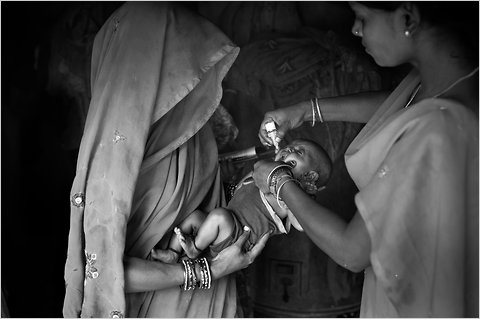
In honour of World Polio Day, India Ink interviewed Dr. Naveen Thacker, who was part of the team that led India's polio eradication effort. With no new cases reported in the country since January 2011, India will be certified "polio-free" in January 2014 by the World Health Organization (WHO) if no new cases are reported by then; it has already been removed from a list of countries with "active transmission of wild poliovirus".
Dr. Thacker explains that he became involved in polio eradication in 1994, when there was a polio outbreak in his home state of Gujarat. Initially, he was involved in creating awareness of the polio virus and wrote small booklets that he distributed to all paediatricians in India and Rotary clubs of polio-endemic countries. In total, he wrote over 8,000 postcards a year to paediatricians and Rotarians to support Pulse polio (the government vaccination programme) and report cases of acute flaccid paralysis (AFP). Stemming from this, Dr. Thacker was invited to be a member of the India Expert Advisory Group, contributing to the government's polio policy, with recommendations on behalf of the Indian Academy of Pediatrics. He has also published papers, chapters in books, and newspaper articles and delivered guest lectures and talks on polio.
Based on this experience, Dr. Thacker discusses several communication-related elements that contributed to India's success. For example:
- He states that "critically, there was strong leadership and political support at every level of government." - The India Expert Advisory Group addressed challenges such as identifying high-risk children that were missed in a polio vaccination round. Along these lines, he highlights the importance of public-private partnerships, which helped to ensure that India was able to deliver vaccines to those who had previously been unreached.
- He describes hurdles such as pockets of resistance to the polio vaccine, particularly in western Uttar Pradesh, in minority communities. This resistance mainly stemmed from false rumours about the polio vaccine. This was overcome by involving religious leaders, local medical practitioners, and celebrities, who together highlighted the necessity for polio eradication. "Where the mass marketing campaign did not reach, the door-to-door campaign by 2.3 million volunteers across the country meant that we reached children in the hardest-to-reach rural communities." Dr. Thacker notes that, despite these efforts, some middle-class communities were reluctant to take repeated doses, as they felt their child was fully protected. The solution was to engage members of the Indian Academy of Pediatrics, who were able to convince parents of the need to take additional polio drops.
Dr. Thacker asserts that, "[i]f the endemic countries follow this example and develop accountability mechanisms, work around security challenges and ensure community involvement in the polio program, we can eradicate polio everywhere."
"India Ink: Notes on the World's Largest Democracy" blog, The New York Times/International Herald Tribune. Image credit: Sephi Bergerson
- Log in to post comments